
Dibrachys fuscicornis
Dibrachys fuscicornis
Description
How to identify
Dibrachys fuscicornis belongs to the order Hymenoptera, specifically the family Pteromalidae. This is a small insect with a metallic sheen, characteristic of many chalcid wasps.
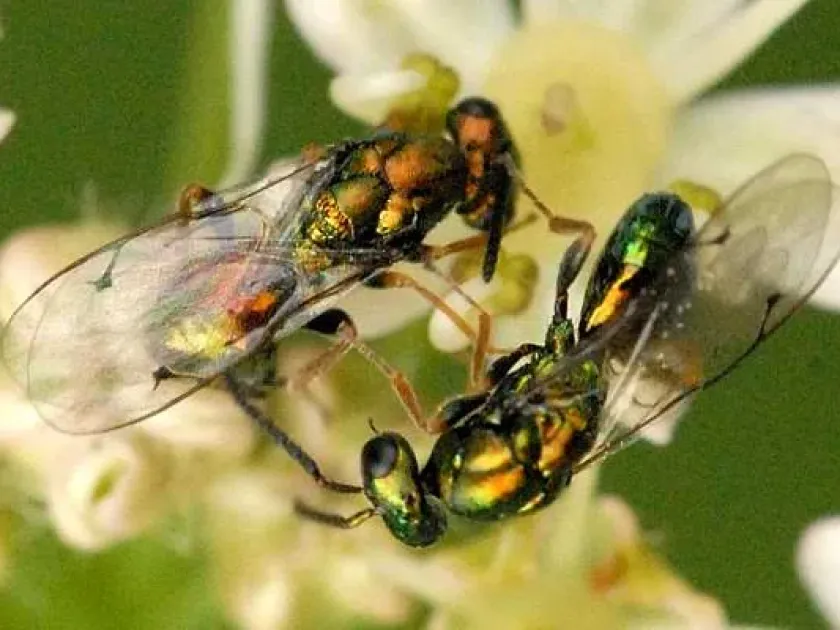
Adults measure approximately 2–3 mm in length. Females have a well-developed ovipositor, allowing them to penetrate the tough pupal cases of other insects or plant tissues.
The wings are transparent with distinct venation typical of the Pteromalidae family. The head and thorax are usually dark with a greenish or bronze reflection.
Development occurs within the host's body, making it a typical endoparasite. Larvae are whitish, legless, and adapted to feed on the internal tissues of their host.
Identification in the field is difficult due to their microscopic size, requiring laboratory equipment and professional morphological assessment of adults.
What it damages
Although this species is often viewed as a beneficial entomophage, it can act as a hyperparasite, negatively affecting natural insect population regulators.
The pest attacks the pupae of Lepidoptera and other insect groups, which serve as crucial regulators of pest populations in gardens and forests.
Damage to beneficial entomofauna leads to a disruption of the natural balance, indirectly contributing to the mass outbreaks of primary plant pests.
The species does not feed directly on plant tissues; however, its presence in the ecosystem destabilizes the natural suppression mechanisms of harmful insects.
Economic damage manifests as a reduction in the efficacy of biological control programs where Dibrachys fuscicornis acts as an unwanted parasite.
When it appears
Activity begins with the onset of stable warmth in the spring when overwintering individuals emerge from their shelters.
The parasite can produce several generations within a single season, depending on local climate conditions and the availability of suitable hosts.
Peak population density usually occurs in the second half of summer when a high concentration of pupae from various insects is available for oviposition.
In autumn, adults prepare for diapause, moving into protected areas such as tree bark, plant debris, or the soil layer to survive the winter.
The life cycle duration shortens significantly during hot weather, allowing the species to adapt rapidly to changing seasonal conditions.
Signs of infestation
The main sign of infestation is the presence of empty pupal cases or cocoons of other insects showing characteristic small, round emergence holes.
Dissecting affected pupae may reveal parasite larvae or frass, confirming the presence of Dibrachys fuscicornis.
An indirect sign is a sudden decrease in the population of beneficial wasps or other natural enemies of pests in a specific area.
Adult presence can be detected using yellow sticky traps placed in the garden during the period of peak insect flight activity.
Regular visual inspection of pest cocoons and pupae for holes should be conducted throughout the growing season.
Control measures
Control measures are primarily aimed at preserving natural biodiversity to minimize the negative impact of hyperparasites.
It is recommended to avoid unnecessary use of broad-spectrum chemical insecticides, which kill both pests and their natural regulators.
An effective method involves creating refugia, such as strips of flowering plants that attract beneficial entomofauna and support their reproduction.
Timely removal and destruction of plant debris are crucial, as these can serve as overwintering sites for both pests and parasites.
- Monitoring population levels with traps.
- Limiting the use of chemical pesticides.
- Maintaining ecological infrastructure on the site.
- Biological control through habitat management.
Taxonomy
- Latin name
- Dibrachys fuscicornis
- Order
- Hymenoptera
- Family
- Pteromalidae
- EPPO code
- DIBRFU
Discussion
No discussions yet — be the first.