
Dibrachys
Dibrachys
Description
How to identify
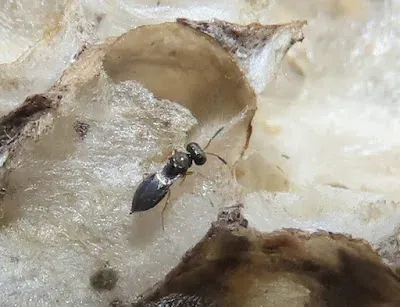
Dibrachys is a genus of parasitic wasps belonging to the Pteromalidae family within the order Hymenoptera. These insects are extremely small, typically measuring between 2 and 3 millimeters in length.
Visually, they resemble typical chalcids, often exhibiting a metallic sheen on their bodies, which is usually dark green or black. The head and thorax are well-developed, and the wings are transparent with characteristic venation.
The biological role of Dibrachys is complex. In nature, it often acts as a secondary parasite (hyperparasite), attacking the larvae of other beneficial insects, which makes it an undesirable guest in agricultural ecosystems.
Identification in the field is difficult due to their microscopic size. Specialists use binocular magnifiers or microscopes for precise identification based on the structure of the antennae and wing veins.
Females possess a distinct ovipositor, allowing them to penetrate substrates or host cocoons to lay eggs, which provides a secure environment for their developing offspring.
What it damages
The primary damage caused by Dibrachys lies in the suppression of beneficial entomophage populations that naturally control agricultural pest numbers.
This pest is frequently found in grain storage facilities, warehouses, and orchards, where it parasitizes the pupae of leafrollers, codling moths, and other harmful lepidopterans.
By harming beneficial insects (primary parasites), Dibrachys indirectly promotes outbreaks of crop pests that would otherwise have been suppressed by the primary parasitoids.
In storage environments, Dibrachys can parasitize the larvae of stored product moths, reducing the efficacy of biological control agents used in integrated pest management.
Thus, its harmfulness is indirect, negatively affecting the balance of biological control agents within the agroecosystem.
When it appears
The activity period of Dibrachys is closely tied to the lifecycle of its hosts. In open fields, mass emergence of adults is observed during the summer months.
These insects primarily overwinter in the prepupal or pupal stage within plant debris or protected shelters where their hosts were located.
Spring emergence typically occurs when average daily temperatures exceed 10–12 degrees Celsius, which coincides with the start of primary pest activity.
The number of generations per year depends on the climatic zone: in southern regions, several generations may develop, while in northern areas, only one or two occur.
In autumn, as temperatures drop, development slows down, and the insects enter diapause to ensure survival until the following season.
Signs of infestation
The primary sign of infestation is the presence of microscopic exit holes on pest cocoons, which indicate the emergence of adult Dibrachys.
When inspecting grain storage or orchards, a noticeable decline in the population of beneficial parasitoids can indirectly point to the presence of hyperparasites.
The presence of adult insects on flowers or plant leaves during their flight period can also serve as an indicator of their population on a site.
In closed facilities, a sign of infestation is the death or failure of beneficial insect larvae used in biological control programs (such as Trichogramma or Bracon species).
Specialists use pheromone traps or sweep nets to monitor the presence of this species in fields and storage areas.
Control measures
Controlling Dibrachys is challenging because it is a hyperparasite. Broad-spectrum chemical insecticides may kill it, but they also destroy beneficial insects, potentially worsening the pest situation.
The foundation of control is the adherence to proper grain storage technologies that prevent pest access to storage facilities.
It is crucial to conduct regular disinfection of warehouses, eliminating sources of infestation where Dibrachys might sustain its population.
When using biological control methods for crop protection, one must carefully monitor the release timing of beneficial entomophages to minimize the risks of hyperparasite infestation.
- Regular cleaning of storage areas to remove grain debris.
- Use of fine-mesh screening on warehouse ventilation windows.
- Monitoring the population density of beneficial insects in agroecosystems.
Taxonomy
- Latin name
- Dibrachys
- Order
- Hymenoptera
- Family
- Pteromalidae
- EPPO code
- DIBRSP
Discussion
No discussions yet — be the first.