
Western harvester ant
Pogonomyrmex occidentalis
Description
How to identify
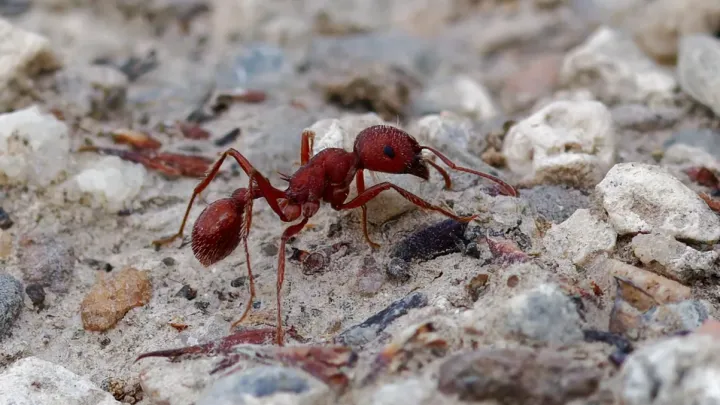
The Western harvester ant (scientific name Pogonomyrmex occidentalis) belongs to the Formicidae family and the Myrmicinae subfamily. These are medium-sized insects with a body length ranging from 5 to 7 millimeters.
The coloration of these ants varies from reddish-brown to dark orange. Their body is covered with a thick chitinous layer, and the head features powerful mandibles adapted for crushing seeds, which is typical for harvester species.
Unlike other ant species, this one constructs large cone-shaped mounds and creates a cleared, vegetation-free zone around the entrance. This makes the nests highly visible in open landscapes.
Worker ants are extremely aggressive when defending their nest. They possess a stinger that causes intense burning and allergic reactions in humans and animals due to a specific alkaloid venom.
This species is a typical representative of the entomofauna in arid regions, preferring sandy and stony soils where it is easy to excavate deep tunnels.
What it damages
The primary damage consists of the destruction of vegetation around the nest. Within a radius of up to 3-5 meters around the nest entrance, ants completely destroy agricultural crops and pasture grasses.
The ants actively collect seeds of various plants, including cereal crops, clover, and wild grasses, leading to thin stands in pastures and fields.
Damage manifests as a loss of pasture productivity. Persistent colony activity hinders forage growth, and the earth mounds created by the ants impede the operation of agricultural machinery.
While ants do not feed on the vegetative mass, their habit of clipping young sprouts to create "solar clearings" leads to the physical destruction of emerging seedlings.
Mass infestation of fields can lead to significant economic losses, especially in regions with low vegetation density where every square meter of land has significant value.
When it appears
Peak activity for the Western harvester ant occurs during the spring and summer. In early spring, colonies resume nest expansion activities after their period of diapause.
Ants collect seeds most intensely during the seed-ripening phase in the fields. This timing coincides with the active growth phases of major agricultural crops.
During hot summer months, ants may limit surface activity during the day, preferring early morning or late evening hours for foraging.
The colony life cycle includes egg-laying by the queen at the beginning of the season; larval development takes several weeks, requiring a constant influx of nutrients into the nest.
Activity decreases in autumn, and the colony begins preparations for winter by moving seed stores into deep nest chambers located below the soil frost line.
Signs of infestation
The main sign of infestation is the presence of characteristic "bald" soil patches in circular or cone shapes amidst crops or pastures, completely devoid of any vegetation.
On the surface of these areas, one can often find piles of small stones, gravel, and seed shell remains, which ants eject from the nest after cleaning their chambers.
The constant movement of worker ants along defined trails from the nest to foraging areas is direct evidence of active colony life.
Crop seedlings around these zones often appear clipped or are completely absent within several meters of the nest center.
Characteristic noise and the movement of a large number of large red ants when the nest is disturbed are clear indicators of this species' presence.
Control measures
Controlling this pest is difficult due to the depth of the chambers (up to 2-3 meters), which makes surface-applied insecticides ineffective against the entire colony.
The use of targeted methods is recommended: applying granular poisoned baits directly into the burrows, which the ants mistake for food and carry inside the nest.
Plowing fields may temporarily disrupt the nest structure; however, complete eradication requires repeated deep soil cultivation throughout the season.
Biological control methods include preserving natural enemies of ants, such as certain bird species and small mammals that prey on adult ants.
- Application of selective insecticides based on fipronil.
- Mechanical nest excavation combined with fumigation.
- Monitoring field perimeters to identify new colonies before they expand.
Taxonomy
- Latin name
- Pogonomyrmex occidentalis
- Order
- Hymenoptera
- Family
- Formicidae
- EPPO code
- POGOOC
Discussion
No discussions yet — be the first.