
Alluaud ant
Plagiolepis alluaudi
Description
How to identify
The Alluaud ant (Plagiolepis alluaudi) is a small species of ant belonging to the family Formicidae and the subfamily Formicinae. It is widely recognized as a significant invasive pest in tropical and subtropical regions.
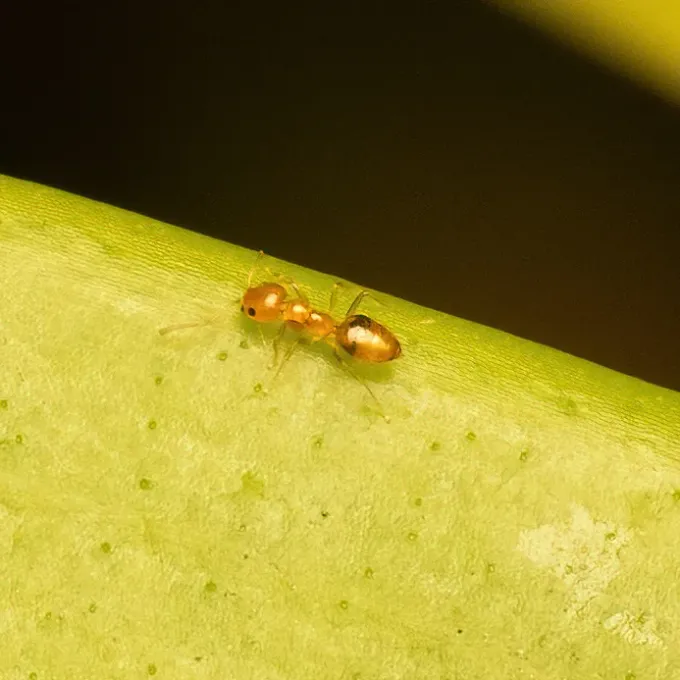
These workers are very small, measuring approximately 1.5–2 mm in length, which allows them to hide easily in the crevices of plants or dense foliage.
Their coloration typically ranges from light yellow to brownish-yellow, providing them with effective camouflage against many common plant surfaces and soil types.
The species is polygynous, meaning colonies contain multiple queens, which contributes to their capacity for rapid population expansion and colonizing new areas.
They are known for forming extensive "supercolonies" that can span large areas, making total eradication difficult without comprehensive management strategies.
What it damages
While the Alluaud ant does not feed directly on plant tissues, it causes significant indirect damage by tending and protecting sap-sucking insects.
They maintain mutualistic relationships with aphids, mealybugs, scales, and whiteflies, which produce honeydew—a sugary substance that serves as a primary food source for the ants.
By actively defending these sap-suckers from natural predators like ladybirds and lacewings, the ants cause an exponential increase in pest populations on crops.
The resulting damage includes stunted plant growth, curled and yellowed leaves, and significant loss of vigor due to continuous nutrient depletion by the pests.
Furthermore, the honeydew excretion leads to the growth of sooty mold, a black fungus that covers leaves and interferes with essential photosynthesis.
When it appears
In warm climates, Plagiolepis alluaudi remains active throughout the year, as they do not undergo a winter diapause unless the environment becomes critically cold.
Activity peaks during the spring and summer months when aphid populations are most prolific and require intense protection from the ant colonies.
As temperatures drop or during dry spells, these ants often migrate into protected areas, such as greenhouses or the base of potted plants, to maintain their colony.
Swarming periods for new queens to establish additional nests often occur during periods of high humidity or seasonal shifts in weather.
In greenhouse settings, their activity remains constant, necessitating continuous monitoring and preventive measures throughout the entire production cycle.
Signs of infestation
A primary indicator of their presence is the observation of persistent ant trails running up and down plant stems or along irrigation lines.
Unexpected clusters of aphids or mealybugs in areas where natural enemies are present strongly suggest that ants are protecting the pest colony.
Sticky honeydew residues on leaves, which often attract dust or lead to the growth of dark sooty mold, are clear signs of sap-sucking pest infestation supported by ants.
Disturbed soil around the base of plants or small excavations near the root zone can indicate that the ants have established their nests nearby.
An aggressive response or increased movement of the ants when the plant is touched is a reliable sign that they are actively tending to pests on that specific host.
Control measures
Effective control requires an integrated approach that targets both the ants and the sap-sucking pests they rely on for food.
Physical barriers such as sticky adhesive bands applied to tree trunks prevent the ants from reaching the canopy, effectively cutting off their access to the pests.
The use of slow-acting bait stations containing targeted insecticides is highly effective, as the worker ants carry the bait back to the nest to feed the queens.
Systemic insecticides applied to control the aphids or mealybugs will make the plant's sap unattractive, forcing the ants to abandon the area in search of food.
- Regular weeding to remove host plants that support aphid infestations.
- Encouraging natural predators such as lady beetles to help manage pest levels.
- Cleaning tree bark and removing debris around plants to eliminate favorable nesting sites.
Taxonomy
- Latin name
- Plagiolepis alluaudi
- Order
- Hymenoptera
- Family
- Formicidae
- EPPO code
- PLGLAL
Discussion
No discussions yet — be the first.