
Plagiolepis ant
Plagiolepis
Description
How to identify
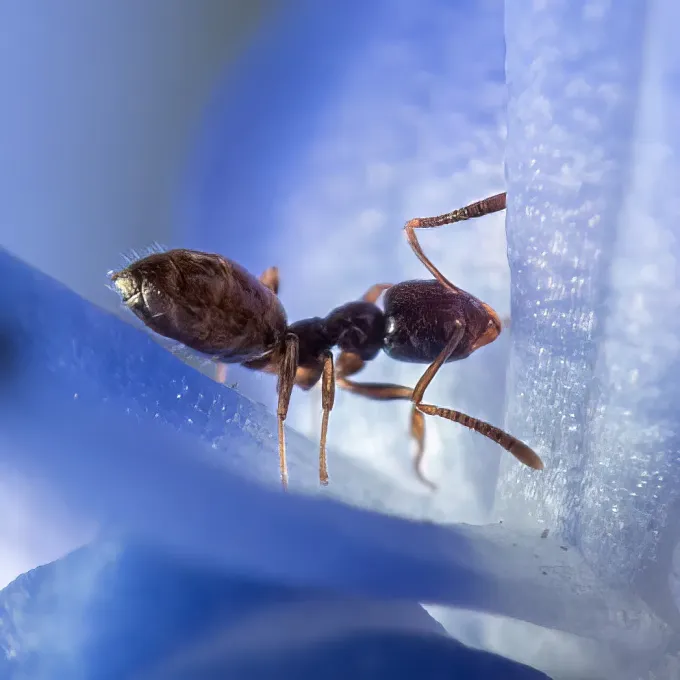
The Plagiolepis genus belongs to the Formicidae family, order Hymenoptera. These are extremely small insects, with workers rarely exceeding 2–3 mm in length, making them difficult to detect in soil or on plants.
Their coloration ranges from yellowish-brown to nearly black. The body has a distinct appearance with a marked constriction between the thorax and the abdomen, and the head is proportionally large relative to the rest of the body.
A significant biological feature is their polygynous colony structure, meaning several queens can coexist in a single nest, ensuring rapid population growth and resilience.
Nests are often located in the upper soil layers, under stones, or in dry wood, usually in close proximity to the root systems of cultivated plants.
Unlike larger forest ants, these ants do not construct large, visible mounds, preferring a hidden lifestyle close to their primary food sources.
What it damages
The primary damage caused by Plagiolepis involves their symbiotic relationship with sap-sucking pests, particularly aphids, scales, and mealybugs.
The ants actively "farm" these pests, protecting them from natural predators like ladybugs and lacewings, while transporting them to new, succulent plant shoots.
As a result of this ant activity, aphid populations thrive, leading to severe depletion of young shoots, structural deformation, and stunted plant growth.
The honeydew secreted by aphids creates a sticky surface that promotes the growth of sooty mold, which blocks photosynthesis and ruins the plant's health.
In some cases, the nest excavation process can disrupt the soil around roots, causing the root system to dry out and reducing the plant's ability to absorb nutrients.
When it appears
The activity of Plagiolepis ants begins in early spring, as soon as the topsoil temperature consistently stays above +10 °C.
Activity peaks in May and June, coinciding with the rapid growth of new plant shoots, which are primary targets for aphid colonization.
Throughout the summer, colonies remain active, foraging across large areas of the garden in search of sweet honeydew secretions from their host pests.
As temperatures drop in autumn, the ants move deeper into the soil to prepare for winter hibernation, significantly reducing their surface activity.
Because colonies contain multiple queens, they can sustain their lifecycle and recover quickly from environmental stress or human intervention.
Signs of infestation
The most common sign of a colony is the presence of steady "ant trails" along plant stems leading to clusters of aphids or scales.
Affected leaves often show signs of curling, yellowing, and a sticky residue (honeydew), which eventually develops a black, powdery coating of sooty mold.
Colony presence is often marked by small, inconspicuous holes in the soil, sometimes surrounded by tiny particles of excavated earth near the base of plants.
A sudden, rapid increase in aphid numbers on shrubs or trees, accompanied by small ants actively defending them, is a clear indicator of a Plagiolepis infestation.
Long-term infestations lead to weakened plants with poor flowering, sparse foliage, and significant losses in fruit quality or yield.
Control measures
Effective control of Plagiolepis requires an integrated approach that targets both the ants and the sap-sucking pests they protect.
Installing sticky bands on tree trunks is an effective physical barrier that prevents ants from transporting pests to healthy foliage.
Systematic management of aphid populations with insecticides or horticultural soaps is essential, as depriving ants of their food source often forces them to relocate.
The use of slow-acting bait stations containing systemic insecticides allows the ants to carry the poison back to the nest, effectively eliminating the queens.
- Regular cultivation of soil around plants to disrupt nest tunnels.
- Using bio-insecticides based on Beauveria bassiana fungi.
- Planting repellent crops such as lavender, mint, or marigolds.
- Pruning dense branches to improve airflow and reduce pest niches.
Taxonomy
- Latin name
- Plagiolepis
- Order
- Hymenoptera
- Family
- Formicidae
- EPPO code
- PLGLSP
Discussion
No discussions yet — be the first.