
Pheidole lamia harvester ant
Pheidole lamia
Description
How to identify
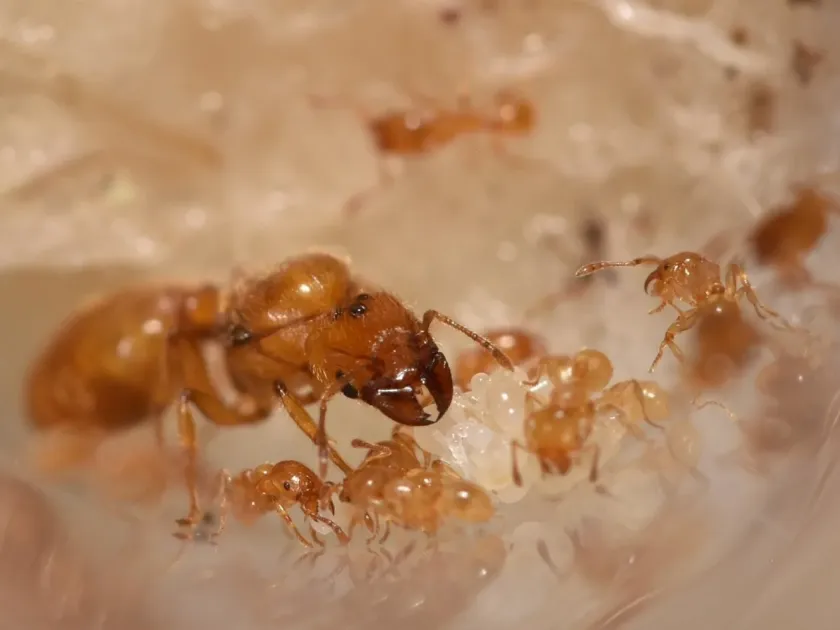
The Pheidole lamia ant is a member of the Myrmicinae subfamily. This species displays significant polymorphism, featuring both small workers and large-headed soldiers within the same colony.
Their coloration ranges from yellowish-brown to dark brown, providing excellent camouflage against soil backgrounds, which allows them to forage undetected on farmland.
The soldiers are equipped with powerful, specialized mandibles that enable them to crush hard seeds, making them highly efficient harvesters of agricultural grains and seeds.
Colonies typically reside in underground nests characterized by complex tunnel systems and multiple surface entrances, often marked by small mounds of excavated soil particles.
As a widely distributed species in arid and semi-arid regions, they have adapted perfectly to agricultural landscapes where they interact frequently with human-planted vegetation.
What it damages
The primary agricultural damage caused by Pheidole lamia occurs during the planting season when they actively collect seeds from legumes, cereals, and oilseed crops.
By consuming seeds directly from the soil surface or shallow depths, these ants can cause severe thinning of crop stands, leading to significant yield loss and replanting costs.
In addition to seed theft, their extensive tunneling activities near root zones can disrupt the soil structure, causing damage to young roots and inducing wilting in sensitive plants.
These ants may also impact horticulture by protecting sap-sucking insects like aphids, which interferes with natural biological control and leads to secondary plant health issues.
Damage is often most severe during drought conditions when natural seed sources are scarce and ants become highly dependent on agricultural fields for food supplies.
When it appears
The foraging activity of Pheidole lamia is highly dependent on soil temperature, typically commencing in the spring when soil temperatures reach 15-18 degrees Celsius.
Peak activity occurs from late spring through early summer, coinciding with the critical stages of seed germination and seedling emergence for most major crops.
During the intense heat of summer, these ants often shift their foraging activity to cooler hours, including night or twilight periods, to maintain colony efficiency.
Autumn brings a surge in seed collection activity as the colony prepares food reserves for the winter period, potentially posing a risk to late-sown winter crops.
The population cycle and reproductive success of the colony are closely tied to seasonal food availability and soil moisture levels in the local environment.
Signs of infestation
A primary indicator of infestation is the appearance of small, distinct soil mounds around nest entrances shortly after the field has been seeded and prepared.
Observation of ant trails leading from seed rows to nest entrances, often accompanied by piles of discarded seed husks, confirms the presence of an active colony.
Sudden patches of bare soil within a field, where seeds failed to germinate despite adequate conditions, are a telltale sign of heavy harvester ant predation.
Increased ant presence on young plant stems, often associated with the presence of tended aphid colonies, indicates a high level of colonization and agricultural interference.
Monitoring the field during the dawn or dusk hours provides the best opportunity to observe ant movement and identify the exact locations of the subterranean nests.
Control measures
Effective management begins with proper agronomic practices, specifically ensuring that seeds are planted at a sufficient depth to remain inaccessible to foraging workers.
The use of seed treatments with repellent properties can significantly reduce the attractiveness of seeds to harvester ants during the early stages of crop development.
Targeted application of insecticidal baits near identified nest entrances is a viable method for reducing colony populations without widespread environmental impact.
Mechanical disturbance of the soil, such as through row cultivation, can disrupt underground tunnel systems and encourage the colony to relocate away from the crop rows.
In high-pressure situations, integrated pest management strategies should be applied to minimize the impact while preserving the balance of beneficial insects in the field.
Taxonomy
- Latin name
- Pheidole lamia
- Order
- Hymenoptera
- Family
- Formicidae
- EPPO code
- PHEILA
Discussion
No discussions yet — be the first.