
Big-headed ant
Pheidole dentata
Description
How to identify
The big-headed ant, Pheidole dentata, belongs to the order Hymenoptera and the family Formicidae. It is a dimorphic species where the soldier caste is easily identified by its disproportionately large head and powerful mandibles.
Adult ants are typically yellowish-brown or reddish-brown in color. The worker ants are much smaller than the soldiers, measuring approximately 3–4 mm in length, while the soldiers appear significantly more robust.
Nests of this species are most commonly found in rotting wood, under rocks, or in the soil, making them elusive inhabitants of gardens and forested areas. The large size of their colonies allows them to quickly dominate the local landscape.
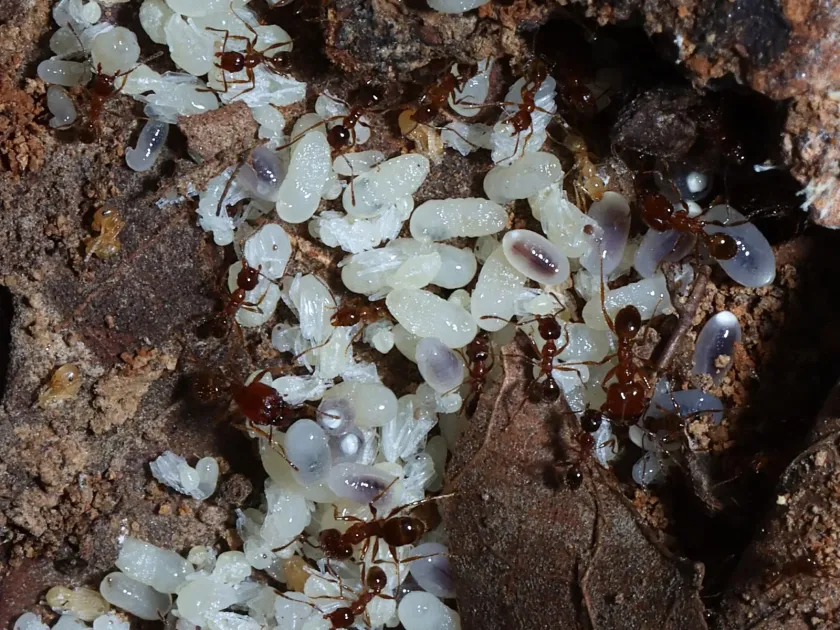
Reproduction occurs through nuptial flights, after which the queen establishes a new colony in a suitable shelter. The development cycle includes egg, larval, pupal, and adult stages, typical for social insects.
A crucial factor is their complex social structure, which enables the division of labor between workers, soldiers, and the queen, contributing to the species' survival even under challenging environmental conditions.
What it damages
This species is not a direct consumer of plant tissues, yet it causes significant indirect damage to agricultural crops and ornamental plants. The primary harm is linked to their close symbiotic relationship with aphids and scale insects.
The ants actively protect colonies of sucking insects from natural predators like ladybugs and lacewings. In exchange for this protection, the ants feed on the honeydew secreted by these pests.
Protected by the ants, aphids reproduce exponentially, depleting plant sap and leading to weakening, leaf deformation, and reduced overall crop yields.
Furthermore, Pheidole dentata may damage seeds during germination or remove soil particles from the root zone, which disrupts the connection between roots and soil, causing young seedlings to wither.
The presence of an anthill near cultivated plants complicates agricultural maintenance and may lead to the spread of fungal diseases on leaves contaminated by the sugary secretions of the pests.
When it appears
The activity of these ants begins in early spring as soon as the soil warms up to optimal temperatures. During this period, they start repairing nests and searching for sources of protein and carbohydrates.
The highest level of damage is observed in summer, when colony populations peak and aphid infestations on crops are at their maximum due to higher temperatures.
In autumn, ants decrease their activity in preparation for hibernation. They migrate to deeper soil layers or move further into decaying wood debris to survive the cold season.
The duration of the activity season depends heavily on the regional climate; however, in southern latitudes, this cycle can span from March through October.
In greenhouses or controlled indoor environments, the activity cycle may remain uninterrupted if stable temperatures favorable to the colony's existence are maintained.
Signs of infestation
The first sign of infestation is the presence of large numbers of ants traveling along plant stems to access aphid or scale insect colonies.
The appearance of a sticky residue on the upper side of leaves (honeydew) indicates the presence of sucking insects protected by the ants. Over time, this residue may turn black due to the growth of sooty mold.
Fresh dirt mounds or ant tunnels near the base of trees and shrubs indicate the proximity of a nest, which may be located very close to the plant roots.
Changes in plant behavior, such as leaf curling or premature leaf drop, are often secondary signs indicating that the plant is being stressed by the pests guarded by the ants.
It is also worth monitoring the movement of small soil particles or plant debris by the ants, which may suggest active landscaping around their food source.
Control measures
The primary control measure focuses on eliminating the ants' food source: aphids and other sucking pests. Using contact insecticides against aphids significantly reduces the site's attractiveness to ants.
Installing sticky bands on the trunks of fruit trees helps block the ants' path, preventing them from reaching the pest colonies in the plant canopy.
The use of specialized slow-acting bait allows for the effective destruction of the entire colony, including the queen, which is a key step in managing social insects.
To prevent colonization of the site, it is recommended to maintain sanitation, promptly removing rotting stumps, fallen branches, and other nesting sites.
As an organic method, dusting ant-prone areas with diatomaceous earth can be effective, as it damages the insect's exoskeleton upon contact, thereby reducing their overall population.
Taxonomy
- Latin name
- Pheidole dentata
- Order
- Hymenoptera
- Family
- Formicidae
- EPPO code
- PHEIDE
Discussion
No discussions yet — be the first.