
Weaver ant
Oecophylla smaragdina
Description
How to identify
The weaver ant (Oecophylla smaragdina) belongs to the family Formicidae (order Hymenoptera). These ants are known for their vibrant orange or greenish coloration, allowing them to blend into foliage.
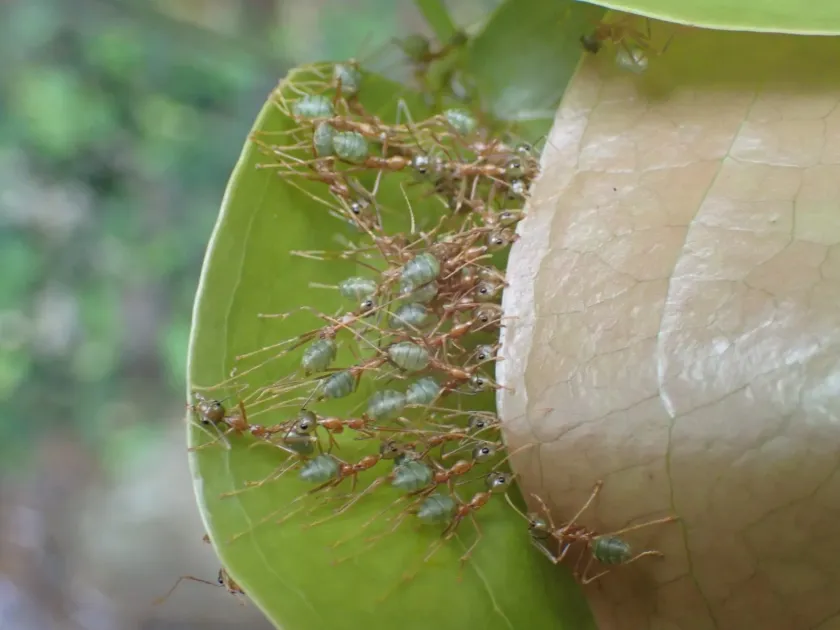
They are famous for their unique nest-building technique, where they use their own larvae to weave leaves together with silk, creating protective structures within tree canopies.
Colonies of these ants are large and highly aggressive. A single colony can spread across several trees, creating a vast network of interconnected nests that act as a single territory.
The life cycle involves complete metamorphosis, where the queen produces eggs, and the workers manage the development of the brood while utilizing the larvae for construction tasks.
These ants are extremely territorial and will attack any perceived threat to their nests or their managed resources, making them a significant nuisance in orchard management.
What it damages
The primary agricultural damage is caused by the ant's mutualistic relationship with sap-sucking pests like aphids, scale insects, and mealybugs, which they protect from natural predators.
By protecting these pests, weaver ants contribute to massive outbreaks of aphids and scales, which significantly weaken trees and can facilitate the transmission of plant pathogens.
They affect a wide range of tropical and subtropical crops, including citrus, mango, cashew, cacao, and coffee, where they establish their nests in the branches.
Physical damage occurs as the ants pull leaves together to form nests, which stunts the growth of young shoots and disrupts the tree's photosynthetic capability.
Their aggressive nature and painful bites make routine orchard maintenance and harvesting difficult for workers, leading to indirect economic losses for farmers.
When it appears
Weaver ants are active year-round in tropical climates. Their colony expansion is constant, provided there is a stable supply of food and suitable host plants.
Activity peaks during warmer, humid periods when trees produce new, succulent growth, which is preferred by the ants for constructing new nests and supporting aphid populations.
The development cycle of the worker caste typically spans 4 to 8 weeks, ensuring rapid colony turnover and the ability to maintain a persistent presence in the canopy.
During the dry season, the ants tend to focus their activities around water sources while continuing to manage their honeydew-producing livestock on host trees.
Colony migration is most frequent when resources become scarce or when the current tree canopy no longer supports the expansion of the colony's nest structure.
Signs of infestation
The most visible sign of infestation is the presence of nests made from living leaves stitched together with silk threads in the tree canopy.
Distinct, heavy ant trails along the trunks and branches indicate a well-established colony moving between nests and feeding sites throughout the tree.
Large clusters of aphids or scale insects on young branches, which are frequently visited by the ants, serve as a strong indicator of an ant colony's presence.
The development of sooty mold on the foliage, triggered by the sugary honeydew excreted by aphids, is a classic secondary sign of weaver ant activity.
A sharp, acidic smell released when a nest is disturbed or a branch is shaken is a definitive indicator of the presence of the weaver ant species.
Control measures
Implementing barrier bands treated with insecticides on tree trunks is a highly effective way to prevent ants from accessing the canopy and protecting their livestock.
Systemic pest control measures targeting sap-sucking insects will indirectly reduce weaver ant populations by removing their food source and causing the colony to migrate.
Pruning infested branches and physically removing nests can manage population levels in smaller plantations, though this must be done with protective gear.
Biological control methods, such as the application of entomopathogenic fungi, can be used to specifically target the ants without harming beneficial ecosystem predators.
- Maintain weed-free environments under trees to reduce movement.
- Use slow-acting bait stations to reduce colony size effectively.
- Adopt Integrated Pest Management (IPM) to balance control with biodiversity.
Taxonomy
- Latin name
- Oecophylla smaragdina
- Order
- Hymenoptera
- Family
- Formicidae
- EPPO code
- OECOSM
Discussion
No discussions yet — be the first.