
Weaver ant
Oecophylla longinoda
Description
How to identify
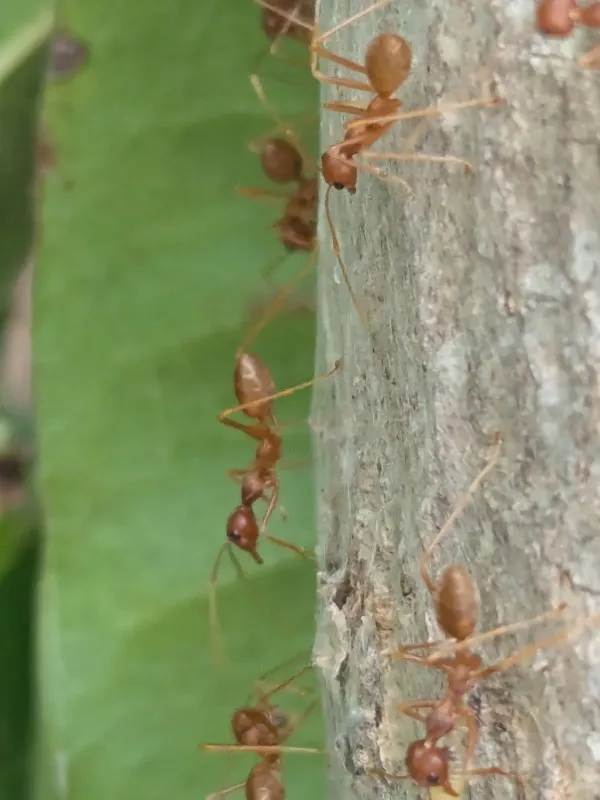
The weaver ant (Oecophylla longinoda) is a species within the family Formicidae. These ants are known for their distinct reddish-brown color and aggressive social structure.
They are famous for their unique nest-building behavior. The ants use their own larvae as living tools to weave together leaves of living trees using silk, forming complex, spherical nest structures.
These ants are highly territorial and dominate the canopy of the trees they inhabit. They possess strong mandibles and chemical defense mechanisms, making them formidable inhabitants of any plantation.
The colony structure is highly hierarchical, with a queen and a vast network of workers that maintain the territory. They rarely descend to the forest floor, preferring the safety of the tree canopy.
Due to their size and aggressive nature, they are easily distinguishable from other smaller ant species that inhabit agricultural plots.
What it damages
The primary agricultural damage caused by weaver ants is their mutualistic relationship with sap-sucking insects, particularly aphids, scale insects, and mealybugs.
By protecting these sap-suckers from natural predators and parasitoids, weaver ants inadvertently cause a massive population explosion of pests that damage the host plant.
The accumulation of honeydew secreted by these pests promotes the growth of sooty mold, which coats the leaves and branches, severely hindering photosynthesis.
In commercial agriculture, their presence significantly disrupts manual labor, such as pruning or harvesting, due to their aggressive biting and spraying of formic acid.
While some farmers use them for biological control, uncontrolled infestations often result in stunted plant growth and poor fruit quality due to the high density of fostered sap-sucking pests.
Signs of infestation
The most visible sign of an infestation is the presence of nests made from green living leaves that are stitched together with visible white silk threads.
Clear, well-defined ant trails running along the branches and trunks of trees are reliable indicators that a mature colony is actively foraging and defending the area.
A high concentration of aphids or scale insects on young shoots, accompanied by ants aggressively patrolling the area, confirms the presence of a weaver ant colony.
Defensive behavior is a key sign: when a branch is disturbed, hundreds of ants will immediately rush toward the source of the vibration to attack.
The presence of a black sooty coating on the foliage is a late-stage sign, indicating that the ants have been successfully farming aphids on the tree for an extended period.
Control measures
Control strategies often involve the direct application of insecticides to tree trunks to break the ants' foraging paths and prevent them from reaching the canopy.
Physical barriers, such as sticky bands or specialized repellent-treated rings, are effective in protecting individual trees from re-colonization.
Managing the population of sap-sucking insects is essential; by reducing the number of aphids or scales, the ants' food supply is cut, forcing them to relocate.
Manual removal of nests is a viable but challenging method, requiring heavy protective clothing and careful coordination to avoid mass bites.
Integrated pest management programs often utilize targeted spraying of systemic insecticides to eliminate the secondary pests, effectively discouraging weaver ant nesting activity.
Taxonomy
- Latin name
- Oecophylla longinoda
- Order
- Hymenoptera
- Family
- Formicidae
- EPPO code
- OECOLO
Discussion
No discussions yet — be the first.