
Weaver ants
Oecophylla
Description
How to identify
Weaver ants (genus Oecophylla) belong to the order Hymenoptera, family Formicidae. They are large social insects known for their unique and sophisticated method of building arboreal nests.
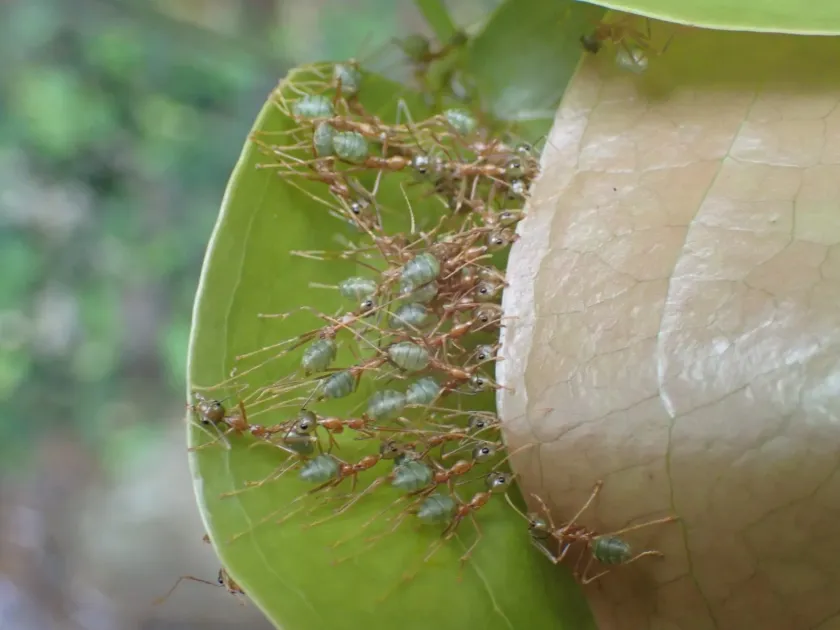
The worker ants use their own larvae as living "shuttles" to produce silk, which is used to bind and "sew" leaves together. These adult ants are highly aggressive and possess strong mandibles to defend their colonies.
Colonies of these ants are characterized by high population density and occupy large territories across the tree canopy. Visually, their nests look like dense spheres made of stitched leaves hanging from branches.
The genus includes two primary species: Oecophylla smaragdina and Oecophylla longinoda. Their appearance ranges from bright green to orange or brownish, depending on their geographic distribution.
These insects act as dominant predators in tropical ecosystems and agro-ecosystems. Their cooperative ability to swarm and attack makes them formidable not only to other small insects but also to humans.
What it damages
The main crops affected include tropical fruit trees such as citrus, mango, cocoa, cashew, and coffee. Weaver ants create favorable conditions for the proliferation of various sap-sucking pests.
The primary damage occurs because weaver ants actively farm and protect aphids, mealybugs, and scale insects. They defend these pests from natural predators in exchange for honeydew, a sugary secretion.
As a result of this symbiosis, the population of harmful sap-sucking insects on the tree increases dramatically, leading to plant stress. Leaves yellow, deform, and drop prematurely due to excessive sap extraction.
Sooty mold often grows on the honeydew secretions left on leaves and fruits. This fungal growth obstructs photosynthesis and significantly reduces the market value and quality of the harvest.
Furthermore, ants can interfere with pollination and the growth of young shoots by aggressively attacking workers during orchard maintenance, complicating harvest and pruning tasks.
When it appears
The activity of weaver ants is directly dependent on the temperature and humidity characteristic of tropical climates. They remain active year-round if weather conditions remain consistently warm.
The peak time for building new nests and expanding colonies occurs during the rainy season. During this time, the abundance of foliage facilitates the leaf-stitching process for forming new living chambers.
In dry periods, ant activity may decrease slightly, but they do not hibernate. Instead, they move to deeper parts of the canopy where the microclimate remains suitable for larval development.
The life cycle of the colony is constant: the queen lays eggs continuously, and new generations of workers are produced cyclically. This ensures a persistent threat to agricultural crops.
For agronomists, it is crucial to monitor the appearance of the first "stitched" leaves in the canopy. Early detection allows for effective intervention before a colony can colonize an entire tree.
Signs of infestation
The first sign of infestation is the presence of characteristic nests made of living, rolled, or stitched leaves. These nests are tightly attached to branches and have a specific structural surface.
Active ant trails can be observed on tree branches and trunks, where they move in large, disciplined groups. They move rapidly and exhibit clear aggression when disturbed.
High populations of aphids, mealybugs, or scale insects on young shoots and the undersides of leaves are strong indicators of weaver ant presence, as the ants constantly patrol these pest colonies.
Black sooty mold on leaves and fruit is a common symptom, as the fungus thrives on the honeydew produced by the protected sap-sucking insects.
Damage to the skin of young fruits or deformation of young foliage can also be indirect signs. Ants may damage delicate plant tissues while establishing paths or reinforcing their nests.
Control measures
Mechanical removal of nests is the primary and most effective control method for small areas. Nests should be pruned and immediately destroyed in sealed containers.
To prevent ants from accessing the canopy, sticky bands (glue barriers) can be applied to tree trunks. This effectively blocks the movement of workers from the ground to the foliage.
Contact insecticides based on pyrethroids are effective when applied directly to nests. However, caution must be exercised to avoid harming beneficial pollinators and natural predators.
It is essential to control the sap-sucking pests simultaneously. Using systemic pesticides against aphids and mealybugs deprives the ants of their food source, forcing the colony to migrate.
- Regular canopy sanitation pruning to limit nest growth.
- Use of repellents around the base of the tree.
- Encouraging natural entomophagous insects that prey on ants.
- Strict quarantine procedures when transporting seedlings from infested areas.
Taxonomy
- Latin name
- Oecophylla
- Order
- Hymenoptera
- Family
- Formicidae
- EPPO code
- OECOSP
Discussion
No discussions yet — be the first.