
Black house ant
Ochetellus glaber
Description
How to identify
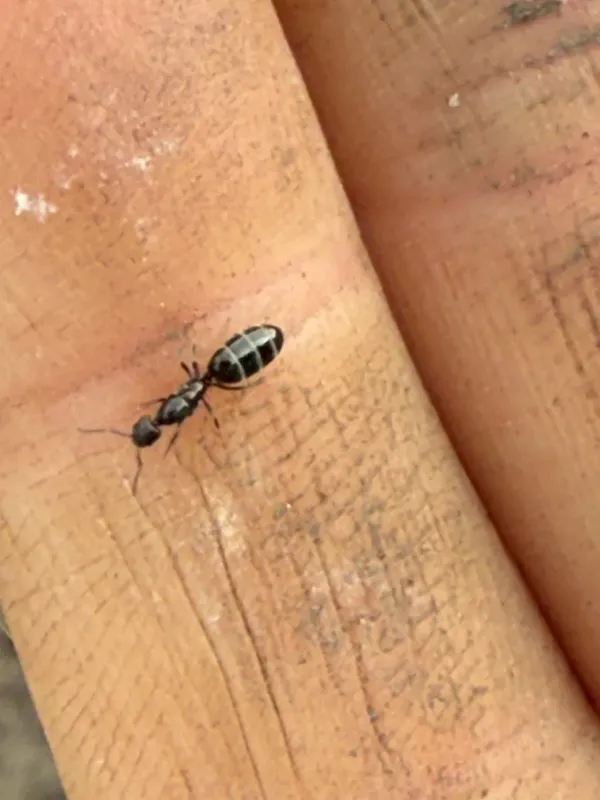
The black house ant (Ochetellus glaber) belongs to the family Formicidae and the order Hymenoptera. These are small insects, with workers measuring only 2.5–3 mm in length.
The body of these ants has a characteristic shiny black or dark brown color. The cuticle surface is smooth, which distinguishes them from other ant species common in gardens and buildings.
A distinctive feature of this species is their movement pattern. They travel along clearly defined trails, sticking to the edges of surfaces, walls, or plant stems.
In their natural habitat, they prefer to nest in rotting wood, under tree bark, and in cavities of building structures, making them a significant threat to households.
The life cycle of the colony includes multiple queens, which allows the population to grow rapidly and colonize new areas, creating satellite nests.
What it damages
The primary damage caused by these insects is associated with their close symbiotic relationship with aphids and other sap-sucking plant pests. Ants actively protect aphid colonies from predators, promoting their proliferation.
Affected crops include a wide range of fruit trees, shrubs, ornamental flowers, and vegetables colonized by sap-sucking insects such as scale insects, mealybugs, and aphids.
During their activity, ants transport these pests from one plant to another, thereby triggering the large-scale spread of fungal diseases across the entire garden area.
In addition to protecting aphids, worker ants often damage tender buds and flowers of crops, feeding on their inner tissues to access plant sap.
Indoors, these insects can invade living areas, contaminating food supplies and establishing constant foraging trails throughout kitchen and pantry zones.
When it appears
The activity of the black house ant depends directly on temperature. In temperate regions, peak activity occurs during the spring and summer, starting with stable warm weather.
During winter or periods of prolonged cold, the colony enters a state of slowed metabolism, although activity may persist year-round in heated buildings.
Reproduction and the emergence of winged individuals (alates) for mating usually occur on warm, humid days, which is when the most intense spread of the species is observed.
Colony growth rates accelerate during high humidity, making rainy summers particularly favorable for ant expansion in gardens.
In autumn, ants begin preparing for overwintering, often moving closer to the warm foundations of buildings, which serves as a signal for initiating control measures.
Signs of infestation
The first sign of presence is the appearance of persistent "ant trails" running along baseboards, walls, or the trunks of garden trees.
Massive clusters of aphids on young shoots and plant tops, actively tended by ants, are a clear indication that the colony is using these plants as a pasture.
The presence of small piles of soil or wood dust near foundations, wall cracks, or tree bases indicates the proximity of a nest.
The appearance of ants indoors, especially at night, suggests that outdoor food sources have been exhausted and the insects have expanded their foraging area.
A characteristic "ant odor" released when they feel threatened or for trail marking can also serve as an indirect sign of a high population density.
Control measures
Effective control requires a comprehensive approach, aimed at both eliminating the ants and removing their food sources, namely aphid colonies.
The use of gel baits based on stomach-action insecticides is recommended; these are carried by workers back to the nest, leading to the destruction of the queens and the entire colony.
- Applying sticky barrier bands to tree trunks.
- Eradicating aphid colonies on garden crops.
- Sealing cracks and crevices in building structures.
- Using contact insecticides along known movement trails.
It is important to maintain sanitation on the property, promptly removing decaying wood and other organic waste that can serve as harborage for ants.
When large colonies are discovered, it is advisable to use professional pest control products that act systemically to prevent rapid population recovery.
Taxonomy
- Latin name
- Ochetellus glaber
- Order
- Hymenoptera
- Family
- Formicidae
- EPPO code
- OCHEGL
Discussion
No discussions yet — be the first.