
European red ant
Myrmica ruginodis
Description
How to identify
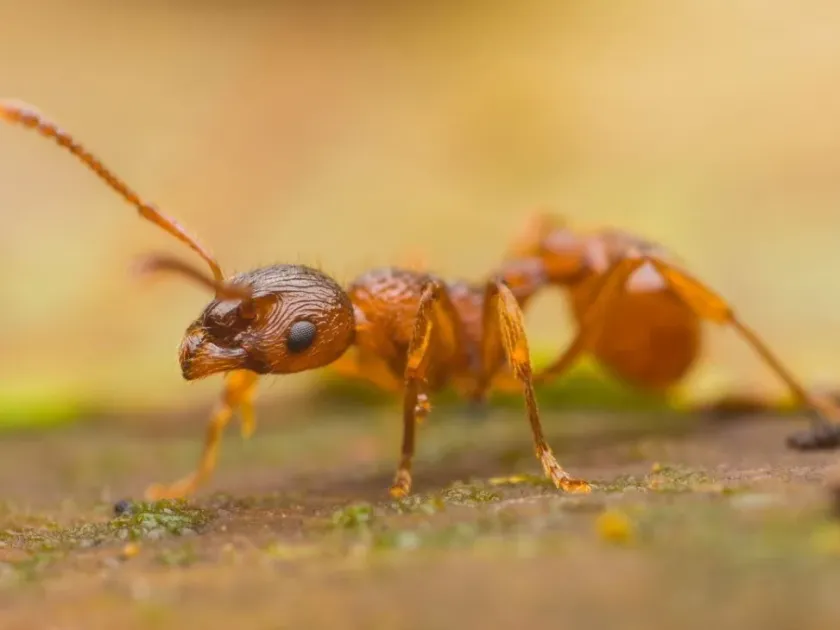
The European red ant (Myrmica ruginodis) is a species of the order Hymenoptera, family Formicidae. They are small insects, typically measuring between 4 and 6 mm in length, with a distinct reddish-brown body.
A key identification feature is the presence of long spines on the propodeum (the back part of the thorax). These spines, combined with the matt appearance of the body covered in fine hairs, distinguish them from common black ants.
These ants thrive in moist environments. They often establish colonies in decaying wood, under the bark of fallen trees, in dense turf, or deep within moist forest leaf litter.
Colonies can be polygynous, meaning they have multiple queens, which makes the population highly resilient and capable of rapid recovery after disturbances. They are diurnal, spending their days foraging for food.
They possess a functional and potent sting. When their nest is disturbed, workers are highly aggressive and will readily sting, which is often painful to gardeners and workers tending the plants.
What it damages
The primary agricultural damage caused by Myrmica ruginodis is their mutualistic relationship with aphids. These ants protect aphid colonies from natural predators like ladybugs and lacewings, enabling uncontrolled aphid outbreaks.
Aphids fed and protected by ants suck sap from succulent young shoots and leaves. This leads to the curling of leaves, stunted shoot development, and a significant reduction in the overall vitality and yield of the plant.
Furthermore, ants facilitate the spread of sooty mold, a fungus that grows on the sugary honeydew excreted by aphids. This mold covers leaf surfaces, hindering photosynthesis and weakening the plant further.
Ants can also physically damage root systems. When nesting at the base of plants, their tunneling activities disrupt soil structure and feed on delicate fine roots, which can be lethal for young seedlings or sensitive ornamentals.
The presence of ants in container plants often alters the soil chemistry and moisture balance, leading to poor growth or even the death of indoor or patio plants due to constant soil disturbance.
When it appears
Activity begins in early spring as soon as soil temperatures reach approximately +10...+12°C. Workers emerge to repair nests and resume foraging for food sources to support the colony's growth.
The peak of their activity occurs during the summer months, specifically from June through August. This period aligns with the rapid development of garden crops and the highest population levels of aphids.
During the summer, ants expand their foraging trails across the garden, covering large areas of fruit trees and berry shrubs to maintain their aphid "herds." They remain active throughout the day.
Mating flights typically take place in the latter half of the summer. After successful mating, new queens seek out suitable locations to establish new colonies, contributing to the spread of the species.
As autumn temperatures drop, the ants retreat deeper into the soil or find protected sites within woody debris to enter a state of dormancy until the following spring season.
Signs of infestation
The most obvious sign of an infestation is the presence of ant trails along stems and branches, leading to clusters of aphids on leaves. They are constantly moving to and from their food sources.
Stunted, curled, or sticky leaves (due to honeydew) are clear indications of aphid colonies supported by ants. In severe cases, a black layer of sooty mold will cover the affected parts of the plant.
Small mounds of disturbed soil or circular openings at the base of trees and shrubs confirm the presence of a nest. Ants frequently bring soil to the surface to maintain their underground galleries.
Plants in certain areas may show signs of sudden wilting or retarded growth. If the soil around the base of these plants feels loose or hollow, it is a strong indicator of an ant colony undermining the roots.
Frequent, painful stings while weeding or harvesting are a direct and unfortunate sign of high ant activity in your garden, requiring immediate attention to manage the infestation.
Control measures
Effective control of the European red ant requires an integrated approach. The first priority is to create mechanical barriers that prevent ants from reaching the canopy of trees and bushes.
Sticky bands or mechanical barriers applied around the trunks of fruit trees are very effective at stopping ants from reaching the aphids in the foliage, allowing natural predators to return and reduce the aphid population.
The use of bait stations containing slow-acting insecticides is highly effective for complete colony eradication. Workers carry the poisoned bait back to the nest, where it is shared with the queen and larvae.
Managing the aphid population with systemic insecticides or natural soaps removes the food source for the ants, forcing them to relocate away from your crops to find better foraging grounds.
- Regular soil cultivation to disrupt underground tunnels.
- Planting repellent species like mint or wormwood near vulnerable crops.
- Local application of soap-based solutions to destroy surface nests.
- Removing decaying wood and logs where colonies often reside.
Taxonomy
- Latin name
- Myrmica ruginodis
- Order
- Hymenoptera
- Family
- Formicidae
- EPPO code
- MYRCRN
Discussion
No discussions yet — be the first.