
Indian thief ant
Monomorium indicum
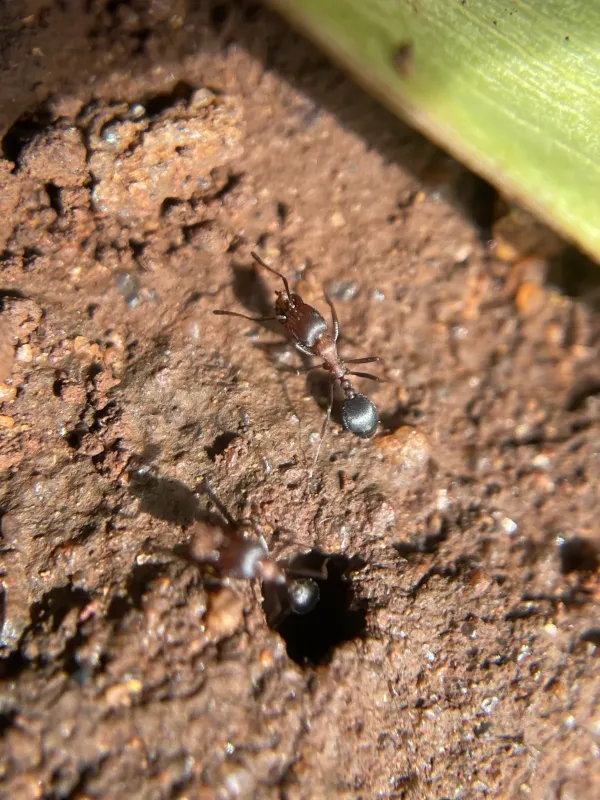
Description
How to identify
The Indian thief ant (Monomorium indicum) belongs to the order Hymenoptera, family Formicidae. These are tiny insects, typically 2–3 mm long, with a light brown to reddish-brown coloration.
The species is characterized by a two-segmented pedicel and a distinctive thoracic structure with a clearly visible promesonotal suture. Workers possess strong mandibles capable of both excavating soil and defending their colony.
Nests are primarily located in the soil, often under stones or within the root zones of plants, making them highly integrated into the agricultural environment.
A key biological feature is polygyny, where multiple queens occupy a single colony, allowing the population to recover rapidly even after localized extermination efforts.
Identifying these ants can be difficult due to their secretive nature, but excavating soil near infested plants often reveals large chambers containing numerous larvae and pupae attended by aggressive workers.
What it damages
The primary damage caused by Monomorium indicum is indirect; they act as "farmers" for aphids and scale insects, protecting them from natural predators to feed on their honeydew.
By preventing ladybugs and lacewings from controlling aphid populations, these ants cause a massive surge in sap-sucking insects, leading to significant yield loss and plant decline.
In food-scarce conditions, the ants can directly damage crops by feeding on germinating seeds, destroying the embryo, or gnawing on young shoots and roots.
The wounds left by aphids under the protection of these ants serve as entry points for secondary fungal and bacterial infections, further weakening the plant's health.
In addition, their tunneling activity around root systems can cause soil desiccation, which negatively impacts nutrient uptake and plant growth, particularly during drought periods.
When it appears
The activity of Monomorium indicum is strictly dependent on soil temperature; they become active as soon as the ground warms up to approximately +15 to +18 degrees Celsius.
Peak activity occurs during the hot summer months, as the climate becomes ideal for aphid multiplication, which in turn demands more intensive protection by the ant colonies.
During prolonged dry spells, these ants are more likely to resort to damaging plant roots to extract moisture and nutrients, increasing their visibility and impact on field crops.
As autumn approaches and soil temperatures drop, the colonies retreat to deeper soil layers or areas beneath perennial plants to overwinter.
Early spring is a critical time for monitoring, as workers emerge to expand their territory and exploit the newly planted seedlings in the agricultural fields.
Signs of infestation
The first signs of infestation include small, neatly excavated soil mounds or holes near the base of plant stems, surrounded by fine soil particles.
Large aggregations of aphids on the undersides of leaves or on young stalks, consistently attended by small brown ants, are a clear indicator of a nearby colony.
Leaf curling, deformation, and the presence of sooty mold are classic secondary symptoms caused by the honeydew-producing insects farmed by the thief ants.
Wilting of specific plants in a field, despite adequate irrigation, often suggests root system damage or disturbance caused by underground ant tunnels.
Increased ant movement along plant stems during early morning or evening hours is a reliable signal that the colony is actively managing its aphid herd on your crops.
Control measures
Effective management of the Indian thief ant requires a multi-pronged approach that targets both the ant colony and the honeydew-producing pests they protect.
- Application of professional-grade insecticidal baits in gel or granule form, which foragers carry back to the colony to eliminate the queens.
- Targeted soil treatments using systemic insecticides around the root zone to disrupt nesting sites.
- Rigorous control of aphid and scale insect populations using systemic insecticides to deprive the ants of their primary food source.
- Implementing cultural practices such as deep tillage to disrupt underground galleries and nest structures.
- Using sticky barriers on trees or tall plants to physically prevent ants from reaching the canopy and tending to pests.
Taxonomy
- Latin name
- Monomorium indicum
- Order
- Hymenoptera
- Family
- Formicidae
- EPPO code
- MONOIN
Discussion
No discussions yet — be the first.