
Harvester ant
Messor structor
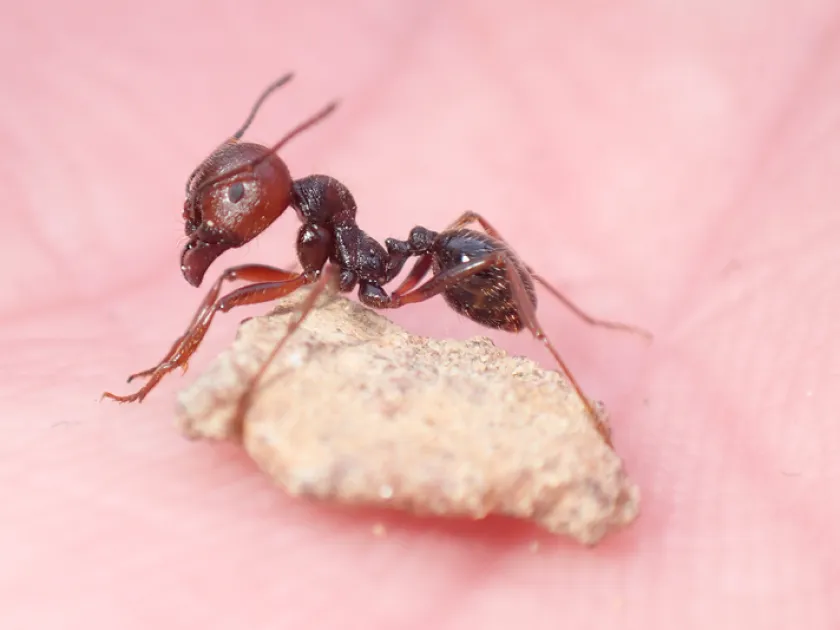
Description
How to identify
The harvester ant (Messor structor) belongs to the order Hymenoptera, family Formicidae. It is a social insect characterized by a distinct polymorphism among workers.
Adult workers feature a large, powerful head with massive mandibles, specifically adapted for grinding seeds and grains into food for the colony.
These ants are generally dark brown or black in color. They do not possess a stinger, but they can deliver a painful bite if their nest is threatened.
They construct deep, extensive nesting systems in the soil, often located under vegetation or near agricultural plots, providing them with stable conditions.
A single colony can house thousands of individuals, coordinated by a highly productive queen and operating through well-defined foraging trails.
What it damages
The primary damage caused by harvester ants is the mass collection and destruction of seeds of various crops, including wheat, barley, and many vegetables.
During the germination phase, they may cut off young seedlings to facilitate access to the nutrient-rich seed kernel, resulting in reduced crop density.
Harvester ants indirectly harm crops by tending to aphid populations, protecting them from natural predators, which leads to increased viral infections on plants.
Their subterranean digging activities often disturb the soil around root systems, causing the soil to dry out and the plant roots to wither and die.
In large-scale farming, these ants can strip significant portions of planted seeds, leading to high economic losses and the need for costly reseeding.
When it appears
Activity typically begins in early spring, as soon as the soil temperature rises above 10–12°C, and continues until late autumn.
The peak activity period coincides with the sowing season and the grain ripening stage, as these times offer the most available seed resources.
During summer heat, harvester ants may become nocturnal or limit their activity to early morning and late evening to avoid lethal temperatures.
In autumn, they aggressively gather and store seeds to prepare for the winter, making their presence highly noticeable during harvest time.
They hibernate within the deepest chambers of their nests, where the temperature remains constant and stable throughout the winter months.
Signs of infestation
A major indicator of their presence is the accumulation of husks and empty seed shells near the entrances of the anthill, forming debris mounds.
The presence of well-worn foraging paths leading from the anthill toward the seed beds serves as definitive proof of an active colony.
Sudden wilting of seedlings in well-irrigated areas often suggests that ants have damaged the roots through their burrowing activities.
Empty seed coats appearing on the surface of garden beds indicate that the ants have successfully excavated and processed the seeds.
Visible surface collapses or small craters around the base of stems indicate that the ants have created tunnels directly beneath the crop.
Control measures
The most effective method involves the use of specialized bait pellets that the ants carry back to the colony, effectively eliminating the queen and workers.
Regular deep tillage and soil cultivation can break up the internal structure of the nest, forcing the colony to relocate or reducing their numbers.
Creating physical or chemical barriers around plots using diatomaceous earth or mustard powder can deter ants from reaching vulnerable seedlings.
Active management of aphid populations is essential, as the honeydew produced by aphids is a primary food source that sustains the ant colonies.
- Use of granular insecticides approved for ant control.
- Application of boric acid-based baits in protected stations.
- Frequent soil agitation to disrupt nesting sites.
- Maintaining field borders free of weeds to reduce nesting shelters.
Taxonomy
- Latin name
- Messor structor
- Order
- Hymenoptera
- Family
- Formicidae
- EPPO code
- MESRST
Discussion
No discussions yet — be the first.