
Harvester ant
Messor gallus
Description
How to identify
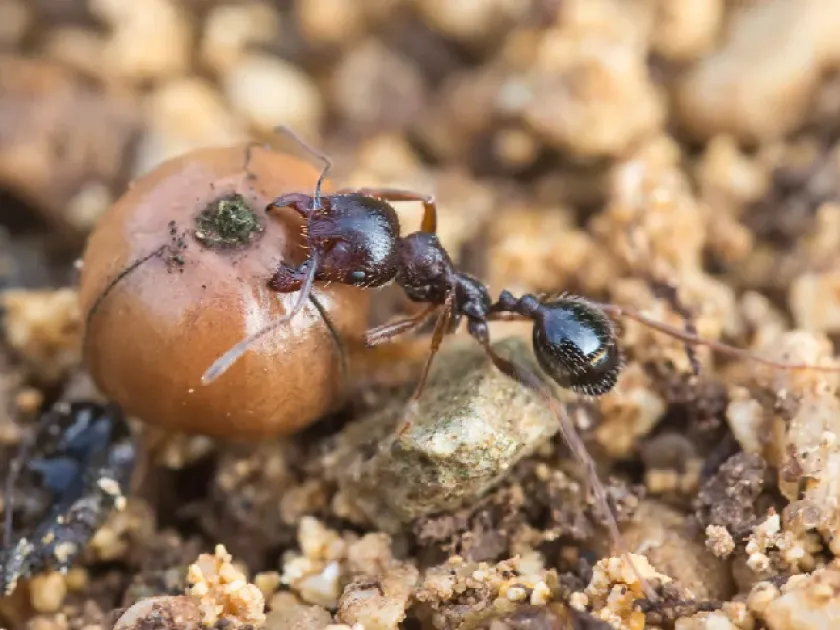
The harvester ant Messor gallus belongs to the Formicidae family and the Hymenoptera order. They exhibit significant caste polymorphism, meaning that workers vary greatly in size.
Major workers, often referred to as soldiers, possess massive heart-shaped heads. These are equipped with strong mandibles capable of crushing tough seed coats.
The body is typically dark brown or matte black. Unlike many other species, they lack a glossy sheen, which helps in identifying them in the field.
A key biological trait is the psammophore, a specialized basket of long hairs beneath the head used for carrying and storing seeds during transit.
They establish complex nest systems deep underground, featuring dedicated chambers used specifically for the storage of collected seeds and grain.
What it damages
Messor gallus causes the most significant damage during sowing and early germination phases by actively harvesting sown seeds from the soil.
They target a variety of agricultural staples, including wheat, barley, rye, sunflower, millet, and various grain legumes.
By removing seeds from the soil, they create gaps in the crop rows, leading to poor stand density and the need for costly reseeding efforts.
During the germination stage, the ants strip the endosperm, which deprives the young seedling of essential nutrients needed for survival.
Beyond seed loss, their tunneling activities can disturb the soil structure and damage the root systems of young, vulnerable plants.
When it appears
Activity for Messor gallus begins in early spring as soon as the soil temperature reaches levels suitable for their biological metabolic processes.
Peak foraging activity correlates with key agricultural timings: the spring sowing season and the grain ripening period in the summer months.
During winter, these ants retreat into deep underground chambers, entering a state of dormancy to survive cold temperatures.
Daily foraging patterns can shift; during extreme summer heat, they often switch to nocturnal or crepuscular activity to minimize water loss.
The length of their active season is largely determined by local climatic conditions and usually lasts until the onset of late autumn cold spells.
Signs of infestation
The primary sign of infestation is the presence of distinctive small earth mounds surrounding the entrance holes of nests in the field.
Clearly visible ant trails leading from nest entrances to seed rows or ripening crops indicate active foraging and seed collection behavior.
Heaps of husks, seed coats, and debris found near nest entrances serve as a strong indicator that the colony is processing harvested grain.
Large gaps in rows where seeds are missing from the seed drills are direct evidence of harvester ant activity within the crop.
Observing a consistent stream of ants carrying material towards specific points in the field helps pinpoint the exact location of their underground colonies.
Control measures
Mechanical cultivation, such as deep plowing or harrowing between rows, can destroy nest structures and significantly reduce colony populations.
The use of targeted insecticidal baits, which foragers carry back into the colony, is one of the most effective methods for managing large infestations.
Treating seeds with repellent-type coatings during the pre-sowing stage can significantly deter ants from collecting newly planted grain.
- Maintaining clean fields by eliminating weeds reduces alternative food sources and limits ant migration into crops.
- Ensuring proper planting depth makes it harder for ants to access the seed during the germination phase.
- Local spot treatments of nest entrances using contact insecticides can manage high-density ant hotspots.
Integrated pest management (IPM), combining monitoring with both cultural and chemical control, is the most reliable strategy for protecting fields.
Taxonomy
- Latin name
- Messor gallus
- Order
- Hymenoptera
- Family
- Formicidae
- EPPO code
- MESRGA
Discussion
No discussions yet — be the first.