
Harvester ant
Messor barbarus
Description
How to identify
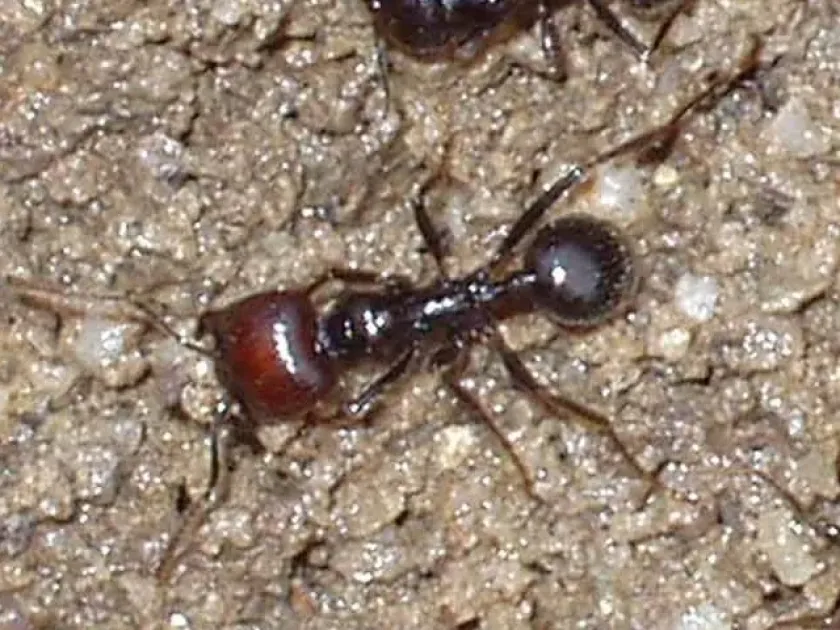
The harvester ant (Messor barbarus) belongs to the order Hymenoptera and the family Formicidae. These are large insects characterized by a significant polymorphism among the worker caste.
The head of the soldier ants is disproportionately large, equipped with powerful mandibles designed for grinding hard seeds. The body color ranges from dark brown to black, often with a reddish hue on the heads of larger individuals.
This species builds deep nests with an extensive network of underground chambers. They are primarily ground-dwelling insects that actively maintain permanent foraging trails across fields.
Reproduction occurs through nuptial flights, after which a queen establishes a new colony in the soil. A queen's lifespan can reach several decades, ensuring long-term population stability in the area.
A single colony can consist of several thousand individuals. During the active season, they demonstrate high social organization when collecting and transporting food resources.
What it damages
The primary damage occurs through the mass collection of seeds from agricultural crops directly from the soil surface or plant heads. They particularly favor cereal crops like wheat, barley, and millet.
During the sowing season, harvester ants can carry away a significant portion of seeds from open seed drills. This leads to sparse stands and a substantial reduction in crop yield.
Besides cereals, they may damage seeds of sunflowers, flax, and various legumes. Their activity is especially noticeable in arid regions, where access to nutrition is limited.
Specialized granary chambers within the nest can hold massive reserves of grain harvested from the fields, leading to direct economic losses for the farming operation.
Beyond seed consumption, the excavation of underground tunnels can disrupt soil structure and potentially damage the root systems of young plants near the nests.
When it appears
Activity begins in early spring as soon as the soil warms to a temperature conducive to colony life. Peak activity is observed during warm and dry periods of the year.
During hot summer months, the ants often shift to nocturnal or crepuscular habits to avoid overheating. In the daytime, they retreat to the cooler, deeper chambers of their nest.
In autumn, activity gradually decreases as the colony prepares for winter diapause. The depth of their nests allows them to successfully survive significant temperature fluctuations.
The period of intensive seed collection coincides with the crop ripening phase and subsequent harvest. At this time, maximum amounts of harvestable material are present on the ground.
In drought years, harvester ants become more aggressive in their search for food, extending their foraging radius around their established nests.
Signs of infestation
The first sign of a colony presence is clear, well-defined foraging trails on the ground. These paths often lead directly to sowing areas or locations where seeds have accumulated.
A characteristic indicator is the presence of piles of cleaned seed husks or plant debris near the nest entrance. Ants "husk" the seeds, discarding unnecessary parts before storing them.
Noticeable gaps in rows of crops, occurring because seeds were removed from the soil shortly after planting, are a strong indication of harvester ant activity.
The presence of large numbers of worker ants with distinct, massive heads near the seed material is a direct visual confirmation of this species.
The existence of deep vertical holes in the soil, surrounded by neat cones of excavated earth, points to a stable, long-term pest nest.
Control measures
The most effective management method is the timely treatment of seed material with insecticidal seed dressings. This repels ants from the seeds placed in the soil.
The use of insecticidal baits in zones with high nest density helps to locally reduce colony numbers. Baits must contain ingredients highly attractive to foraging workers.
Agronomic measures include deep autumn plowing, which destroys surface tunnels and disturbs the colony. This disrupts the nest's microclimate and leads to the mortality of many individuals.
It is important to maintain optimal planting techniques that ensure rapid germination. The shorter the time seeds remain exposed in the soil, the less opportunity ants have for collection.
Implementing environmentally safe control methods requires monitoring population density and targeting nests only when economic damage thresholds are exceeded.
Taxonomy
- Latin name
- Messor barbarus
- Order
- Hymenoptera
- Family
- Formicidae
- EPPO code
- MESRBA
Discussion
No discussions yet — be the first.