
Harvester ant
Messor
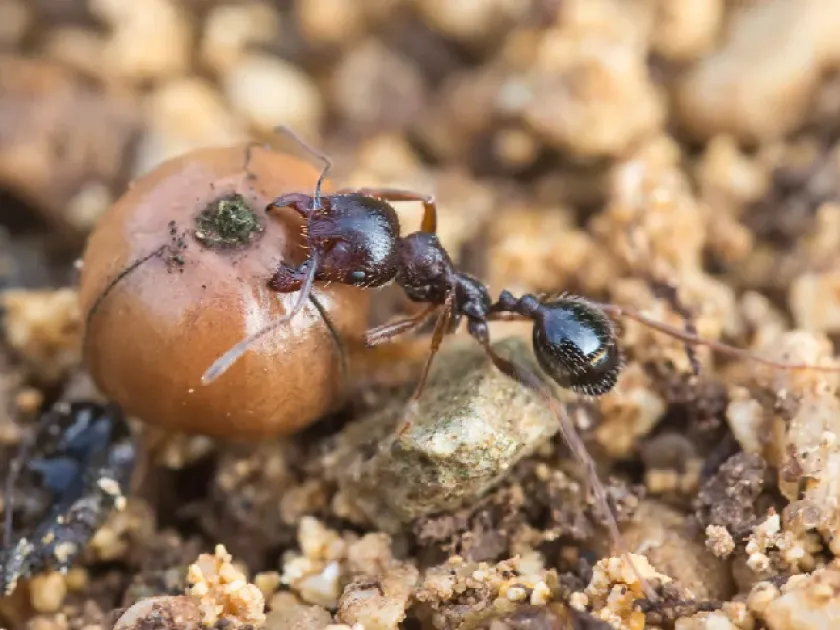
Description
How to identify
The harvester ant (genus Messor) belongs to the family Formicidae. These insects are well-known for their polymorphic nature, meaning workers vary significantly in size, with larger individuals serving as guards and processors of seeds.
They are typically dark brown or black in color and possess large, muscular heads equipped with powerful mandibles. These anatomical features are highly specialized for crushing hard grains and seeds collected from the field.
The colonies reside in deep, complex underground nests. These structures include specialized chambers for drying and storing seeds, protecting them from moisture and preventing spoilage during the inactive seasons.
The life cycle follows a complete metamorphosis: egg, larva, pupa, and adult. A single queen usually heads the colony, and her longevity allows the colony to persist in the same location for many years, demanding consistent management.
These ants are primarily diurnal, active during the day. They create distinct, long-lasting trails from their nests to foraging grounds, making their movement patterns predictable once they have established a stable food source.
What it damages
Harvester ants cause significant economic damage by collecting seeds of various crops, including wheat, barley, sunflower, and legumes. Their foraging activity is most intense during the planting season, immediately after sowing.
The main result of their activity is a reduced plant stand. By removing seeds from the rows, they create gaps in the fields, leading to uneven crop distribution and a direct decrease in potential yield per hectare.
In addition to seed removal, they may clip emerging seedlings, causing mechanical damage to young plants. This often requires farmers to perform expensive reseeding operations to fill the damaged areas of the field.
Damage is often localized near the edges of fields bordering undisturbed grasslands or fence lines where large, established colonies have thrived for years. These hotspots can serve as centers for expanding foraging pressure.
Beyond seed loss, their mound-building activities disturb the soil structure. Furthermore, the germination of leftover seeds or weed seeds deposited around the nest entrance can create localized weed pressure that competes with crops.
Control measures
Effective management begins with deep tillage, which physically destroys the nest structure. Disrupting the galleries and storage chambers is crucial to damaging the colony's capacity for rapid recovery and resource storage.
Using systemic seed treatments is a primary defense strategy. Applying appropriate insecticides to the seed coat makes the grains unpalatable or toxic to the ants, effectively deterring them from foraging on the newly planted rows.
For high-density areas, insecticidal baits can be deployed. These are designed to be collected by workers and brought back to the nest, ensuring that the queen and brood are exposed to the control agent, which is essential for colony suppression.
Proper planting depth is a fundamental cultural control method. Ensuring that seeds are placed at the optimal depth according to agronomic requirements reduces the ants' ability to detect and retrieve the seeds from the soil surface.
Regular scouting of fields during the early stages of germination is vital. Early identification of ant trails or foraging activity allows for targeted, localized control measures that prevent larger-scale infestations across the entire field.
Taxonomy
- Latin name
- Messor
- Order
- Hymenoptera
- Family
- Formicidae
- EPPO code
- MESRSP
Discussion
No discussions yet — be the first.