
Liometopum ant
Liometopum luctuosum
Description
How to identify
Liometopum luctuosum is a species of ant belonging to the family Formicidae and the subfamily Dolichoderinae. These ants are known for their complex colonial organization and social structure.
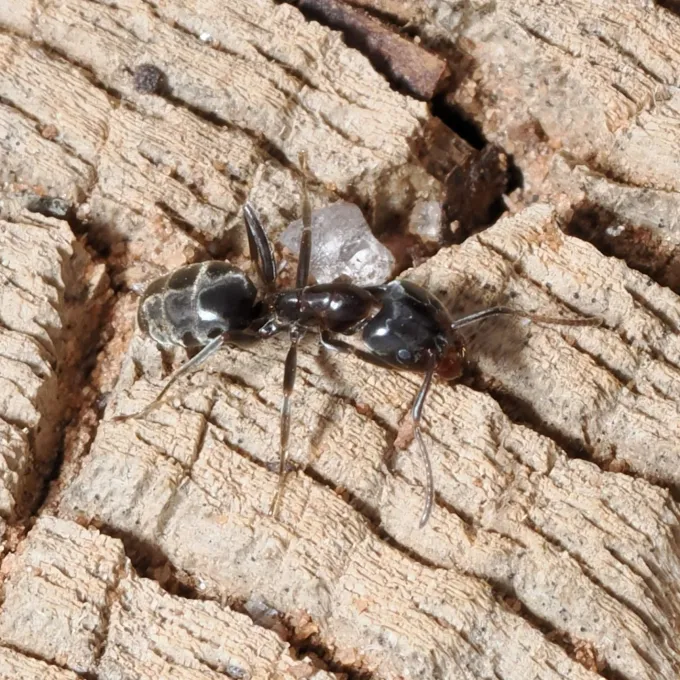
Physically, they appear as dark-colored ants with a matte or slightly shiny cuticle. Their heads are robust, featuring strong mandibles that allow them to manipulate wood and organic material effectively.
These ants are characterized by their ability to nest in cavities within trees. They occupy both living wood and dead debris, showing high adaptability to forest and garden environments.
Taxonomically, the genus Liometopum is recognized for its significant role in ecological niches, though some species may behave as structural pests when nesting in valuable tree species.
Identification is typically based on morphological characteristics such as the shape of the petiole, body pubescence, and the specific arrangement of the antennal segments.
What it damages
The species causes damage to a variety of deciduous and coniferous trees, primarily by excavating tunnels and galleries within the heartwood and sapwood for nesting.
While they do not consume wood as a primary food source, their nesting activities weaken the structural integrity of the trunks and branches, leading to potential breakage during wind events.
The destruction of cambium layers caused by their nesting activity can hinder the tree's vascular system, resulting in branch dieback and reduced vitality of the host plant.
A major indirect threat is the mutualistic relationship these ants have with aphids and scale insects. The ants protect these sap-sucking pests from natural predators, leading to massive infestations.
Prolonged occupation by a large colony often leads to the decline of the tree, making it more susceptible to secondary infections, fungal pathogens, and environmental stress.
When it appears
Activity begins in early spring, as temperatures rise, signaling the end of the winter dormancy period and the resumption of foraging and brood rearing.
During the summer months, the colony is highly active, with workers continuously moving along the trunk to forage, manage aphid colonies, and expand the nest galleries.
Autumn brings a gradual decrease in temperature, prompting the ants to concentrate their activities deeper within the nest to prepare for the winter months.
Winter dormancy is spent in the deepest parts of the galleries within the tree, where the stable internal wood temperature helps the colony survive cold weather.
The developmental cycle of the larvae is highly dependent on ambient temperatures, with growth occurring rapidly during the peak of summer when resources are abundant.
Signs of infestation
A primary sign of infestation is the presence of fine wood shavings or "frass" deposited at the base of the tree or in branch crotches, indicating active gallery excavation.
Consistent, heavy trails of ants moving up and down the bark are clear indicators of a functional nest located somewhere within the tree's structure.
The presence of dense aphid clusters on new shoots, specifically those attended by ants, is a strong indicator of the colony's farming behavior.
Hollow sounds detected when tapping the trunk suggest internal structural damage caused by the extensive tunneling of the ant colony.
- Darkened or cracked bark at the entry points of the nest.
- A distinct, lingering odor characteristic of the colony's glandular secretions.
- Wilting leaves and thinning canopy as a sign of tree decline.
Control measures
The most effective management strategy involves maintaining tree health through proper pruning, wound care, and avoiding unnecessary damage to the bark.
Applying sticky adhesive bands to the tree trunk serves as a mechanical barrier, preventing ants from reaching the canopy and tending to aphids.
The use of slow-acting gel or liquid baits is highly recommended; workers carry the insecticide back to the nest, effectively targeting the queen and developing larvae.
Targeted application of insecticides to the nest site or around the tree base can help reduce population density during periods of peak activity.
In cases of severe structural degradation, sanitary removal of the infested tree is necessary to prevent the spread of the colony to adjacent healthy plants.
Taxonomy
- Latin name
- Liometopum luctuosum
- Order
- Hymenoptera
- Family
- Formicidae
- EPPO code
- LIOMLU
Discussion
No discussions yet — be the first.