
Argentine ant
Linepithema humile
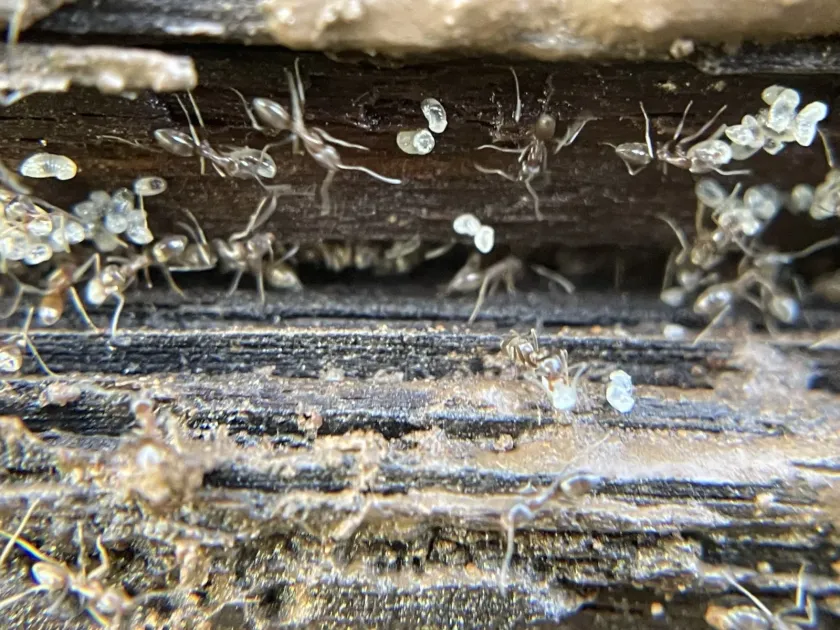
Description
How to identify
The Argentine ant (Linepithema humile) is a member of the Hymenoptera order and the Formicidae family. These are small insects, typically 2–3 mm long, ranging in color from light to dark brown.
A key characteristic of this species is the lack of polymorphism: all workers are uniform in appearance. They do not possess a stinger; instead, they bite and release a distinctive musty odor when crushed.
Their colonies are highly efficient, featuring multiple queens (polygyny) and intense cooperation between nests, which allows them to form massive supercolonies that can span entire neighborhoods or regions.
You can identify them by their movement patterns: they travel in defined, consistent trails that often stretch for long distances along fences, structures, or tree branches.
Unlike many native ant species, they do not build prominent mounds. They prefer to nest in shallow soil, under stones, inside decaying wood, or within dense organic mulch.
What it damages
The Argentine ant does not feed on plant tissue directly but causes severe indirect damage by tending to sap-sucking pests such as aphids, mealybugs, and scale insects.
By actively protecting these pests from natural predators and parasitoids, the ants enable aphid populations to explode, leading to significant stress on trees, shrubs, and ornamental plants.
The honeydew excreted by these sap-suckers accumulates on leaves and promotes the growth of sooty mold, a fungus that covers the plant in black soot and interferes with photosynthesis.
Citrus trees, vineyards, and orchards are particularly vulnerable. The presence of ants disrupts biological control efforts, making it difficult for beneficial insects to manage pest outbreaks.
In some instances, Argentine ants can interfere with pollination by frequenting flowers and may even damage seeds or young buds in their search for resources.
When it appears
The activity of the Argentine ant is highly dependent on temperature, with optimal foraging conditions occurring between 15 and 30 degrees Celsius.
During the spring and summer, their foraging activity peaks as they require vast amounts of carbohydrates to support the colony and the associated aphid populations.
As weather conditions cool, ants may migrate toward warmer environments, including the root zones of trees or greenhouse structures, to survive the winter months.
In temperate and tropical climates, these ants can remain active throughout the entire year, which makes them a particularly persistent threat to agriculture.
Soil moisture levels also influence their distribution; during dry spells, they are frequently drawn to irrigation systems, which can become clogged by dead ants and debris.
Signs of infestation
The most reliable sign of an infestation is the presence of steady, dense ant trails climbing up tree trunks to reach colonies of aphids on young, tender growth.
Sticky honeydew residue on foliage, often accompanied by patches of black sooty mold, is a classic indicator that aphids or scale insects are being protected by ants.
Stunted plant growth and wilting shoots are frequent symptoms, resulting from the excessive sap depletion caused by the protected pest colonies.
Upon disturbing the soil or mulch near the base of a plant, one will observe a rapid, mass movement of small brown ants defending their nesting sites.
Finding large concentrations of ants near water sources, drippers, or hydroponic lines is another clear indication of an Argentine ant presence in the area.
Control measures
Managing the Argentine ant is notoriously difficult due to their social structure; using quick-acting contact insecticides only stimulates queens to produce more brood.
The most effective strategy involves using slow-acting bait stations. Workers carry the toxic bait back to the nest, effectively eliminating queens and the entire colony over time.
Applying sticky barriers or specialized ant guards on tree trunks can physically prevent them from accessing the canopy, allowing natural predators to suppress aphid populations.
An integrated approach requires simultaneous management of the honeydew-producing pests using systemic insecticides, which deprives the ants of their primary food source.
- Use slow-acting gel or liquid baits.
- Install physical sticky barriers on tree trunks.
- Implement systemic pest control for aphids and scale.
- Remove debris and weeds that harbor ant colonies and pest populations.
Taxonomy
- Latin name
- Linepithema humile
- Order
- Hymenoptera
- Family
- Formicidae
- EPPO code
- IRIDHU
Discussion
No discussions yet — be the first.