
Leptothorax ant
Leptothorax unifasciatus
Description
How to identify
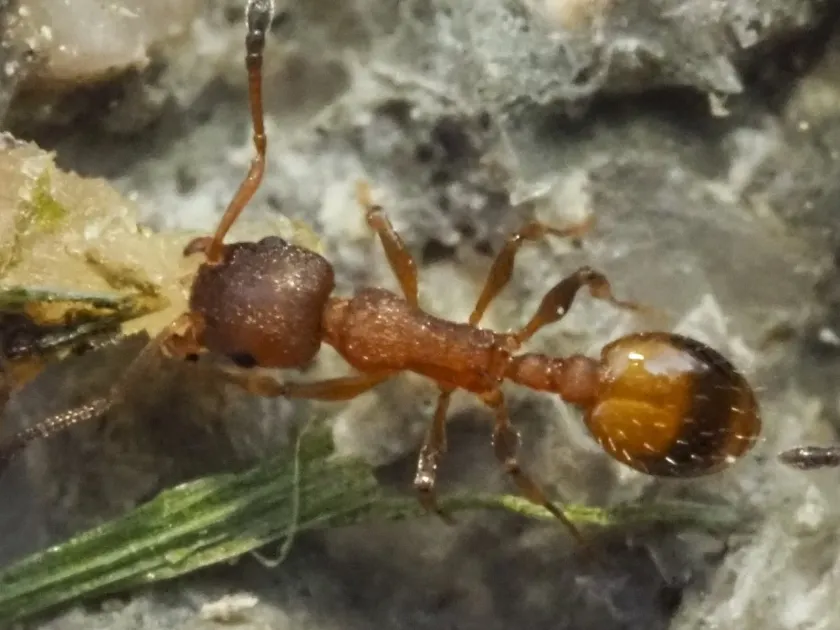
Leptothorax unifasciatus is a small ant species belonging to the Formicidae family and Myrmicinae subfamily. Adult worker ants are approximately 2.5–3.5 mm long. They are generally yellowish-brown with a distinct dark transverse band on their abdomen, which is their signature appearance.
These ants are known for nesting in confined spaces such as wood crevices, dry plant stems, under tree bark, or within gaps in rocks. They live secretive lives and rarely form large mounds, often living in small, discreet colonies.
A key identifying feature of this species is the presence of long, needle-like hairs on their bodies and heads. The queen appears similar to the workers but is larger, and her well-developed thorax indicates she possessed wings during the mating flight phase.
The life cycle involves complete metamorphosis: egg, larva, pupa, and adult. Larval development is typically slow, highly dependent on the availability of nutrients and the ambient temperature of their nesting site.
Unlike larger garden ants, these insects do not build prominent dirt mounds. This makes them difficult to spot in the early stages of garden colonization until the population grows sufficiently to be noticeable.
What it damages
While not direct consumers of plant tissue, these ants cause significant indirect damage by tending and protecting aphid colonies on fruit and ornamental plants. By driving away predators, they allow aphid populations to flourish.
During their foraging, these ants may damage flower buds and delicate petals by chewing on them to extract sugary nectar. This leads to deformed blooms and reduced yields in fruit-bearing shrubs and flowering plants.
They pose a specific threat in nurseries and orchards, as they can facilitate the spread of fungal spores and bacteria; these pathogens adhere to the ants' legs and are transmitted to open wounds in tree bark or root systems.
Nesting within the wood of weakened trees contributes to the premature breakdown of bark and promotes the development of decay and rot, significantly shortening the lifespan of affected ornamental plants.
Furthermore, their presence in garden beds can become a nuisance, as they aggressively defend their nests when disturbed, complicating routine gardening tasks such as pruning or weeding around their habitat.
When it appears
Activity for Leptothorax begins in early spring as soon as soil temperatures reach 10–12 degrees Celsius. During this time, workers emerge to forage and scout for suitable sites to establish new colonies.
The peak of their activity occurs in June and July, aligning with the rapid growth cycle of aphids. During this period, the ants are highly active in tending to aphid populations on leaves and stems.
The nuptial flight of winged reproductive individuals usually takes place in mid-summer. New queens and males leave the parent nest to mate and search for new locations to establish future colonies.
As autumn approaches, activity levels drop significantly. With the onset of the first frost, the colony retreats deep into their wood or soil nests, entering a state of diapause until the following spring.
During the winter, the colony survives by relying on carbohydrate stores accumulated in the bodies of the workers and a slowed metabolism, which allows them to endure cold temperatures within their sheltered nests.
Signs of infestation
The first sign of a Leptothorax infestation is the presence of aphid colonies on young shoots that are being actively patrolled by ants, even if no obvious nest is visible nearby.
Small holes or fine wood dust found at the base of dry twigs, shrubs, or in crevices of garden structures are clear indicators that these areas are being used as nesting sites.
Leaves that are curled, deformed, and covered in a sticky substance known as honeydew are evidence that the ants are successfully maintaining a pest colony on the plant.
The gradual wilting of individual branches that cannot be attributed to drought or root disease is often a secondary consequence of an ant colony inhabiting the tree’s woody tissue.
If you observe the area carefully, you may notice linear trails of worker ants moving along tree trunks or plant supports, which they use as highways to transport food back to the colony.
Control measures
The primary control strategy is to target the aphid colonies, as they are the main attractant for the ants. Using biopesticides based on entomopathogenic fungi can effectively reduce aphid numbers without harming beneficial garden insects.
Physically removing affected branches where nests have been identified is one of the most effective ways to eradicate a local population of Leptothorax ants.
Applying sticky adhesive bands to tree trunks acts as a barrier, preventing ants from reaching the canopy. This breaks the food supply chain and encourages the colony to relocate to a different area.
Using bait stations containing slow-acting insecticides (like boric acid or borax) allows the workers to carry the bait into the nest, eventually eliminating the queen and the entire brood.
- Regular weeding reduces available nesting sites.
- Keeping the base of trees clean and clear of debris.
- Using wood ash as a natural deterrent around plants.
- Encouraging natural predators such as ground-feeding birds.
Taxonomy
- Latin name
- Leptothorax unifasciatus
- Order
- Hymenoptera
- Family
- Formicidae
- EPPO code
- LEPXUN
Discussion
No discussions yet — be the first.