
Black garden ant
Lasius niger
Description
How to identify
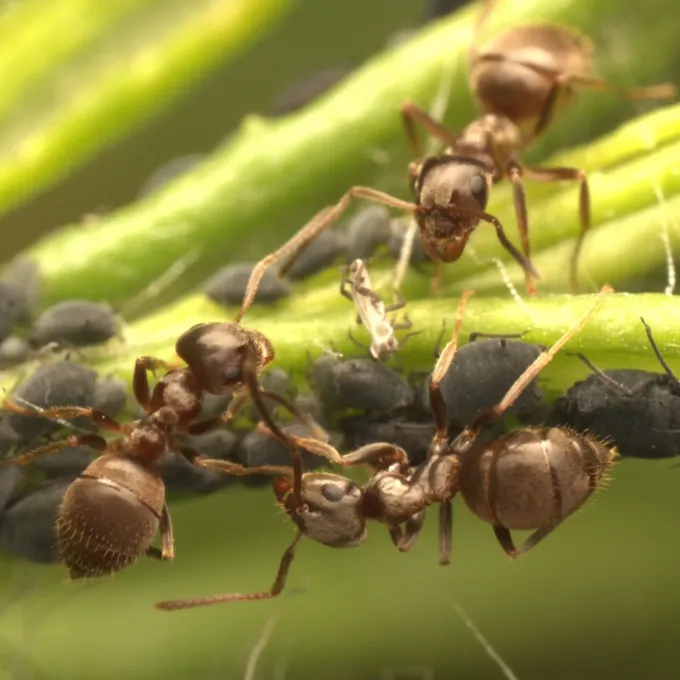
The black garden ant (Lasius niger) belongs to the Hymenoptera order, Formicidae family. Workers measure 3–5 mm in length and have a dark brown to black body.
The queen is significantly larger, often reaching 10 mm in length, and is the reproductive center of the colony, living for many years under stable conditions.
The colony structure is highly organized, consisting of workers, soldiers, and a queen. They are very adaptable and construct nests in soil, under rocks, or in rotting wood.
During the mating season, swarms of winged reproductive individuals emerge from the nest to mate, after which the queens establish new colonies in suitable locations.
These ants are resilient and survive winter by retreating deep underground, below the frost line, where they wait for spring warmth to resume activity.
What it damages
The primary concern for gardeners is the symbiotic relationship between ants and aphids. Ants protect aphids from predators and actively transport them to healthy plant tissues.
By farming aphids, ants accelerate the spread of these sap-sucking pests, which leads to stunted plant growth, leaf curling, and overall decreased vigor of the host plant.
Physical damage occurs when ants dig tunnels near the root zones of trees and garden plants, which can cause soil drying, root exposure, and eventual wilting of crops.
Ants can also damage seeds during planting and feed on young seedlings, negatively impacting the emergence and survival rate of various vegetable crops.
The accumulation of honeydew secreted by aphids leads to the growth of sooty mold, which blocks sunlight from leaves and reduces the plant's ability to perform photosynthesis.
When it appears
The black garden ant becomes active in early spring as soon as soil temperatures increase, usually once conditions rise above 10°C (50°F).
The period of peak nuisance coincides with the rapid vegetative growth of plants in late spring and early summer when aphid populations are at their most vulnerable.
Nuptial flights, during which new queens look for nesting sites, typically take place in mid-summer, often triggered by warm, humid, and still weather conditions.
Throughout the growing season, ants maintain constant traffic, creating trails between their nest and the host plants that serve as their aphid "farms."
As autumn temperatures drop, the colony decreases surface activity and slowly retreats into their subterranean galleries for the winter hibernation period.
Signs of infestation
The most common sign of an infestation is observing persistent lines of black ants crawling up and down the stems of trees, shrubs, or garden vegetables.
Leaves that are curled, yellowed, or sticky are clear indicators of a heavy aphid infestation that is being actively managed by an ant colony.
Small mounds of excavated soil at the base of plants or near garden beds are distinct markings left by the ants during their nest construction and maintenance.
The presence of sooty mold, a black powdery fungus, on the foliage is a secondary effect resulting from the honeydew excreted by aphids protected by the ants.
Unexplained wilting of young plants, especially in dry weather, often points to ants compromising the soil structure around the delicate root system.
Control measures
Effective management focuses on limiting ant access to plants and disrupting the symbiosis with aphids through both chemical and cultural practices.
- Apply specialized ant bait stations or gels containing slow-acting insecticides, which are carried back to the nest to eliminate the queen and brood.
- Install sticky barriers around tree trunks to prevent ants from reaching the canopy, thereby making aphids vulnerable to their natural predators.
- Regular soil cultivation around the garden helps disrupt nest architecture and discourages colonies from establishing themselves in high-value crop areas.
- Encourage beneficial insects such as ladybirds and lacewings, which are natural predators of aphids and help minimize the attraction for ants.
- Use essential oils like peppermint or clove, which can act as natural deterrents to keep ants away from specific beds or container plants.
Taxonomy
- Latin name
- Lasius niger
- Order
- Hymenoptera
- Family
- Formicidae
- EPPO code
- LASINI
Discussion
No discussions yet — be the first.