
Brown carpenter ant
Lasius emarginatus
Description
How to identify
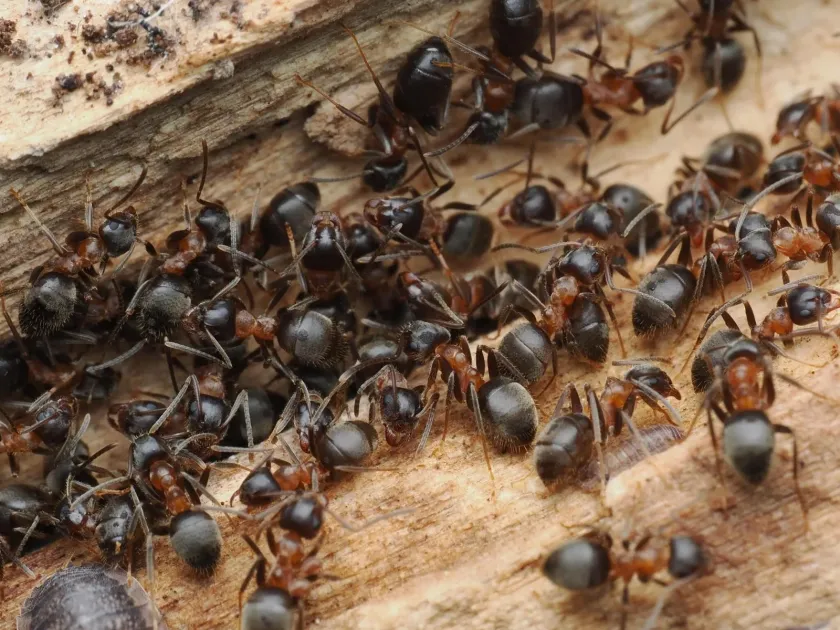
The brown carpenter ant (Lasius emarginatus) is a species of the Formicidae family. Workers are typically 3.5 to 4.5 mm long, characterized by a bicolored appearance: dark brown head and abdomen, contrasting with a lighter, yellowish-brown thorax.
Unlike many other ant species, these ants often nest in wood, wall crevices, and under tree bark, rather than just in the soil. The queens are larger and typically remain deep within the colony, making them difficult to locate during inspections.
These ants are highly social and exhibit aggressive behavior when defending their nests or foraging trails. They often establish multiple satellite colonies, which allows the total population to expand rapidly throughout a garden or structure.
They are well-adapted to human-disturbed environments and frequently move between trees and building foundations. Their ability to navigate using pheromone trails ensures constant communication between foraging groups and the central nest.
They thrive in warm, dry conditions, often choosing sites that are exposed to direct sunlight. This makes garden features like ornamental logs, stone walls, and tree trunks ideal locations for their colonies.
What it damages
The primary concern with Lasius emarginatus is their habit of creating nesting galleries in wood, which can weaken structural integrity. While they do not consume wood as a food source, their excavation activities create moisture-prone pathways.
These ants are notorious for farming aphids and scale insects. They protect these pests from predators, allowing them to suck sap from shoots, which leads to stunted growth, leaf curling, and overall plant decline.
The honeydew excreted by aphids, protected by the ants, promotes the growth of sooty mold. This black fungal coating covers leaves and hinders photosynthesis, significantly reducing the vigor of fruit trees and shrubs.
In residential buildings, these ants can invade wooden framing, windowsills, and decorative panels. By expanding existing cracks and voids, they can accelerate the decay and structural breakdown of timber elements.
In horticultural settings, they may damage the root systems of young trees by eroding the soil around them. This exposes roots to air and drought, which can lead to the wilting and eventual death of young saplings.
When it appears
Activity typically commences in early spring as soil temperatures reach approximately +10–12 degrees Celsius. Initially, scout ants emerge to search for food sources to sustain the developing brood.
The peak of activity occurs in early summer, particularly during the mating flights in June and July. During this time, the number of workers foraging on plants increases significantly to support colony growth.
Throughout the dry summer months, they are most active in protecting their aphid "herds." They are often seen traveling in clear lines along trunks and walls, seeking moisture and carbohydrates.
Activity gradually tapers off in autumn as the ants prepare for winter. They retreat into deeper nesting sites in the soil or well within wood structures to survive the colder temperatures.
During the winter, the ants enter a state of dormancy (diapause) inside their protected galleries. Consequently, surface-level treatments are ineffective during this dormant season.
Signs of infestation
The most prominent sign of an infestation is a line of ants traveling along tree trunks or building edges. These trails often lead to clusters of aphids on the tender tips of branches.
A consistent presence of aphids or scale insects on plants that are otherwise healthy, but persistently monitored by ants, indicates an active symbiotic relationship fostered by the carpenter ants.
The presence of "frass" or fine wood shavings near the base of trees or in the joints of wooden structures is a classic indicator that ants are excavating the timber to enlarge their nest.
Sticky residue (honeydew) on leaves, followed by the appearance of black sooty mold, suggests that ants are tending to sap-sucking insects nearby, requiring immediate management.
Sunken soil or tunnels appearing around the base of fruit trees or under patio stones are strong indicators of a significant underground nest system associated with this species.
Control measures
The most effective long-term control method involves the use of slow-acting toxic baits. Workers carry the bait back to the colony, effectively eliminating the queen and preventing future population growth.
Applying sticky adhesive bands around the trunks of trees acts as a physical barrier. This prevents ants from reaching the canopy, which effectively isolates aphid populations and encourages natural predators like ladybugs.
Systemic insecticides should be applied to control aphid infestations. By eliminating the food source provided by the aphids, the ants are discouraged from colonizing those specific plants.
For structural infestations, professionals recommend injecting insecticides directly into the galleries found in the wood. Sealing cracks and crevices with exterior-grade caulk also limits their ability to re-enter.
- Regular soil cultivation disrupts shallow nesting galleries and exposes the brood.
- Remove rotting logs, stumps, and debris to eliminate potential nesting sites.
- Planting repellent herbs like mint or lavender around the base of trees can provide a mild deterrent effect.
Taxonomy
- Latin name
- Lasius emarginatus
- Order
- Hymenoptera
- Family
- Formicidae
- EPPO code
- LASIEM
Discussion
No discussions yet — be the first.