
Brown carpenter ant
Lasius brunneus
Description
How to identify
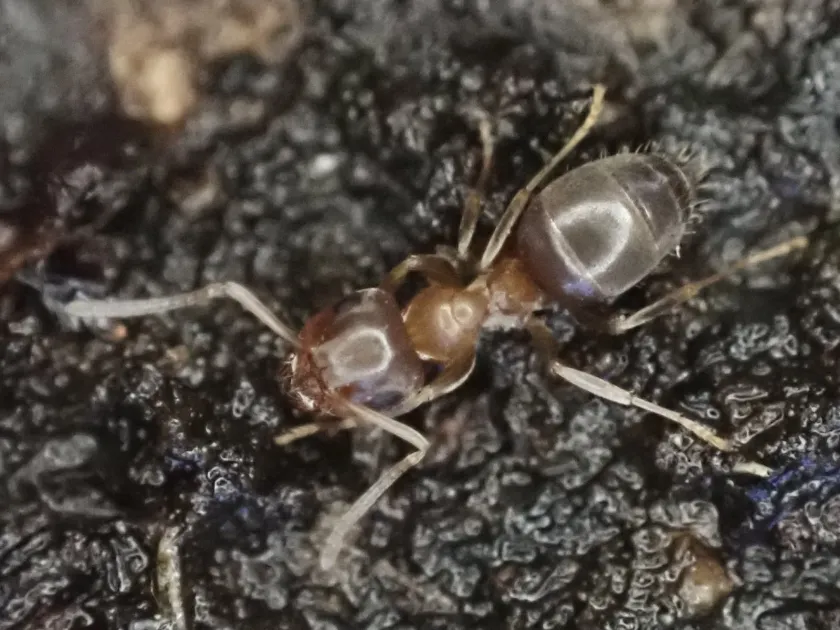
The brown carpenter ant Lasius brunneus is a species of ant belonging to the Formicidae family, known for its ability to bore into wood. Adult worker ants are small, typically ranging from 2 to 4 mm in length.
Their bodies are characterized by a light brown or reddish-brown coloration. A key identification feature is that their head and thorax are usually lighter in color compared to the darker, sometimes blackish, abdomen.
The cuticle of these ants is generally smooth and glossy, with sparse hair coverage. This distinctive appearance helps differentiate them from other common ant species found in woodland and garden habitats.
Queens of this species are significantly larger, growing up to 9 mm in length, and exhibit a darker, more uniform body color. They rarely emerge from the nest, focusing entirely on egg production and colony management.
These ants form populous colonies that can inhabit a single tree for many years. Because they are nocturnal, they are rarely seen during the day, which often allows their population to grow unnoticed.
What it damages
These ants primarily target deciduous trees, such as oaks, limes, and various fruit trees. They prefer to establish nests in wood that is already decaying or affected by heart rot fungi.
Damage occurs when the ants excavate extensive galleries throughout the interior of the trunk and larger branches. This tunneling activity severely compromises the structural integrity of the tree, increasing the risk of wood breakage.
They act as guardians for aphids, which they tend and protect in exchange for honeydew. The massive aphid populations supported by these ants sap essential nutrients from the leaves and young shoots of the tree.
The galleries created by the ants act as entry points for water and secondary pathogens, such as bacteria and wood-rotting fungi. This leads to internal rot that eventually kills the affected woody tissue.
In mature trees, persistent colonies can cause significant crown dieback and growth stagnation. Over time, the tree's health declines until it eventually succumbs to environmental stressors or physical collapse.
When it appears
Colony activity typically begins in early spring, as soon as temperatures consistently rise above 10-12 degrees Celsius. Workers start emerging from their winter quarters to forage for food.
The peak period for reproduction and the emergence of winged reproductive individuals is usually during June and July. During these months, increased activity is observed around the base and lower bark of the host tree.
Summer is the time of maximum colony expansion. During this season, the ants are highly active in extending their internal galleries, which accelerates the rate of damage to the host tree's structure.
As autumn approaches and temperatures drop, the activity levels of the foraging workers decline. The ants gradually retreat into the deep heartwood of the tree to settle in their winter galleries.
The colony spends the winter in a state of diapause within the wood. They remain in these deep, insulated galleries throughout the colder months until the return of spring weather triggers activity again.
Signs of infestation
One of the most obvious signs of an infestation is the presence of fine sawdust or "frass" accumulating at the base of the tree or on the bark surface, discarded from the internal galleries.
Visible ant trails climbing up the trunk are common during the night. These paths connect the nest to aphid colonies in the upper branches, confirming that the tree is being actively managed by the ants.
A hollow sound upon tapping the trunk indicates the presence of extensive interior galleries. This structural damage is often accompanied by thinning foliage or patches of dry, dead branches in the crown.
The presence of large, flourishing colonies of aphids on leaves without other obvious explanations often suggests a mutualistic relationship with carpenter ants inhabiting the tree.
Small, circular entrance holes in the bark are another indicator. While these holes are often small, they serve as the primary exit points for the workers to leave the nest and forage.
Control measures
Sanitary pruning is the primary preventive measure. Removing dead, dying, or decaying branches eliminates the entry points and habitat preferred by these ants for nesting.
Application of contact-based insecticides to the trunk and around identified entrance holes can help reduce the number of foraging workers and deter new colony establishment.
Sticky bands or physical barriers placed around the trunk are highly effective. These prevent the ants from accessing the crown, effectively breaking the cycle of aphid protection and reducing tree stress.
For established deep-seated colonies, the use of slow-acting gel baits is recommended. The ants carry the bait into the heart of the nest, which helps to eliminate the queen and the entire colony.
Maintaining tree vigor through proper watering and fertilization is essential. Healthy, fast-growing trees are much more resilient and less attractive to carpenter ants compared to stressed or stagnant ones.
Taxonomy
- Latin name
- Lasius brunneus
- Order
- Hymenoptera
- Family
- Formicidae
- EPPO code
- LASIBR
Discussion
No discussions yet — be the first.