

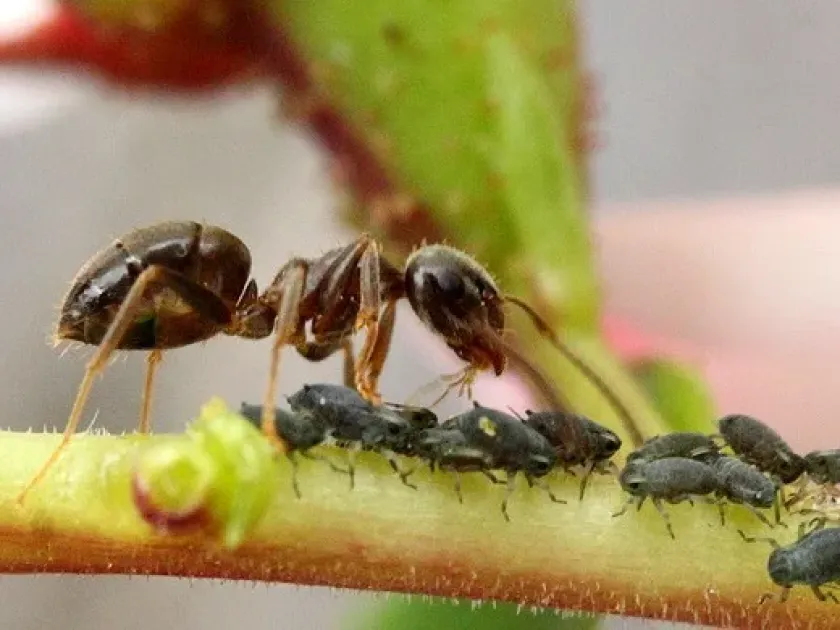
Description
How to identify
The black garden ant (lat. Lasius niger) belongs to the order Hymenoptera and the family Formicidae. These small insects, with workers measuring 3–5 mm, are characterized by their dark brown to black coloration and complex social structure.
A single colony is governed by a queen, which can live for several decades. The workers perform all labor duties, including foraging, nursing the brood, and defending the colony from intruders.
They undergo a complete metamorphosis process, consisting of egg, larva, pupa, and adult stages. The workers are highly attentive to the environment, moving the brood to different levels of the nest to maintain optimal heat and moisture levels.
These ants are highly resilient, capable of building nests in various locations, including soil, under rocks, or in decaying timber, making them a common sight in urban and rural gardens.
Communication is facilitated by chemical signals called pheromones, which allow the ants to coordinate large-scale foraging efforts and defensive reactions effectively.
What it damages
The primary concern regarding black garden ants in agriculture is their mutualistic relationship with aphids and scale insects. Ants protect these pests from natural predators to collect the honeydew they excrete.
Many fruit-bearing trees, such as apple and plum trees, as well as various berry bushes, suffer from infestations facilitated by ants. The ants actively transport aphids to tender young leaves and buds where they can thrive.
This farming behavior leads to severe plant stress, including leaf curling, stunted growth, and a reduction in crop yield. The honeydew accumulation also promotes the growth of sooty mold, which impairs photosynthesis.
Ants can also cause direct damage by nesting near the root systems of delicate plants. Their constant tunneling disturbs the soil, causing roots to dry out and leading to poor nutrient uptake.
Furthermore, ants act as vectors for various plant pathogens, carrying fungal spores and bacteria from one plant to another as they traverse the garden environment.
When it appears
The activity of black garden ants begins in early spring, once the soil temperature reaches approximately 10 degrees Celsius, allowing the colony to resume its foraging routine.
Peak activity occurs during late spring and throughout summer, coinciding with the rapid reproduction of aphid populations. During this time, the traffic on ant trails is at its highest.
In mid-summer, when temperatures are elevated, colonies often move their nests to cooler, moister soil layers or under deep mulching to prevent the desiccation of the brood.
As autumn approaches and temperatures drop, the ants gradually slow down their activities. They prepare for the winter months by plugging nest entrances and retreating into deeper, more stable soil strata.
The ants spend the winter in a state of diapause, a dormant condition that allows them to survive freezing temperatures deep underground until spring signals them to emerge again.
Signs of infestation
The most visible indicator of ant presence is the well-defined, permanent trails they establish along garden paths, fences, and the trunks of trees, which they use to navigate to food sources.
Clusters of aphids on new plant growth accompanied by a high density of ants patrolling the area are definitive signs that the ants are actively farming the pests.
Small mounds of excavated soil or crater-like entrances in vegetable beds or around the base of ornamental shrubs often point to the location of a nest colony.
Disturbed soil around roots or plants showing signs of wilting without apparent cause can also indicate that the root zone has been impacted by subterranean ant tunnels.
- Visible ant trails on surfaces.
- Honeydew or sticky residue on leaves.
- Heavy aphid infestation on new shoots.
- Small soil heaps near plant roots.
Control measures
Effective control requires breaking the link between the ants and the aphids they farm. Using systemic insecticides to eliminate the aphids is often the most critical step in managing the ant population.
Installing sticky traps or grease bands around tree trunks provides a physical barrier that prevents ants from climbing up to access or protect aphid colonies on the canopy.
Bait stations containing slow-acting gel baits are highly effective. Foragers take the bait back to the nest, where it is shared with the queen and brood, leading to the eradication of the entire colony.
Regular soil cultivation and the removal of weeds around the garden significantly disrupt the ants' ability to establish stable colonies and discourage them from remaining in the area.
Natural repellents like garlic, lavender, or peppermint oil can be used for temporary deterrents, although these require frequent reapplication to remain effective in open garden spaces.
Content graph
Connections · Black garden ant
Most often together:
Marketplace
Products · 2

RembeK Duo
Innovative company "Agro Protection", LLC
Insecticides
0
0
·
50
21 offer
0.95 €per 1 l
Buy
Biology
Taxonomy
- Latin name
- Lasius
- Order
- Hymenoptera
- Family
- Formicidae
- EPPO code
- LASISP
Community
Discussion
No discussions yet — be the first.