
Hypoponera punctatissima
Hypoponera punctatissima
Description
How to identify
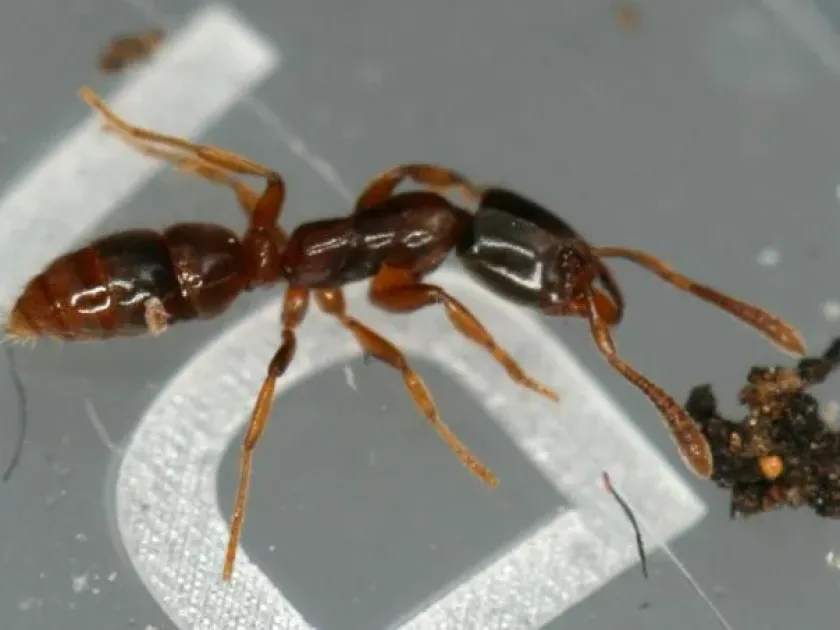
Hypoponera punctatissima is a tiny ant species belonging to the Ponerinae subfamily, with workers measuring approximately 2.5–3 mm in length. Their bodies are brownish-yellow to brown and feature a distinctive dense, fine punctation.
Unlike many other ant species, these insects lead a cryptic, soil-dwelling lifestyle. Their slender bodies are highly adapted for navigation through narrow tunnels within the soil or the growing medium in plant pots.
The species exhibits polymorphism, yet the workers are relatively uniform in structure. A key morphological feature is the lack of complex eyes, which are either significantly reduced or replaced by tiny, rudimentary structures.
Systematically, this species belongs to the Formicidae family, order Hymenoptera. They are thermophilic insects that often become synanthropic in temperate climates, commonly infesting greenhouses, conservatories, and residential areas.
They move quite slowly and often freeze in place when disturbed, showing little aggression. This quiet, non-confrontational behavior often allows the infestation to go unnoticed for a long time.
What it damages
The primary damage caused by Hypoponera punctatissima involves the disruption of the root systems of young plants and seedlings. While they do not directly feed on plant tissues, their nesting activity is highly destructive to the root zone.
As they build nests within pots, these ants excavate the soil, creating large air pockets around the roots. This leads to root dehydration, stunted growth, and in severe cases, the death of the plant due to poor soil-to-root contact.
Ants serve as vectors for various pathogens, including root rot and mold fungi. By moving constantly through the substrate, they inadvertently introduce these pathogens directly into the sensitive rhizosphere of the plants.
In addition to physical damage, this species is frequently associated with the farming of root aphids and mealybugs. The ants protect these sap-sucking pests and transport them to healthy roots, causing widespread infestations.
Damage is most prevalent in peat-based or organic-rich substrates, which provide an ideal microclimate for the ants to build their nests and raise their brood.
When it appears
In greenhouse environments, Hypoponera punctatissima remains active throughout the entire year. The stable thermal conditions found in these facilities allow the colonies to reproduce without seasonal interruptions.
Activity levels peak during the spring and summer months when rising temperatures stimulate larval development. During this time, colony populations can grow rapidly, leading to the quick colonization of new pots and sections.
During the winter, although metabolic rates decrease, the colonies remain viable within the soil if indoor temperatures remain moderate. This makes them a persistent year-round threat to indoor horticulture.
In outdoor environments within temperate zones, this species is rarely encountered and usually fails to survive the winter. Consequently, infestations are almost always introduced via contaminated soil or infested nursery stock.
The migration of ants into new pots or greenhouse sections typically occurs through the introduction of new plant material or the reuse of non-sterilized growing media.
Signs of infestation
The first sign of infestation is often unexplained plant decline, such as yellowing leaves, loss of turgor, and poor growth rates. Careful inspection of the substrate is required to confirm the presence of ants.
On the surface of the growing medium or in the drainage tray, you may notice small tunnels and piles of fine, excavated soil. The ants themselves are extremely secretive and rarely appear on the surface during the day.
When lifting a pot or during repotting, look for small, yellowish-brown insects scurrying away, often carrying white larvae and pupae. This is a definitive indicator of an active nest within the root ball.
The presence of root aphids or mealybugs on the roots is another strong indicator, as these ants often actively tend to and protect these sap-sucking pests, facilitating their spread across the greenhouse.
Excessive moisture retention in the soil or the presence of fungal growth on the substrate surface can also indicate that the soil structure has been compromised by ant galleries, which disrupts proper drainage and aeration.
Control measures
Effective control of Hypoponera punctatissima is challenging due to their cryptic habits. The use of slow-acting insecticidal baits, such as those containing hydramethylnon or fipronil, is highly recommended to eliminate the queen.
Systemic insecticides applied as soil drenches can be very effective in eradicating colonies within pots. It is essential to use products approved for greenhouse use and strictly follow the application regulations.
Good agricultural practices include avoiding over-irrigation, which creates ideal humidity for ant nesting, and ensuring all incoming plant material is quarantined and inspected before being introduced to the main collection.
Biological control using entomopathogenic nematodes (e.g., Steinernema feltiae) is an environmentally friendly option. These nematodes can be applied via irrigation and will actively hunt and kill ant larvae and workers within their tunnels.
- Deploying long-acting bait stations.
- Sterilizing growing media before use.
- Quarantining and inspecting all new plant arrivals.
- Applying systemic insecticides to the soil as a drench.
- Monitoring the root zone for signs of tended aphids.
Taxonomy
- Latin name
- Hypoponera punctatissima
- Order
- Hymenoptera
- Family
- Formicidae
- EPPO code
- HPPOPU
Discussion
No discussions yet — be the first.