
Red-headed ant
Formica truncorum
Description
How to identify
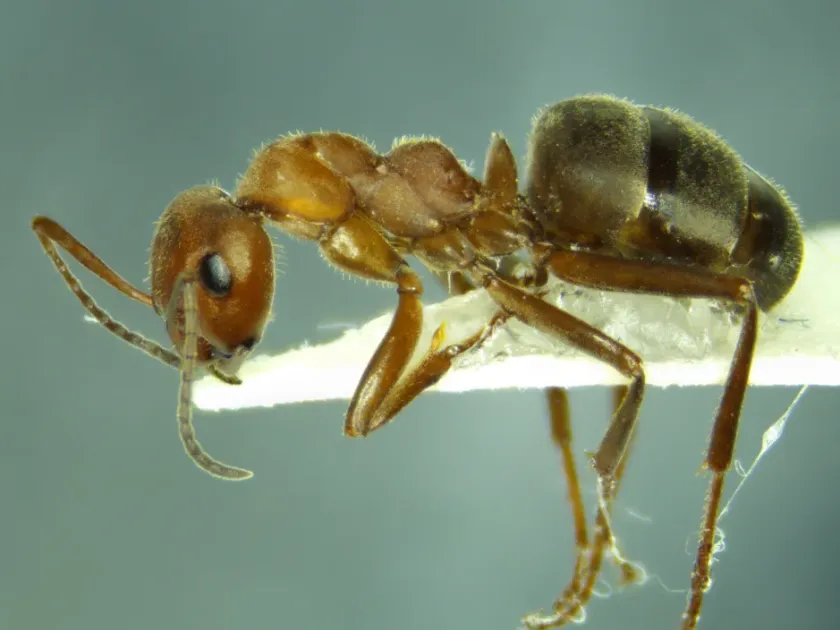
The red-headed ant, known scientifically as Formica truncorum, belongs to the Formicidae family within the order Hymenoptera. They are easily recognized by their distinct reddish-brown head and thorax, contrasted with a dark brown or black abdomen.
Worker ants typically measure between 5 and 9 millimeters in length. Their heads are relatively large and covered in dense, short hairs, which is a key diagnostic feature for identification in the field.
These ants primarily inhabit wooded areas and forest edges, where they establish colonies in decaying wood, old stumps, or under surface leaf litter.
They are known for constructing domed nests using a mixture of soil, pine needles, and small twigs, creating a highly organized social structure within the colony.
As a species, they are highly territorial and aggressive, often dominating their immediate environment and competing with other ant species for resources.
What it damages
The primary concern for gardeners is the symbiotic relationship between these ants and aphids. The ants protect the aphids from natural predators like ladybugs, allowing aphid populations to explode.
Excessive aphid colonization leads to stunted plant growth, leaf curling, and yellowing, as the aphids extract sap from the tender shoots and foliage of garden plants.
Beyond farming aphids, the ants themselves may gnaw on young buds and shoots in search of sweet nectar, causing mechanical damage to flowers and reducing overall crop yields.
Nesting activity within the wood of fruit trees can accelerate rot and decay, particularly in trees that are already weakened by age or environmental stress.
The sticky honeydew secreted by aphids provides a substrate for sooty mold, which blocks sunlight from leaves and disrupts the plant's natural photosynthetic processes.
When it appears
Red-headed ants typically emerge from their overwintering sites in early spring, as soon as soil temperatures reach 8–10 degrees Celsius, coinciding with initial bud break.
Peak activity occurs throughout the summer months of June and July, when the growth of host plants and the population of aphid colonies are at their absolute highest.
As autumn temperatures begin to drop, the ants reduce their foraging activity and start preparing their nests for the transition into winter dormancy.
During the winter months, the colony retreats deep underground or into protected woody debris, entering a state of diapause to survive cold conditions.
Daily activity cycles are also influenced by weather patterns; foraging is significantly curtailed during periods of heavy rain or extreme heat.
Signs of infestation
One of the most obvious signs of a red-headed ant presence is the formation of persistent ant trails along the trunks of trees, leading directly to aphid colonies.
The presence of mounds made of debris, soil, and organic matter near the base of stumps or trees is a clear indicator of a well-established ant colony.
Noticing ants constantly traveling up and down branches to defend aphid colonies is a reliable visual cue that the plant is under pressure from these insects.
Sticky, shiny residue on leaves, caused by aphid honeydew, confirms an active infestation that is being facilitated by the presence of ants.
Physical damage to the bark or young buds, accompanied by heavy ant traffic, indicates that the pests are actively utilizing the plant as a food source.
Control measures
Applying sticky adhesive barriers around tree trunks is an effective way to physically prevent ants from reaching the canopy and tending to aphids.
Controlling the aphid population using horticultural soaps or systemic insecticides is crucial, as the ants will often abandon the plant if their food source is removed.
For persistent colonies, bait systems containing boric acid can be highly effective; workers carry the bait back to the nest, eliminating the queen and the colony.
- Removing old stumps and decaying wood to eliminate nesting sites.
- Maintaining garden hygiene by controlling weeds that host aphids.
- Encouraging natural predators such as ladybirds and lacewings in the garden.
When infestation levels are severe, professional-grade granular baits applied to the soil surrounding the nest may be required to achieve complete control.
Taxonomy
- Latin name
- Formica truncorum
- Order
- Hymenoptera
- Family
- Formicidae
- EPPO code
- FORMTR
Discussion
No discussions yet — be the first.