
Slave-making ant
Formica sanguinea
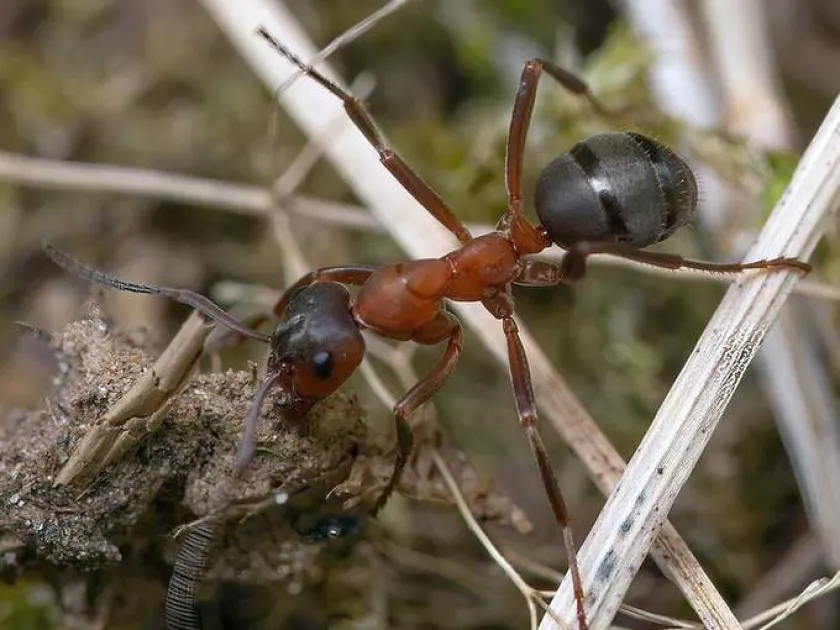
Description
How to identify
The slave-making ant (Formica sanguinea) is a member of the Formicidae family, recognized by its distinct reddish-brown head and thorax with a darker abdomen. They typically grow to 6–9 mm in length.
The defining trait of this species is its parasitic lifestyle. They raid the nests of other ant species to steal pupae, which are raised to serve as workers in their own colony, earning them the name "slave-making ants."
Their nests are frequently built in the soil, often under stones, decaying wood, or stumps, making them common inhabitants of garden environments near forest edges.
These ants are highly aggressive when defending their territory, which often brings them into direct conflict with agricultural efforts or landscaping maintenance.
Identification is aided by their specific reddish coloration and their tendency to occupy open, sunny areas where they can easily access food sources.
What it damages
The primary agricultural damage caused by Formica sanguinea is indirect; they are intensive "farmers" of aphids, protecting them from natural predators to harvest the honeydew the aphids produce.
By fostering aphid populations on fruit trees, berries, and vegetables, these ants prevent the natural biological control of aphids by ladybugs and lacewings.
This protection leads to massive aphid infestations, resulting in stunted plant growth, leaf curling, and the spread of secondary plant diseases like sooty mold.
In addition to aphid farming, their nesting activity can disturb the root systems of garden plants, leading to wilting, nutrient deficiency, and increased vulnerability to soil-borne pathogens.
The cumulative effect is a significant reduction in plant vitality, leading to poor yields and, in severe cases, the death of sensitive seedlings.
When it appears
Ant activity begins in early spring as soon as the soil temperatures rise, prompting the colony to exit the overwintering chambers and begin foraging.
Mid-summer, specifically June and July, marks the peak of their activity, as this is when the colony requires the most food to support larval development and the acquisition of new "slaves."
In late summer and early autumn, the ants intensify their foraging and aphid-tending behavior to store energy reserves before the onset of winter.
The colony undergoes a period of diapause or dormancy during the coldest months, remaining deep underground to survive frost cycles.
Monitoring for these ants should be prioritized in early spring to identify nesting sites before they reach their maximum population capacity in the warmer months.
Signs of infestation
Visible ant trails running along stems and branches are a clear indicator of their presence, especially when they lead directly to dense clusters of aphids.
The accumulation of honeydew—a sticky, sugary substance—on the foliage beneath aphid colonies is a hallmark of ant-protected pest activity.
Small mounds of disturbed soil near the bases of plants or garden structures often indicate the proximity of a Formica sanguinea nest.
Leaves that exhibit curling, yellowing, or physical deformation without signs of fungal or viral infection are often the result of heavy aphid pressure facilitated by these ants.
A sudden, aggressive response when an infested plant is touched suggests that a colony of protective ants is nearby.
Control measures
Managing the slave-making ant requires a strategy that targets both the aphid population and the ant colony itself to break their symbiotic relationship.
Installing sticky barrier bands or grease bands around tree trunks is an effective mechanical method to prevent ants from reaching the aphid colonies in the canopy.
Applying slow-acting insecticide baits is the most efficient way to eliminate the colony, as foragers will carry the toxic substance back to the queen and nest mates.
Cultural control includes keeping garden beds weed-free and maintaining soil health, which reduces the nesting appeal for these ants.
- Regular pruning of branches touching the ground.
- Use of horticultural soap to control aphid infestations.
- Application of diatomaceous earth around plant bases to deter ant movement.
Taxonomy
- Latin name
- Formica sanguinea
- Order
- Hymenoptera
- Family
- Formicidae
- EPPO code
- FORMSA
Discussion
No discussions yet — be the first.