
Meadow ant
Formica pratensis
Description
How to identify
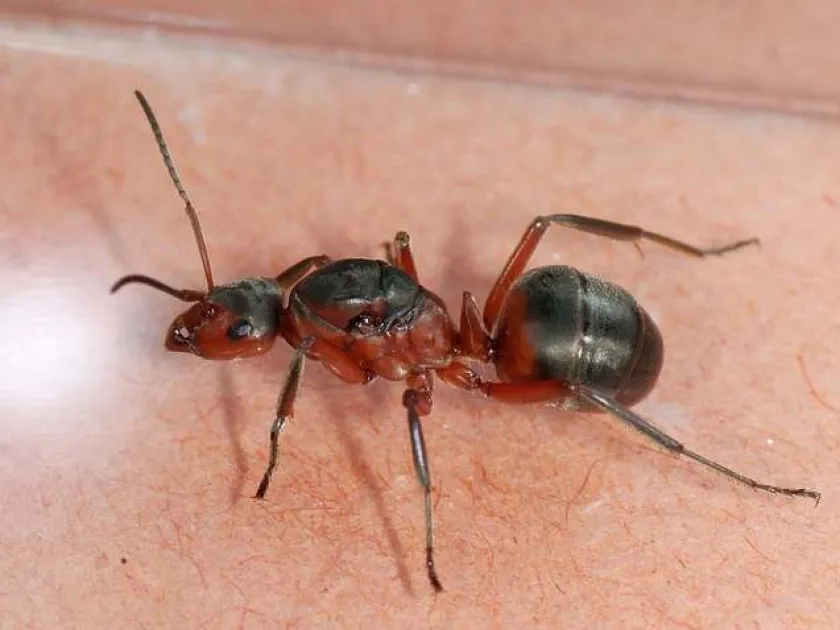
The meadow ant belongs to the order Hymenoptera, family Formicidae. This insect is of medium size, usually brown or dark brown in color.
A distinctive feature of worker ants is the presence of dense hairs on the body, giving them a matte appearance. The head and thorax are typically darker than the abdomen.
Queens are larger than workers and possess a more pronounced coloration. They build nests in the soil, often creating characteristic dome-shaped mounds made of pine needles, twigs, and dry grass.
The life cycle includes complete metamorphosis: egg, larva, pupa, and adult. Colony development is slow, requiring favorable temperature and humidity conditions.
This species is a typical inhabitant of open spaces, meadows, and forest edges, but frequently invades agricultural areas where food is abundant.
What it damages
The primary damage caused by meadow ants lies in their close symbiosis with sap-sucking pests, particularly various species of aphids.
Ants actively farm aphids, protecting them from predators such as ladybugs and relocating aphid colonies to healthy shoots of cultivated plants.
By feeding on honeydew (the sugary excretions of aphids), ants stimulate their reproduction, leading to critical damage to vegetable and fruit crops.
During their activity, ants damage the root systems of seedlings while digging tunnels, which can lead to wilting and the death of young plants.
They also damage flower buds and tender fruits of berry crops by boring holes into them in search of sugary substances.
When it appears
Insect activity begins in the spring when soil temperatures reach sustained positive values, usually in April or May.
The maximum population density and intensity of colony spreading are observed during the summer period, from June through August.
By late summer and early autumn, ants engage in active harvesting and prepare the nest for overwintering, which takes place in deep soil layers.
Throughout the season, several peaks of activity occur, linked to the brood development cycle and the presence of symbionts (aphids).
In autumn, ants enter a state of diapause, ceasing surface activity until the following spring.
Signs of infestation
A sure sign of a colony's presence is the existence of visible mounds made of plant debris or loose soil heaps within the plot.
Clusters of aphids are clearly visible on plants, often being actively herded or protected by ants.
A sticky film, known as honeydew, appears on the leaves of infested plants, often leading to the development of sooty mold that hinders photosynthesis.
Increased ant activity is observed on trails leading to the young shoots of trees and shrubs.
Wilting of seedlings without apparent signs of disease or other pests often indicates root damage caused by ants.
Control measures
Effective protection begins with limiting ant access to tree canopies using sticky trap bands.
The use of insecticidal baits containing active ingredients like diazinon allows for the elimination of the nest from within.
Regular treatment of plants against aphids significantly reduces the garden's attractiveness to ants by depriving them of their main food source.
For small areas, natural methods such as pouring boiling water over nests or using essential oils (mint, wormwood) with repellent properties are effective.
- systematic cultivation of inter-row spaces to disrupt tunnels;
- planting repellent herbs around the perimeter;
- prompt removal of plant debris from the garden.
Taxonomy
- Latin name
- Formica pratensis
- Order
- Hymenoptera
- Family
- Formicidae
- EPPO code
- FORMNI
Discussion
No discussions yet — be the first.