
Podzolic ant
Formica podzolica
Description
How to identify
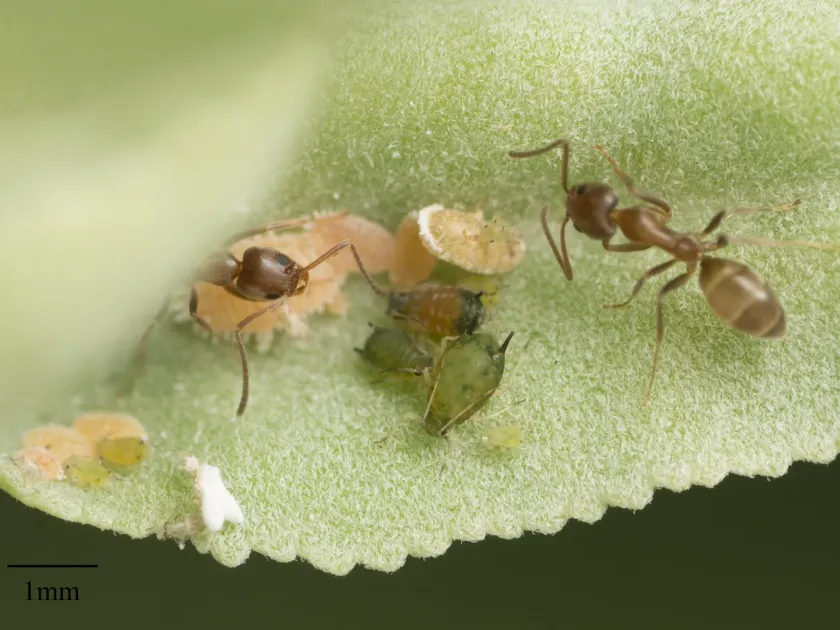
The podzolic ant (Formica podzolica) belongs to the order Hymenoptera and the family Formicidae. They are generally medium-sized, dark-colored ants with a matte appearance.
These ants are known for nesting in open, sunny areas, often constructing mounds made of small twigs, grass clippings, and soil particles gathered from the surroundings.
Workers are highly mobile and aggressive when disturbed, often vibrating their bodies and producing formic acid to deter potential threats to their colony.
Identification often relies on their specific habitat preferences, as they favor well-drained, sandy, or podzolic soils, from which their name is derived.
The colony structure typically includes a single queen or multiple queens, depending on environmental conditions, supporting a large workforce throughout the summer season.
What it damages
While podzolic ants do not consume plant tissue directly, they act as primary pests by protecting and farming sap-sucking insects, specifically aphids and scale insects.
By preventing predators like lady beetles and lacewings from feeding on aphids, the ants ensure the survival and expansion of aphid colonies on valuable crops.
Aphid feeding, fostered by these ants, leads to reduced plant vigor, stunted growth, leaf curling, and the transmission of various plant viruses.
Their tunnel-digging activities in the root zone can cause root desiccation and mechanical damage, especially in young seedlings or container-grown plants.
The honeydew produced by aphids often promotes the growth of sooty mold, which blocks photosynthesis and lowers the quality and yield of fruits and vegetables.
When it appears
The active season for Formica podzolica begins in early spring, once the soil temperature is high enough to stimulate the activity of the overwintering queen and workers.
Mid-summer represents the peak of their agricultural activity, characterized by intensive foraging and the maximal growth of aphid colonies they manage.
As temperatures begin to drop in late autumn, the ants gradually reduce their foraging activity and withdraw into deeper soil chambers to survive the winter months.
The life cycle, consisting of egg, larva, pupa, and adult stages, continues throughout the warm months, allowing for rapid colony replenishment.
Monitoring for colony activity is most effective during the early growth stages of garden crops, when preventative measures can be taken before the aphid populations explode.
Signs of infestation
The presence of well-defined ant trails moving up and down the stems of trees or shrubs is a primary sign of an established podzolic ant colony.
High densities of aphids on leaf undersides, combined with the presence of ants, indicate an active symbiotic relationship that requires immediate attention.
Small mounds of excavated soil or plant debris appearing in garden beds or at the base of trees are clear indicators of subterranean nests nearby.
Visible sticky residues on leaves and fruits confirm that aphids are being farmed, which alerts the grower to the presence of ant support.
Unexplained wilting or poor growth of specific plants in a cluster often points to root system disturbance caused by localized ant activity.
Control measures
Integrated pest management strategies are crucial, starting with mechanical barriers like sticky bands applied to tree trunks to prevent access to the canopy.
Baiting systems containing slow-acting insecticides are highly effective, as workers carry the toxins into the nest, ultimately eliminating the queen.
- Frequent soil tillage to disrupt nest tunnels and colonies.
- Application of horticultural soaps to reduce aphid populations.
- Encouraging the presence of natural aphid predators in the garden.
Applying diatomaceous earth around the base of plants can serve as a non-toxic barrier that irritates the ants and discourages them from passing.
Long-term control requires keeping the garden area clean of debris where ants can hide and ensuring aphid populations are managed before they become widespread.
Taxonomy
- Latin name
- Formica podzolica
- Order
- Hymenoptera
- Family
- Formicidae
- EPPO code
- FORMPZ
Discussion
No discussions yet — be the first.