
Allegheny mound ant
Formica integra
Description
How to identify
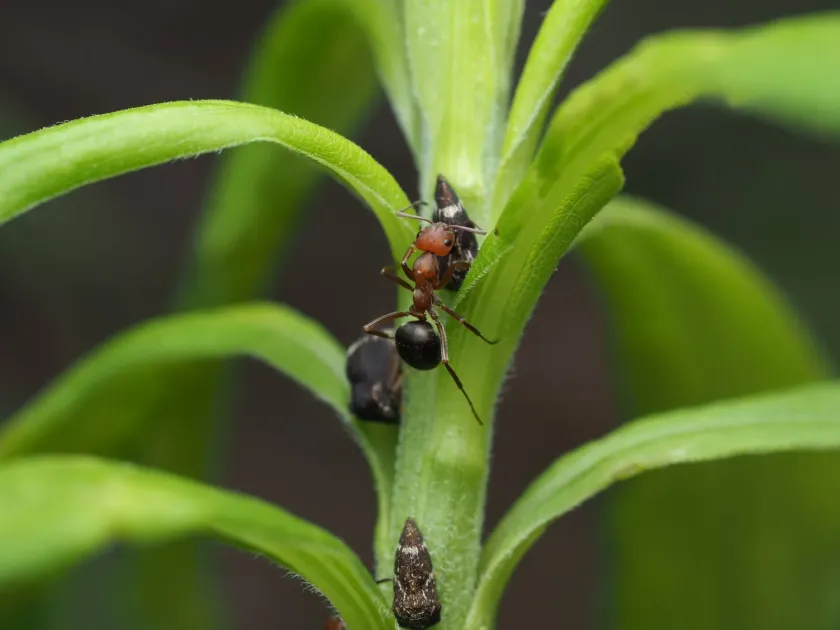
The Allegheny mound ant (scientific name: Formica integra) belongs to the order Hymenoptera and the family Formicidae. These ants are characterized by their medium size, with a reddish-brown thorax and a distinct black head and abdomen.
These ants are known for their complex social structure and aggressive nature when defending their territory. They are often found in wooded areas and orchards, where they build nests in rotting wood, stumps, or at the base of living trees.
They exhibit high activity levels, creating elaborate tunnel systems that extend both into the wood and the surrounding soil. This infrastructure supports large colonies that can persist in the same location for many years.
The life cycle involves distinct stages: egg, larva, pupa, and adult. During the warmer months, the colony focuses on expanding their infrastructure and protecting the aphids they rely on for food.
Identification can be confirmed by observing their activity on tree trunks and their tendency to build mounds of wood debris and soil near the base of infested plants.
What it damages
The primary concern regarding this species is their mutualistic relationship with aphids, scales, and mealybugs. The ants actively herd and protect these pests from predators to harvest the honeydew they produce.
By protecting aphids, the ants ensure that the aphid population remains high, leading to significant damage to young shoots and leaves. The affected parts of the plant often curl, yellow, and suffer from stunted growth.
Fruit trees and ornamental shrubs are the most common victims of this activity. The continuous feeding of sap-sucking insects, combined with the presence of ants, weakens the plant's overall health and vigor.
The honeydew excreted by aphids serves as a substrate for the growth of sooty mold, which covers the leaf surface in a black, powdery layer that hinders photosynthesis and reduces crop yields.
Furthermore, their tunneling activities at the base of trees or shrubs can disrupt soil structure and potentially harm the root systems of young or sensitive plants.
When it appears
Activity for the Allegheny mound ant typically begins in early spring, as soon as soil temperatures reach approximately 10 degrees Celsius. Workers emerge from their wintering quarters to scout for resources.
The peak of their activity occurs during the summer months, specifically June and July, when colony growth is at its maximum and the demand for nutrients to support the larvae is highest.
As autumn approaches and temperatures drop, the activity of the ants outside the nest gradually decreases. They begin to retreat into the deeper, temperature-stable sections of their mounds to prepare for winter.
During the winter, the entire colony remains dormant within the nest, protected from freezing temperatures by the insulating properties of the mound materials and deep soil or wood galleries.
Gardening management should focus on the period between spring and late summer to effectively interrupt the ant-aphid cycle and prevent severe damage to susceptible plants.
Signs of infestation
A primary indicator of their presence is the formation of persistent ant trails running up tree trunks, directly leading to colonies of aphids or scales on the canopy leaves.
Plants affected by the ants often show visible signs of stress, including curled leaves, stickiness from honeydew, and a noticeable presence of sooty mold, which creates a dark, dusty appearance on the foliage.
One might find small piles of debris, wood particles, or disturbed soil around the base of a tree, which indicates the construction or expansion of the ants' nest within the wood or root zone.
The ants demonstrate defensive behavior if the nest area is disturbed, often rushing out in large numbers to protect their territory, which serves as an immediate visual sign of their presence.
If you observe a consistent flow of ants moving between the ground and the foliage, it is a strong indication that they have established a stable foraging route to the aphid colonies above.
Control measures
Applying non-drying sticky barrier tapes around tree trunks is an effective mechanical method to prevent ants from reaching the canopy and tending to their aphid "livestock."
The use of slow-acting, bait-based insecticides is highly effective as it allows the worker ants to carry the toxin back to the colony, ultimately eliminating the queen and the entire nest.
Pruning and removing branches that are heavily infested with aphids can help reduce the food source for the ants, causing them to move away from the compromised area of the garden.
Natural repellents, such as dusting the soil around the base with diatomaceous earth, wood ash, or applying botanical sprays like wormwood tea, can discourage ants from settling in specific spots.
For severe infestations, systemic insecticides labeled for garden use can be applied, provided that all safety guidelines and pre-harvest intervals are strictly followed to protect the crop.
Taxonomy
- Latin name
- Formica integra
- Order
- Hymenoptera
- Family
- Formicidae
- EPPO code
- FORMIN
Discussion
No discussions yet — be the first.