
Ants
Formica
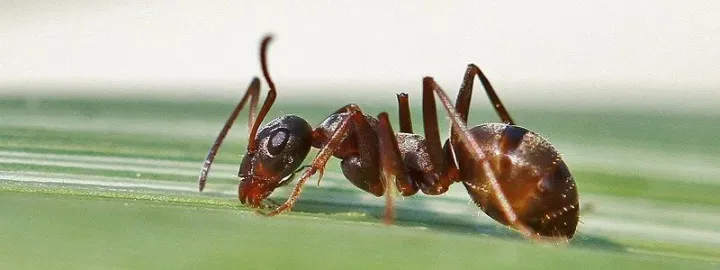
Description
How to identify
Ants (genus Formica) belong to the order Hymenoptera and the family Formicidae. They are eusocial insects that live in complex colonies consisting of a queen, workers, and males, each performing specific roles.
In gardening, the most common species belong to the genera Lasius and Formica. They build intricate nest systems, often underground or within rotting wood, which makes them highly resilient to environmental changes.
Physically, ants are easily identifiable by their narrow "waist" connecting the thorax and abdomen. They possess highly developed mouthparts and antennae, allowing them to communicate and coordinate effectively during foraging.
Their life cycle consists of four stages: egg, larva, pupa, and adult. The development process is entirely dependent on the colony's microclimate, which workers maintain with extreme precision within the nest.
Activity resumes after the winter months when soil temperatures rise sufficiently. Workers emerge to repair nests and scout for resources, marking the beginning of their seasonal activity in the garden.
What it damages
Ants do not typically consume plant tissue directly, but they cause severe indirect damage through their symbiotic relationship with aphids. They actively protect aphid colonies from natural predators like ladybugs.
In exchange for protection, ants harvest the honeydew secreted by aphids. This interaction leads to rapid aphid reproduction, which severely weakens plants by depriving them of sap and nutrients.
Construction of ant nests often damages root systems, particularly in young seedlings or container plants. These tunnels create air pockets around roots, leading to dehydration and nutrient deficiencies.
Ants also cause direct damage to various berries, such as strawberries, by feeding on the soft, ripening flesh. Furthermore, they frequently visit floral buds, which can lead to bud drop or deformation.
They act as carriers for plant pathogens, including fungi and bacteria, which can be easily transported on their bodies from diseased to healthy plants, potentially causing widespread outbreaks.
When it appears
Ant activity typically begins in early spring, as soon as the soil starts to warm up. They appear in search of food sources and building materials to expand their existing nest colonies.
The peak of their activity occurs in late spring and early summer, correlating with the explosion of aphid populations on young plant shoots. This is the period when ants are most visible and aggressive.
During the summer months, ants continuously forage and defend their territory. Their activity often becomes more noticeable in hot, dry weather as they seek out moisture and sugar sources on plants.
As temperatures begin to drop in autumn, their foraging activity slows down. The colony shifts its focus toward preparing the nest for winter by sealing entrances and relocating deeper into the soil.
Winter is spent in a state of diapause, a period of reduced metabolic activity where the colony remains dormant deep underground until conditions become favorable again in the following spring.
Signs of infestation
The most common sign of an ant infestation is the presence of consistent trails of ants moving along stems, branches, or near the base of garden plants. These trails often lead directly to aphid-infested areas.
Mounds of loose soil or small holes in the ground are clear indicators of subterranean nests. These are often situated near the roots of trees or shrubs, which can cause visible stress to the plants.
Curled, yellowing, or distorted leaves are signs of aphid infestation. If ants are present on these leaves, it confirms that the aphids are being protected, preventing natural biological control.
Sticky honeydew residues found on leaves and surrounding surfaces are another symptom. This sugary substance is produced by aphids and is a primary magnet for ants and sooty mold.
- Well-defined ant trails on walls, paths, or soil.
- Signs of plant wilting near suspected nest locations.
- Hollowed-out patches on soft fruits like strawberries or raspberries.
Control measures
Successful ant control requires a two-pronged approach: managing the aphid population to remove the ant's food source and targeting the nest to reduce the overall colony size.
Sticky traps or adhesive barriers placed around tree trunks act as effective mechanical deterrents, preventing ants from reaching the canopy where they protect aphid colonies.
For persistent infestations, bait stations containing slow-acting insecticides are highly effective. Workers carry the bait back to the nest, allowing the poison to reach the queen and eliminate the entire colony.
Regular cultivation of soil, including hoeing and turning, disrupts ant nest architecture. This physical disturbance forces the colony to relocate or depletes their resources, reducing their impact on plants.
Incorporating repellent plants such as lavender, peppermint, or tansy into the garden landscape can help create an environment that ants find less attractive, serving as a natural preventative measure.
Taxonomy
- Latin name
- Formica
- Order
- Hymenoptera
- Family
- Formicidae
- EPPO code
- FORMSP
Discussion
No discussions yet — be the first.