
Dorymyrmex insanus
Dorymyrmex insanus
Description
How to identify
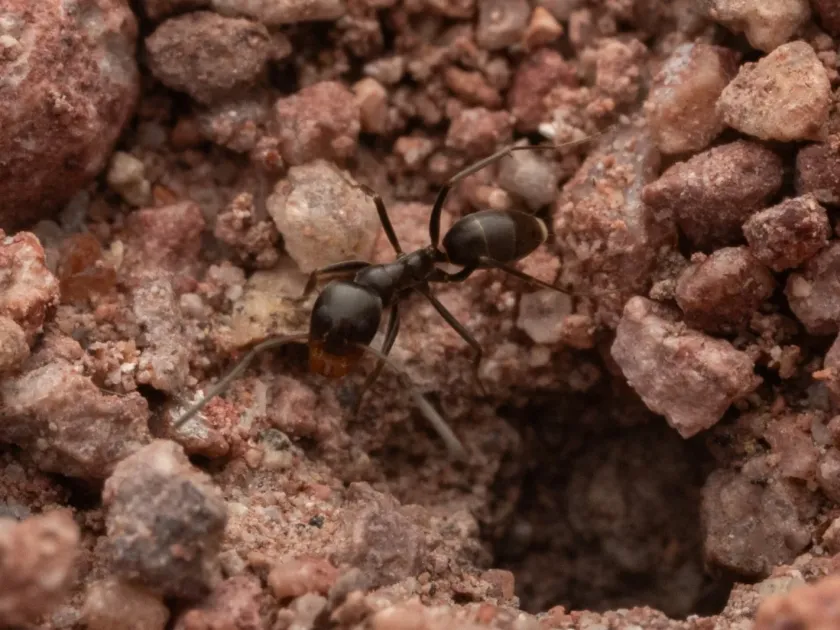
Dorymyrmex insanus, commonly known as the insane ant, is a small species of ant in the subfamily Dolichoderinae, noted for its characteristic erratic and hyperactive movement patterns.
This species belongs to the Formicidae family and is widely distributed in arid and semi-arid regions, where it thrives in open, sunny, and dry soil conditions.
Adult workers are typically slender with coloration ranging from pale yellowish-brown to dark brown, and they possess a well-developed anal gland used for chemical signaling.
They are highly aggressive towards other ant species, often displacing native populations to take control of territories that include potential food sources.
Identification is best achieved by observing their erratic "insane" running behavior and their tendency to build craters or mounds in open ground around cultivated plants.
What it damages
The primary agricultural impact of Dorymyrmex insanus is not direct consumption of plant tissues, but their sophisticated "farming" of sap-sucking insects such as aphids, scales, and mealybugs.
By protecting these pests from natural predators like ladybugs and lacewings, the ants cause aphid populations to explode, leading to severe plant damage.
Infested plants suffer from stunted growth, leaf curling, and yellowing, as the massive number of sucking insects depletes the plant's nutrient reserves.
Their nest-building activities frequently disrupt the root zone of crops, causing soil aeration that leads to rapid desiccation and root damage, particularly in young seedlings.
In cases of severe infestation, the accumulation of honeydew produced by the aphids promotes the growth of sooty mold, which further interferes with plant photosynthesis.
When it appears
Dorymyrmex insanus activity is strictly correlated with temperature; they are most active during the warmer months when the soil is dry and well-heated by the sun.
In spring, as temperatures consistently rise above 15°C, workers become visible on the surface, initiating foraging activities and colony maintenance.
The peak of their seasonal activity occurs during the height of summer, which coincides with the maximum population growth of the aphids they tend.
As autumn approaches and temperatures drop, foraging activity decreases significantly, and the ants retreat to deeper soil levels for winter hibernation.
In regions with year-round mild climates, these ants may remain active during the entire growing season, continuously impacting horticultural production.
Signs of infestation
A primary sign of infestation is a sudden, unexplained increase in aphid or scale populations on young shoots or the undersides of leaves.
Observers will notice frantic, disorganized ant trails moving between these sucking pest colonies and their nearby ground nests.
The presence of fine, crater-like soil mounds at the base of stems or around the root zones of plants is a clear indicator of a resident ant colony.
Sticky honeydew residue on foliage, often accompanied by a black, soot-like fungal growth, confirms that the sap-sucking insects are being farmed by the ants.
The sudden death or wilting of seedlings, often caused by nest-related root disturbance, is another frequent sign of their presence in vegetable or nursery plots.
Control measures
Management of Dorymyrmex insanus requires an integrated approach that targets both the ants themselves and the populations of sap-sucking insects they protect.
- Application of slow-acting insecticidal baits that foragers carry back to the colony to eliminate the queen.
- Control of aphid populations using contact insecticides or systemic products to starve the ants of their honeydew source.
- Use of sticky barriers or mechanical trunk wraps on fruit trees to prevent ant access to the canopy.
- Regular cultivation and tillage of the soil to disturb nest sites and disrupt colony development.
- Maintaining field hygiene by removing weeds that serve as alternative shelters for both ants and aphids.
Taxonomy
- Latin name
- Dorymyrmex insanus
- Order
- Hymenoptera
- Family
- Formicidae
- EPPO code
- DRMXIN
Discussion
No discussions yet — be the first.