
Dolichoderus bidens
Dolichoderus bidens
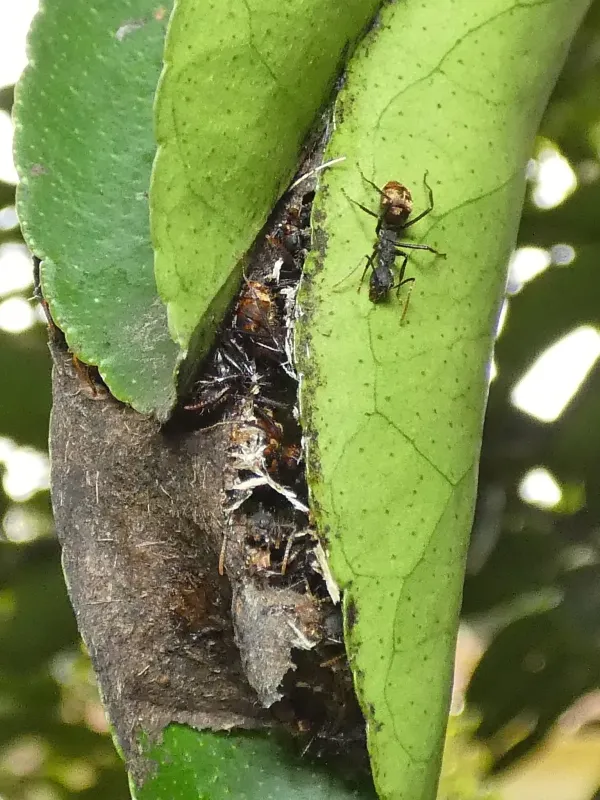
Description
How to identify
Dolichoderus bidens is a species of ant belonging to the subfamily Dolichoderinae. It is easily identified by the two distinct, backward-pointing, spine-like projections on its thorax, which give the species its name.
The adult ants have a smooth, shiny appearance with coloration ranging from dark brown to black. Workers are typically 4–6 mm long and exhibit high mobility on plant surfaces.
This species is well-known for building "carton" nests made from chewed plant fibers mixed with soil or fungi. These structures are often found attached to branches or tucked into hollows of trees.
While they lack a stinger, they possess functional anal glands that secrete defensive chemicals, which they use to protect their colony and territory from intruders.
Their social structure is highly organized, and they are frequently found in tropical and subtropical regions where they maintain stable and large-scale colonies.
What it damages
The primary damage caused by Dolichoderus bidens is indirect; they are well-documented for forming mutualistic relationships with sap-sucking insects like aphids, scales, and mealybugs.
By aggressively defending these honeydew-producing insects from natural predators like ladybugs and lacewings, the ants facilitate massive outbreaks of sucking pests on host plants.
The feeding activity of these protected pests leads to significant plant stress, characterized by stunted growth, leaf curling, and the deformation of young shoots and blossoms.
Furthermore, the ants themselves may damage delicate plant tissues, such as flower buds or young fruits, while foraging for sap, creating entry points for secondary fungal pathogens.
The heavy accumulation of honeydew secreted by the ants' partners leads to the growth of sooty mold, which blocks sunlight and interferes with the plant's photosynthetic efficiency.
When it appears
The activity of Dolichoderus bidens colonies is highly dependent on ambient temperature and moisture levels, generally remaining active throughout the growing season.
In tropical environments, they are active year-round, but colony expansion and nest construction typically peak during the wet season when host plant vigor is highest.
During periods of extreme drought or cold, the ants decrease their foraging activities, retreating deep into their nests to regulate the microclimate and protect the brood.
The dispersal of winged reproductives for the establishment of new colonies occurs during favorable climatic windows, ensuring the rapid spread of the species within the habitat.
Seasonal dynamics are also tightly linked to the life cycles of their symbiotic partners, as the ants actively manage the populations of aphids to ensure a constant supply of food.
Signs of infestation
The most common sign of infestation is the presence of distinct "ant trails" running along the bark of trees, leading to clusters of aphids or other sucking insects.
The detection of "carton" nests attached to tree forks or hidden under peeling bark is a definitive indicator of the presence of this specific ant species.
Sticky honeydew residues on the upper surfaces of leaves are a clear warning sign, often accompanied by the presence of sooty mold growth.
Plants affected by these ants typically show signs of severe chlorosis, leaf wilting, and a general decline in health due to the continuous sap extraction by associated pests.
When disturbed, the ants exhibit aggressive behavior, running rapidly across the plant surfaces, which makes them easy to spot during routine garden monitoring.
Control measures
The most effective strategy involves the physical removal and destruction of the carton nests found on trees, combined with a consistent pruning program for infested branches.
Control must focus on managing the populations of aphids and scale insects; removing the ants' food source makes the plants significantly less attractive to the colony.
Applying sticky glue bands to the trunks of trees creates a physical barrier that prevents ants from ascending the tree to tend to their sap-sucking "livestock."
Targeted use of contact insecticides at nest sites can be effective, though applications should be carefully timed to avoid harming beneficial pollinators and natural predators.
- Maintain good weed control around tree bases.
- Use biological control agents for sap-sucking pests.
- Regularly inspect trunks for bark damage and nest construction.
Taxonomy
- Latin name
- Dolichoderus bidens
- Order
- Hymenoptera
- Family
- Formicidae
- EPPO code
- DOLSBD
Discussion
No discussions yet — be the first.