
Acrobat ant
Crematogaster scutellaris
Description
How to identify
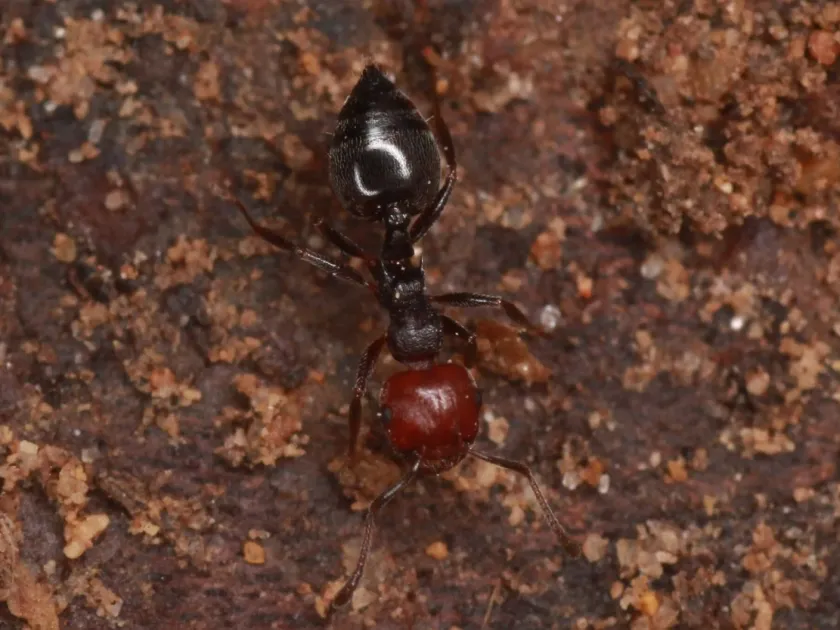
The acrobat ant (Crematogaster scutellaris) is a distinct species of ant, easily recognized by its shiny black abdomen and reddish-brown head and thorax.
Belonging to the family Formicidae (order Hymenoptera), these ants are famous for their defensive behavior of raising their heart-shaped abdomen over their thorax, hence the name "acrobat".
Workers are generally small, ranging from 3 to 5 mm, but the colony size can be quite large, leading to significant infestations in both gardens and wooden structures.
They prefer to nest in dry, decaying wood or inside pre-existing cavities, often taking advantage of trees that are already weakened by other environmental factors.
Their communication is highly effective, with workers establishing distinct chemical trails that can stretch long distances across tree trunks and branches.
What it damages
The primary agricultural damage caused by Crematogaster scutellaris is their mutualistic relationship with aphids and mealybugs, which they farm for honeydew.
By protecting these sap-sucking insects from natural predators, the ants facilitate massive infestations that cause wilting, leaf curling, and stunted growth in fruit trees.
Additionally, they physically damage the tree structure by excavating galleries in the bark and wood to build their nests, which compromises the tree's health.
These nesting sites can serve as entry points for pathogenic fungi and bacterial infections, leading to the rapid decay of the affected wood.
In orchards, this can result in significant yield losses, as the energy of the plant is redirected to support the infestation rather than the development of fruit.
When it appears
The activity period typically begins in the early spring as temperatures consistently remain above 12–15°C, triggering the colony to emerge and hunt.
During the summer months, the activity reaches its peak as the colony focuses on expanding, foraging, and tending to large populations of honeydew-producing insects.
In the autumn, as cooling weather arrives, the ants gradually reduce their foraging activity and focus on securing the colony for the winter months.
The reproductive cycle involving the mating flight of queens and males is synchronized with the warmer months to ensure successful establishment of new colonies.
In milder climates or urban environments with heat islands, they may remain active for extended periods, posing a year-round threat to susceptible trees.
Signs of infestation
A tell-tale sign of an infestation is the presence of consistent, dense lines of ants marching along the trunk or branches of a tree.
Observing large concentrations of aphids or mealybugs on young shoots, accompanied by active ant presence, is a strong indicator of this species.
The presence of fine wood dust or frass accumulating at the base of the tree is a clear symptom that the ants are nesting and excavating within the tree.
Bark lesions, small holes, or areas where the bark seems to be dying back are often located near the main nest entrance.
Visually checking for these signs during routine garden maintenance is essential for early intervention before the tree suffers significant damage.
Control measures
Applying sticky adhesive bands around the trunks of trees is a simple yet effective physical barrier that prevents the ants from accessing the crown.
The use of slow-acting gel baits is highly recommended, as the foraging ants carry the toxic substances back to the nest, successfully eliminating the queen.
Good orchard hygiene, such as removing dead or dying wood and sealing tree cavities, is crucial to eliminate nesting sites that attract these ants.
Simultaneous control of aphid populations is vital, as the reduction of their primary food source often encourages the ant colony to relocate elsewhere.
- Regular monitoring of tree bark during the growth season.
- Application of targeted insecticide sprays if the infestation is severe.
- Encouraging natural biological controls for aphids to limit the attractiveness of the tree.
Taxonomy
- Latin name
- Crematogaster scutellaris
- Order
- Hymenoptera
- Family
- Formicidae
- EPPO code
- CREMSC
Discussion
No discussions yet — be the first.