
Camponotus variegatus
Camponotus variegatus
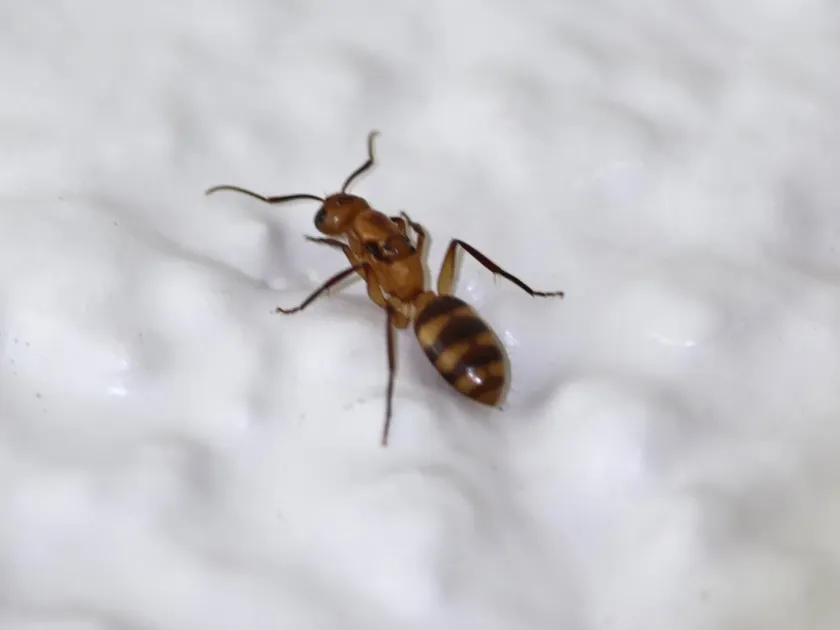
Description
How to identify
Camponotus variegatus is a member of the Formicidae family, order Hymenoptera. Often referred to as a type of carpenter ant, these insects are characterized by a mottled appearance, with colors ranging from yellowish-brown to dark brown, often featuring pale bands across the abdomen.
The species displays significant polymorphism, meaning workers vary greatly in size. You will observe both small foragers and large, intimidating soldiers that possess robust mandibles designed for defense and maintenance of the nest galleries.
Their head shape is typically broad and slightly heart-shaped. Unlike common ground-nesting ants, Camponotus variegatus thrives in arboreal environments, seeking out cavities within wood or behind thick bark to establish their colonies.
Queens of this species are substantial in size and are capable of founding colonies in both natural wood cavities and human-made structures, making them a nuisance for both orchards and wooden building components.
While they lack a stinger, they are capable of delivering a painful bite with their mandibles. When threatened, they may also spray formic acid into the wound, which causes immediate irritation and discomfort for those handling infested trees.
What it damages
Camponotus variegatus is recognized as a significant pest of fruit-bearing and ornamental trees. They are particularly attracted to weakened or decaying trees, frequently infesting citrus, mango, and litchi species in tropical and subtropical regions.
The primary damage is caused by the ants carving out extensive, interconnected galleries within the woody tissues of the tree. This structural damage weakens the branches, making them susceptible to wind breakage and reducing the overall structural integrity of the plant.
A major indirect threat is their mutualistic relationship with sap-sucking insects such as aphids, scales, and mealybugs. The ants protect these pests from natural predators to harvest the honeydew, leading to massive infestations that drain the tree of its vital sap.
The entry points and internal galleries created by the ants serve as infection sites for various wood-decaying fungi and bacterial pathogens. These secondary infections often prove to be more lethal to the tree than the physical tunneling itself.
In severe cases, the disruption of the vascular system prevents nutrients from reaching the foliage. This leads to the progressive yellowing, wilting, and eventual death of individual branches or the entire tree if the colony is large enough.
When it appears
The activity level of Camponotus variegatus is heavily influenced by temperature. In their native range, they are most active during the warmer months, showing peak foraging behavior from spring through late autumn.
During cooler periods, these ants typically retreat deeper into their wooden galleries, entering a state of semi-dormancy or significantly reduced activity. In tropical climates, they may remain active throughout the entire year.
They are primarily nocturnal or crepuscular foragers. It is most common to observe them moving in columns up and down tree trunks during the evening and night hours when temperatures are more favorable and they are less exposed to predators.
The mating flight (the dispersal of winged queens and males) usually occurs during periods of high humidity and stable temperatures. This is a critical time for colony expansion and the establishment of new infestations in neighboring trees.
During the dry season, the need for sugar sources and hydration often drives the ants to become more aggressive, leading to increased activity on the leaves and fruit, where they harvest honeydew from sap-sucking pests.
Signs of infestation
The most reliable sign of an infestation is the presence of fine sawdust, or "frass," found at the base of the tree or tucked into bark crevices. This material is expelled by the ants as they hollow out their internal nesting galleries.
Visible trails of ants consistently traversing the same paths up the trunk indicate a established colony is using the tree as a foraging hub. These lines of ants are often most visible during the evening hours.
A massive, unnatural density of aphids or scale insects on young shoots without the presence of beneficial ladybugs suggests that the sap-suckers are being actively tended and protected by a nearby ant colony.
If you tap the trunk of a suspected tree and hear a hollow or dull sound, it often indicates the presence of large internal voids created by carpenter ant activity, suggesting an advanced state of wood degradation.
Small, circular exit holes in the bark or around branch junctions are clear indicators of entry and exit points used by the worker ants, confirming that the tree is currently serving as a nest site.
Control measures
Effective management of Camponotus variegatus requires an integrated approach. The use of slow-acting gel baits is highly effective, as foragers carry the insecticide back to the nest, ultimately eliminating the queen and the entire colony.
To protect individual trees, install sticky barriers or bands around the trunk. These physical traps prevent the ants from ascending to the canopy, effectively cutting them off from their food source and the sap-sucking pests they protect.
Sanitation is crucial; remove dead wood, prune severely infested branches, and clear away moss or lichen that provides shelter for the ants. Reducing the tree's overall susceptibility to wood-boring insects is the best long-term strategy.
Control of aphids, scales, and mealybugs is mandatory. By removing the source of honeydew, you reduce the tree's attractiveness to the ants, making the environment much less hospitable for colony maintenance.
- Application of systemic insecticides to the soil around the base of the tree.
- Night-time spray applications of contact insecticides on the trunk.
- Consistent pruning to improve airflow and reduce nesting opportunities.
Taxonomy
- Latin name
- Camponotus variegatus
- Order
- Hymenoptera
- Family
- Formicidae
- EPPO code
- CAMOVA
Discussion
No discussions yet — be the first.