
Black carpenter ant
Camponotus vagus
Description
How to identify
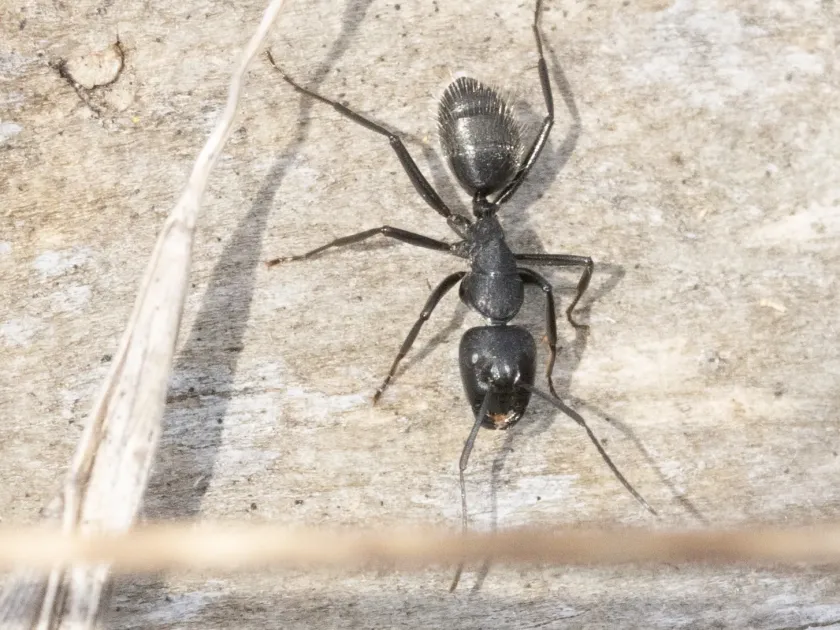
The black carpenter ant (Camponotus vagus) is a prominent member of the Formicidae family. It is recognized as one of the largest ant species in Europe, distinguished by its matte-black coloration and dense, fine hairs covering its body.
Worker ants display polymorphism, with sizes ranging from 6 to 12 mm. They are equipped with powerful mandibles that allow them to effectively excavate galleries within wood. The queen is considerably larger, often reaching 14–16 mm in length.
The colony structure is complex, often consisting of thousands of individuals. Development involves four stages: egg, larva, pupa, and adult. The entire cycle, under favorable conditions, typically takes around two months to complete.
These ants are thermophilic, meaning they favor warm environments. They do not feed on wood but rather excavate it to establish nesting sites, which is why they are frequently found in sunny orchard areas or near decaying wood sources.
Colony expansion typically begins after a nuptial flight, where a newly mated queen seeks out an appropriate site in damaged or rotting wood to start a new generation, often near human-cultivated landscapes.
What it damages
Black carpenter ants primarily target fruit trees such as apple, pear, cherry, and plum. While they do not digest cellulose, their nesting activities involve creating extensive tunnels that compromise the structural integrity of the tree.
The excavation of galleries disrupts the sapwood and the transport of nutrients within the tree. Over time, this leads to the weakening of the tree, reduced fruit yields, and increased susceptibility to fungal diseases and wind damage.
A significant secondary form of damage is the ants' symbiotic relationship with aphids. The ants protect and farm aphid colonies, which in turn feed on the tree's sap, further stressing the plant and covering leaves with honeydew.
The resulting honeydew accumulation often leads to the growth of sooty mold, which impairs photosynthesis. This combination of structural damage and physiological stress significantly shortens the lifespan of the affected trees.
If left unchecked, a large colony can render a tree hollow or structurally unstable, making it a liability in an orchard setting and potentially causing the total loss of the specimen over several seasons.
When it appears
Activity begins in early spring, as temperatures rise and the trees become metabolically active. Ants emerge from their overwintering sites within the wood or soil to begin foraging and colony maintenance.
During the summer months, activity peaks as the colony expands and larvae are reared. This is when workers are most frequently seen traversing tree trunks and branches in search of food sources, including aphid colonies.
The nuptial flight, essential for the dispersal of the species, typically occurs in late spring or early summer. This period allows young queens to leave the parent nest and find suitable locations to establish new colonies.
As autumn temperatures begin to drop, the ants gradually reduce their surface activity. They move deeper into the tree or into underground chambers to prepare for the dormant winter period, known as diapause.
During winter, the colony remains inactive within its galleries. While they can survive cold temperatures, their development ceases entirely until the return of warmer conditions in the following spring.
Signs of infestation
A primary indicator of infestation is the presence of coarse sawdust or wood shavings at the base of a tree. This material is discarded by the ants as they clear out galleries inside the wood.
Small, circular entry holes in the bark may be visible where ants enter and exit the nest. Occasionally, one can hear a faint rustling or crackling sound emanating from inside the trunk, indicating a high density of ant activity.
Ant trails leading from the base of the tree up to the canopy are another telltale sign. These trails are usually established to reach aphid colonies, which the ants rely on for their carbohydrate-rich food supply.
Visual signs of tree health decline, such as patches of dead bark, deep cracks, or soft, spongy areas on the trunk, often indicate the initial entry point where the queen or workers first breached the tree's defenses.
If the tree's structural health appears compromised in specific sections, it is advisable to check for hollow sounds by tapping the bark, as this often reveals the extent of the gallery system inside.
Control measures
The most effective management approach is good orchard hygiene. This includes removing dead or decaying branches and pruning damaged wood, which are the primary sites favored by carpenter ants for nesting.
Applying sticky barriers or specialized glue bands around the trunks of trees can effectively disrupt the ants' access to the canopy, thereby preventing them from tending to aphid colonies and further protecting the tree.
If a nest is confirmed inside a tree, targeted applications of insecticide gels or aerosols into the entry holes can kill the colony. It is important to use products that are safe for trees and effective at reaching deep galleries.
Controlling aphid populations is essential. Using systemic insecticides to eliminate aphids removes the ants' food source, which typically leads to a significant reduction in ant traffic and colony growth.
In cases of existing hollows, filling cavities with tree surgery sealant or cement-based compounds can seal off the nest, preventing further infestation and protecting the interior wood from moisture and pests.
Taxonomy
- Latin name
- Camponotus vagus
- Order
- Hymenoptera
- Family
- Formicidae
- EPPO code
- CAMOVG
Discussion
No discussions yet — be the first.