
Silky tree ant
Camponotus sericeus
Description
How to identify
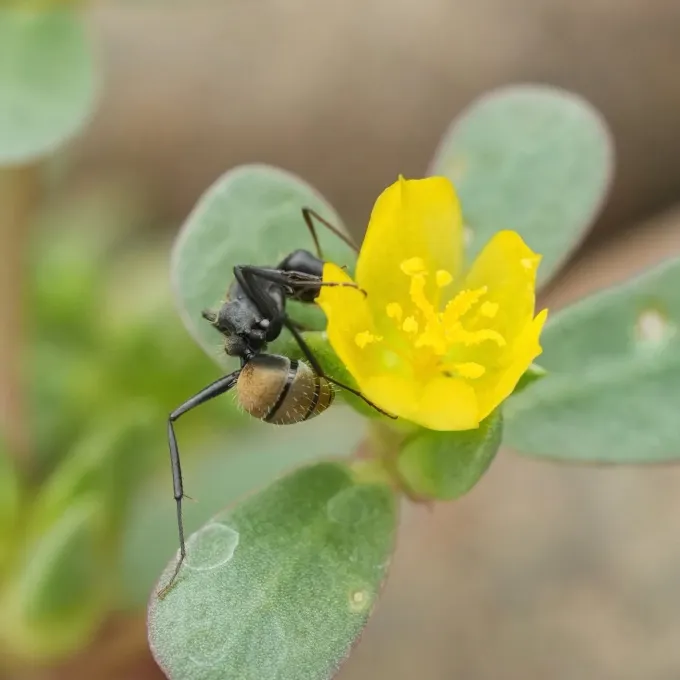
The silky tree ant (Camponotus sericeus) belongs to the Hymenoptera order and the Formicidae family. It is easily recognized by the dense, silky golden or silver pubescence covering its gaster.
Workers are medium-sized with a predominantly black body color. Their heads are large and robust, equipped with powerful mandibles capable of excavating wood.
These ants are generally semi-arboreal, frequently choosing decayed or dry sections of trees to establish their complex gallery systems.
The species biology is highly adapted to tropical and subtropical climates, where they exhibit significant foraging activity both on the ground and in the canopy.
Colonies function with a strict division of labor, ensuring the continuous growth and maintenance of their internal wooden nests.
What it damages
The primary damage is caused by the excavation of wood, which creates hollow spaces inside trunks and branches, compromising the plant's structural integrity.
They infest various fruit trees, ornamental shrubs, and forest species, often targeting those that are already weakened or damaged by other environmental stressors.
While the ants do not ingest the wood as food, their galleries facilitate the entry of fungal pathogens and wood-boring insects, accelerating tree decay.
The ants maintain a symbiotic relationship with honeydew-secreting insects such as aphids, protecting them and thus causing secondary damage to the plant's foliage.
Ongoing infestations lead to reduced sap flow, stunted shoot growth, and an overall decrease in the plant's long-term vitality and fruit yield.
Signs of infestation
The most evident sign of infestation is the presence of fine sawdust or wood shavings accumulation at the base of the tree or in branch crevices.
Visual observation of ant trails running along the bark, moving between their nesting holes and the leafy canopy, is a reliable indicator of activity.
The presence of dense aphid colonies on young leaves, which are actively tended by ants, suggests a strong protective presence of Camponotus sericeus.
Hollow sounds emitted when tapping the bark of an affected tree indicate the existence of internal galleries created by the ant colony.
The distinct shimmery appearance of the ants, caused by their body hair, makes them easy to distinguish from other common black ant species in the garden.
Control measures
Management begins with cultural practices, such as pruning away dead, rotting, or infested limbs to remove suitable nesting sites for the colony.
Using slow-acting toxic baits or gels is the most effective chemical method, as foragers carry the insecticide back to the queen and the brood.
Installing sticky bands on the trunks serves as a physical barrier, preventing ants from reaching the canopy to manage their aphid populations.
Regular maintenance of plant health reduces the risk of initial colonization, as ants are more likely to target trees with existing decay.
Chemical applications should be applied precisely to nesting sites or along major foraging trails, ensuring minimal impact on non-target beneficial species.
Taxonomy
- Latin name
- Camponotus sericeus
- Order
- Hymenoptera
- Family
- Formicidae
- EPPO code
- CAMOSE
Discussion
No discussions yet — be the first.