
Camponotus rufipes
Camponotus rufipes
Description
How to identify
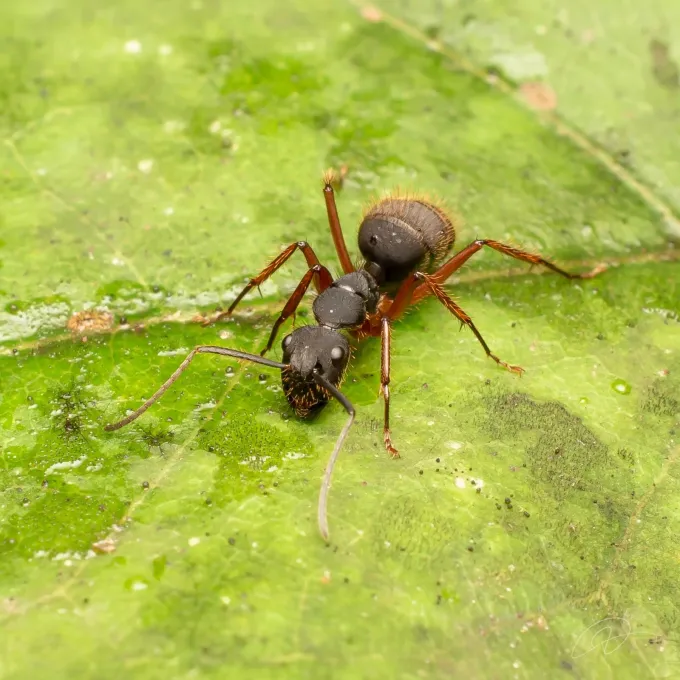
Camponotus rufipes belongs to the order Hymenoptera and the family Formicidae. These ants are recognizable by their large size, reddish-brown limbs, and dark, almost black abdomens.
Worker ants exhibit significant polymorphism, meaning individuals within the same colony can vary greatly in size. Their heads are large and equipped with strong mandibles, which are used for both defense and carrying objects.
The body structure follows the typical Camponotus pattern: the thorax profile is smooth without prominent spines. The body has a characteristic sheen, making it distinct from many other ant species encountered in the field.
These ants typically build nests in decaying wood, soil, or under stones, often incorporating plant debris to stabilize their environment. They maintain highly complex social structures with clear task specialization.
Native to South America, this species has successfully adapted to various environments, including agricultural areas, where they can become notable inhabitants and significant pests in managed landscapes.
What it damages
The damage caused by Camponotus rufipes is primarily indirect; they are well-known for their mutualistic relationship with aphids, scale insects, and other sap-sucking pests, which they protect in exchange for honeydew.
The protection provided by the ants leads to a massive increase in sap-sucking insect populations. This results in plant stunted growth, leaf curling, and overall reduction in crop yields.
Additionally, the ants may cause physical damage to young buds, shoots, and tree bark while foraging or expanding their nests. This damage often serves as an entry point for various fungal and bacterial infections.
Crops most susceptible include citrus trees, coffee plants, berry bushes, and various ornamentals. In nursery settings, a large colony can significantly suppress the development of young seedlings.
Furthermore, these ants act as vectors for plant viruses, transferring pathogens between infested and healthy plant tissues as they move colonies of aphids or forage across the garden.
When it appears
The activity of Camponotus rufipes is highly dependent on environmental temperature and humidity, with peak activity occurring during the warmer spring and summer months.
In spring, as plants begin their active growth, the ants become particularly aggressive, focusing their efforts on providing aphids with access to fresh sap on new plant shoots.
During the summer, the ants expand their foraging routes significantly. In periods of drought, they may relocate closer to irrigated areas, inadvertently causing damage to agricultural crops.
As autumn approaches, activity levels begin to decrease, but the ants remain busy preparing for winter by moving aphid eggs to protected overwintering sites, often near plant roots.
Overwintering occurs within deep sections of the nest, where stable temperatures allow the colony to survive harsh conditions and emerge strong at the beginning of the next growing season.
Signs of infestation
The primary sign of an infestation is the presence of dense ant trails moving along tree trunks or plant stems, which clearly indicates their efforts to tend to aphid colonies.
A high concentration of sap-sucking insects (such as aphids or scale) on the tips of shoots is a secondary, yet critical indicator that a colony is active in the immediate vicinity.
Visual inspection often reveals the presence of honeydew—a sticky, sugary substance that eventually becomes a breeding ground for sooty mold, appearing as black patches on leaves.
Mechanical damage caused by the ants on bark or tender stems often appears as small ragged edges or entry holes. In some cases, shoot wilting is observed, indicating damage to the plant's vascular tissue.
Ant nests can be located by looking for soil mounds near the base of shrubs or trees, often accompanied by heightened ant activity within the soil substrate.
Control measures
Controlling this species requires an integrated approach that targets both the ant colony itself and the sap-sucking insects that attract them to the plants.
- Installing sticky barriers on tree trunks to prevent ants from reaching the canopy and tending to aphids.
- Applying targeted insecticidal baits in gel or granule form, which the workers will carry back to the queen and larvae.
- Using systemic insecticides to reduce aphid populations, thereby removing the food source that attracts the ants.
- Mechanical nest destruction and the use of natural barriers, such as diatomaceous earth, around the base of the plants.
Good agricultural practices, including regular weed management and pruning of infected branches, are essential to minimize the surfaces available for ants to traverse.
Biological control methods include encouraging natural predators, such as ladybugs and lacewings, which prey on aphids and reduce the ants' incentive to inhabit the plants.
Taxonomy
- Latin name
- Camponotus rufipes
- Order
- Hymenoptera
- Family
- Formicidae
- EPPO code
- CAMORU
Discussion
No discussions yet — be the first.