
Carpenter ant
Camponotus pennsylvanicus
Description
How to identify
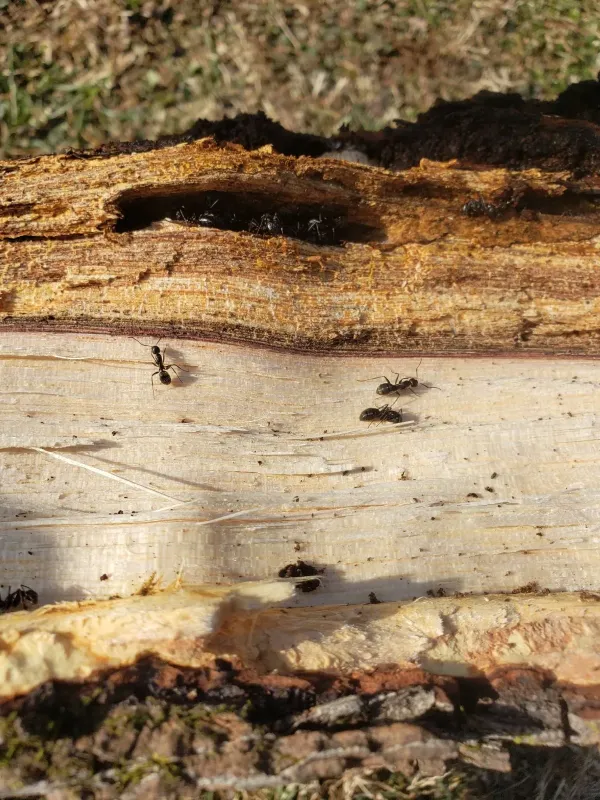
The black carpenter ant (Camponotus pennsylvanicus) belongs to the family Formicidae, order Hymenoptera. They are among the largest ants, with workers measuring between 6 and 13 mm in length.
Their bodies are typically black or dark brown with a dull appearance. Unlike some other insects, they do not possess stingers, but they can bite quite painfully when defending their nests.
The life cycle involves complete metamorphosis, consisting of the egg, larva, pupa, and adult stages. Colonies are initiated by a single queen in moisture-damaged or decaying wood.
These ants are primarily nocturnal, emerging at night to forage for food. They often establish long, winding trails between their nest site and their food sources, such as aphids or tree sap.
A key biological trait is their ability to establish satellite nests, which allows the colony to rapidly expand its presence across a wider area within the orchard or garden.
What it damages
Carpenter ants primarily attack hardwood trees, including oak, maple, poplar, and apple. They prefer trees that are already weakened by disease, moisture, or structural damage.
The damage is caused by the ants excavating galleries in the wood to create nesting chambers. This process does not involve consuming the wood, but it weakens the internal structure of the tree.
These excavated galleries often serve as entry points for fungi, bacteria, and secondary pests, which can accelerate the structural failure and decline of the tree.
In mature trees, extensive internal tunneling can lead to structural instability, significantly increasing the risk of wind damage and branch breakage.
Furthermore, their symbiotic relationship with aphids often exacerbates the damage to crops, as they protect aphids from predators, leading to increased sap-sucking activity on young growth.
Signs of infestation
The most visible sign of an infestation is the presence of frass — a mixture of wood shavings and debris — pushed out of the galleries and accumulating at the base of the tree.
Tapping on the trunk of a suspected infested tree often produces a hollow sound, indicating that the inner wood has been replaced by a network of galleries.
Observing activity on the tree trunk during dusk or night provides visual confirmation of the ant trails leading to the nesting sites.
An abundance of aphids on the foliage and branches is a strong indicator that carpenter ants may be actively tending to them for honeydew production.
Small exit or ventilation holes found in the bark are clear indications that a colony has successfully established a nesting site inside the tree.
Control measures
Effective management begins with proper garden hygiene, which includes the removal of dead, rotting, or severely damaged wood that serves as an ideal nest environment.
It is essential to seal tree wounds and cracks with appropriate pruning sealants to prevent moisture ingress and entry points for potential colonization.
The application of slow-acting toxic bait stations is one of the most efficient methods, as workers carry the poisoned food back to the queen and the brood.
Maintaining a proactive aphid control program helps eliminate a major food source, forcing the ants to look for alternative habitats outside of your garden area.
In cases of severe infestation within high-value landscape trees, direct injection of insecticide into identified galleries can be performed to stop the colony's growth.
Taxonomy
- Latin name
- Camponotus pennsylvanicus
- Order
- Hymenoptera
- Family
- Formicidae
- EPPO code
- CAMOPE
Discussion
No discussions yet — be the first.