
New York carpenter ant
Camponotus novaeboracensis
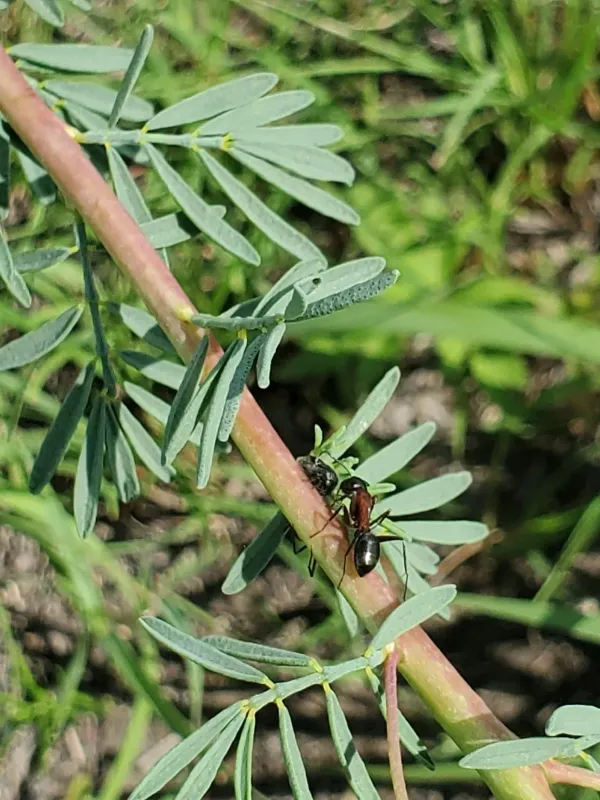
Description
How to identify
The New York carpenter ant (Camponotus novaeboracensis) is a member of the Formicidae family. Workers typically range from 6 to 13 mm in length, while the queen is substantially larger.
Their bodies exhibit a range of colors from dark brown to black, with the thorax and legs often displaying a distinctive reddish-brown tone. A thick covering of golden or yellowish hairs on the abdomen distinguishes them from related species.
These ants are highly social insects that form complex colonies with a sophisticated caste system. Colonies often feature polygyny, meaning multiple queens can reside in a single nest, which increases the colony's capacity for rapid expansion.
They naturally favor moist woodland habitats, where they establish nests in various types of wood, especially logs or trees in varying stages of decay. Their adaptability allows them to thrive in human-altered landscapes as well.
Equipped with powerful mandibles, these ants are capable of excavating wood to build galleries for their brood. This mechanical excavation is what causes structural issues for host trees over time.
What it damages
This pest affects a wide range of hardwood trees, including maples, poplars, and various orchard species. Infestations are most common in trees that already possess damaged bark, hollows, or localized areas of fungal decay.
It is important to note that carpenter ants do not feed on the wood; they consume other insects and sugary substances. The wood is excavated solely to provide a protected environment for the colony to develop.
The presence of carpenter ants significantly weakens the tree's structural integrity. As galleries expand, the internal support of the tree trunk is lost, increasing the risk of breakage during storms or high winds.
Beyond structural damage, the ants accelerate the decline of the tree by creating entry points for secondary pathogens, such as wood-decaying fungi and bacteria, which further degrade the interior timber.
In ornamental and orchard settings, severe infestations can lead to canopy thinning, reduced fruit yields, and the eventual death of the tree if the damage reaches the cambium layer or heartwood.
Signs of infestation
The most telltale sign of an infestation is the presence of "frass" near the tree base. Frass looks like coarse sawdust and consists of wood shavings and insect debris pushed out of the galleries by workers.
Visual inspection often reveals small, smooth entrance holes in the bark or near pruning scars. Tapping the trunk with a hammer can produce a hollow sound in areas where extensive internal excavation has occurred.
During the warmer months, you may observe high activity levels of worker ants on the bark. They often follow specific pheromone trails moving between their nests and sources of food, such as aphid colonies.
Early signs of stress, such as yellowing leaves or dieback of specific branches, may indicate that an internal colony has compromised the tree's vascular system, preventing proper nutrient transport.
In quiet conditions during late spring or summer, you might hear a faint scratching or rustling sound coming from deep within the tree trunk, caused by thousands of ants moving within the galleries.
Control measures
Good cultural practices are the first line of defense. Keeping trees healthy, removing dead wood, and properly pruning damaged branches minimizes the attractive sites for carpenter ant colonization.
If an infestation is discovered, inject liquid or aerosol insecticides directly into the gallery openings using an extension nozzle to reach deep into the nest, ensuring direct contact with the ants.
The use of slow-acting toxic bait stations is highly effective. Workers carry the bait back to the nest, sharing it with the queen and larvae, which eventually leads to the elimination of the entire colony.
Applying sticky barriers or insecticide-treated bands around the base of the trunk can prevent ants from foraging in the canopy, effectively cutting off their access to their primary food source, the aphids.
For trees that have sustained critical structural damage, total removal is the only safe solution. It is vital to dispose of the infested wood properly to prevent the colony from simply relocating to adjacent trees.
Taxonomy
- Latin name
- Camponotus novaeboracensis
- Order
- Hymenoptera
- Family
- Formicidae
- EPPO code
- CAMONO
Discussion
No discussions yet — be the first.