
Carpenter ant
Camponotus ligniperda
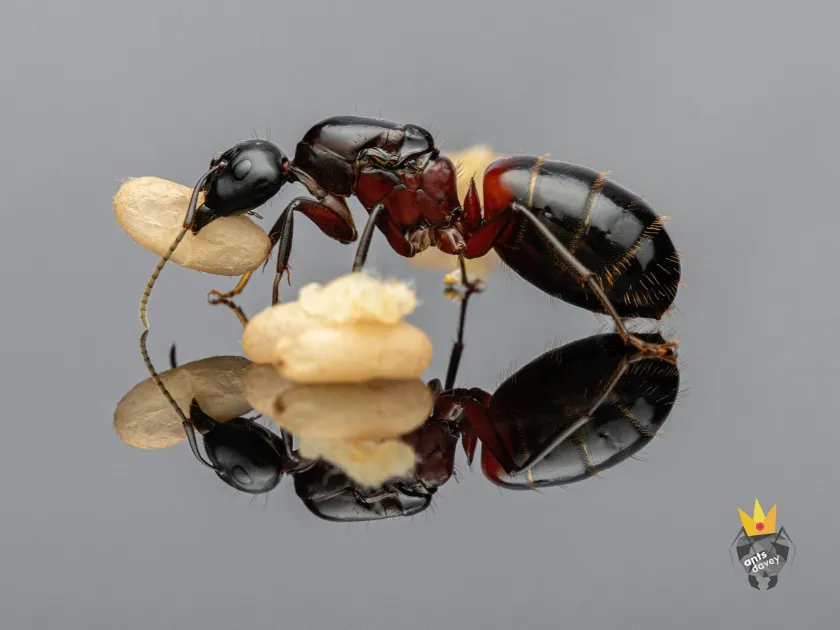
Description
How to identify
The carpenter ant, specifically Camponotus ligniperda, is one of the largest ant species found throughout Europe, with workers measuring between 6 and 14 mm.
The species is easily recognized by its distinct appearance: a dark head and abdomen, combined with a reddish-orange thorax. Their bodies are covered in scattered, coarse hairs.
Taxonomically, they belong to the order Hymenoptera and the family Formicidae. They are well-known for their preference for nesting in woody substrates.
The workers do not have sharp spines on their thorax; instead, it is smoothly rounded, which is a key morphological feature for field identification.
A single colony can house several thousand individuals that work in a highly organized manner to expand their extensive galleries within timber or live trees.
What it damages
Carpenter ants are serious pests of orchard trees, including apple, pear, and plum varieties, where they tunnel into healthy or partially decayed wood.
They do not consume wood as a food source; instead, they remove it to create living chambers, which severely compromises the structural integrity of the tree's trunk and limbs.
The tunnels facilitate the entry of moisture and wood-decaying fungi, leading to accelerated rotting and weakening of the plant's vascular system.
As the galleries grow, trees become highly susceptible to wind-breakage. Furthermore, the overall health of the tree declines, leading to reduced fruit yields and premature death.
Additionally, carpenter ants foster aphid populations on tender shoots, providing protection to these sap-sucking pests in exchange for honeydew, which stunts tree growth.
When it appears
Activity typically begins in early spring as temperatures rise, signaling the colony to emerge from their winter dormancy to resume feeding and foraging.
The peak of their seasonal activity occurs during the warmer summer months (June to August), when the colony invests energy into expanding their nest galleries.
As autumn progresses and temperatures fall, the ants reduce their foraging activity and withdraw deeper into the protective galleries within the wood.
The winter months are spent in a state of diapause inside the nest, utilizing the thermal insulation provided by the wood to survive freezing ambient temperatures.
The cycle repeats each year, with established colonies showing increasing signs of growth as the number of workers and the complexity of the internal tunnels increase.
Signs of infestation
The most tell-tale sign of a carpenter ant infestation is the presence of "frass"—a coarse, sawdust-like material pushed out of holes in the bark or found near the tree base.
Tapping on the trunk of an infested tree often produces a hollow sound, indicating that significant portions of the internal wood have been excavated.
Visible trails of ants moving up and down the trunk, particularly during evening or night hours, strongly suggest that a nest is present within the tree or a nearby structure.
The presence of large aphid clusters on leaves, accompanied by constant ant traffic, is a clear indicator of the symbiotic relationship between the ants and the plant-sucking insects.
Small, slit-like entry holes in the bark or wood, sometimes accompanied by shed wings from reproductive swarmers during spring, are definitive signs of an active colony.
Control measures
Sanitation is the most effective preventative measure; removing dead or decaying wood, stumps, and hollow branches drastically reduces suitable nesting sites.
Applying sticky adhesive barriers to the trunks of fruit trees is a simple, non-chemical way to prevent foraging workers from accessing the upper canopy.
For established infestations, slow-acting bait stations containing specialized insecticides are highly effective, as foragers carry the poison back to the nest to eliminate the queen.
Maintaining tree health through proper pruning and sealing pruning wounds with high-quality horticultural sealants prevents ants from finding easy entry points into the wood.
Targeted application of insecticides to the soil surrounding the base of infested trees during the peak season can help manage and reduce the size of the worker population.
Taxonomy
- Latin name
- Camponotus ligniperda
- Order
- Hymenoptera
- Family
- Formicidae
- EPPO code
- CAMOLI
Discussion
No discussions yet — be the first.