
Smooth carpenter ant
Camponotus laevigatus
Description
How to identify
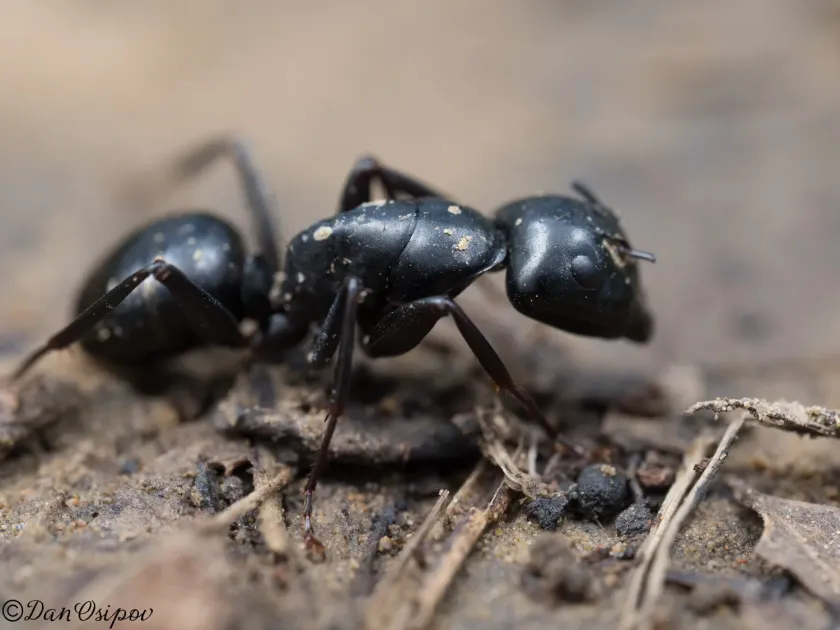
The smooth carpenter ant, scientifically known as Camponotus laevigatus, belongs to the Formicidae family. These ants are among the largest in their genus, with workers often reaching 10–12 mm in length.
They are distinguished by their black, somewhat shiny or smooth body, which lacks dense hair, giving them a sleek appearance compared to other local species.
The head is large and strong, equipped with powerful mandibles designed for excavating wood. Their long, robust legs allow for efficient movement across rough bark surfaces.
These ants are highly social insects that live in colonies characterized by a complex caste system, including workers, soldiers, and a queen.
They prefer to nest in wood, often choosing dead or decaying portions of standing trees to establish their elaborate galleries.
What it damages
The primary damage caused by Camponotus laevigatus is the structural weakening of trees. By carving out extensive tunnels, they disrupt the sapwood and vascular tissue.
While they do not eat the wood, their excavation creates large, hollowed-out chambers, which make trees highly susceptible to wind-throw and mechanical breakage.
These ants often farm aphids, protecting them from predators in exchange for honeydew, which leads to secondary damage on leaves and young shoots of host trees.
The tunnels created by the ants act as entry points for pathogens, such as fungi and bacteria, which can accelerate the decay of the tree's internal structure.
In ornamental or fruit orchards, a severe infestation can eventually lead to the loss of tree vigor and, in time, the premature death of the affected plant.
When it appears
The activity cycle of the smooth carpenter ant starts in early spring when temperatures begin to rise. Workers emerge to forage and expand their colony's reach.
Summer is the peak period for activity. Colonies are most productive during these months, focusing on nest maintenance and the care of larvae.
As autumn approaches and temperatures drop, foraging activity decreases significantly as the ants prepare for the winter months.
During the winter, the entire colony remains inside the wooden galleries, where the depth of the nest provides insulation from external cold temperatures.
A single colony can inhabit a tree for many years, progressively increasing the size of their nest as the population expands over several seasons.
Signs of infestation
The most telltale sign of an infestation is the presence of frass — a fine, sawdust-like material ejected by the ants from their tunnels, found at the base of the tree.
A hollow sound when striking the trunk suggests that the internal wood has been severely compromised by the ants' nest construction.
One may observe small, circular holes in the bark, which serve as the primary access points for workers moving between the interior nest and the outside world.
Frequent movement of large, dark-colored ants along branches, especially near aphid colonies, strongly indicates that a nest is nearby.
Visible sap leaks or bleeding from the bark can also occur as a reaction to the physical trauma inflicted by the ants drilling into the tree.
Control measures
Proper garden maintenance is essential; remove dead or dying trees and old stumps, as these are the primary nesting sites for carpenter ants.
If a nest is discovered in a valued tree, professional-grade contact insecticides or specialized baits should be applied directly into the entrance holes.
Using sticky traps or Tanglefoot-style barriers on trunks can effectively prevent ants from traveling up and down the tree, protecting the canopy.
Integrated pest management should also include controlling aphid populations, which eliminates the primary food source that attracts ants to the tree.
- Prompt removal of fallen timber and decaying stumps.
- Direct injection of insecticides into gallery openings.
- Application of physical barriers on tree trunks.
Taxonomy
- Latin name
- Camponotus laevigatus
- Order
- Hymenoptera
- Family
- Formicidae
- EPPO code
- CAMOLE
Discussion
No discussions yet — be the first.