
Essig's carpenter ant
Camponotus essigi
Description
How to identify
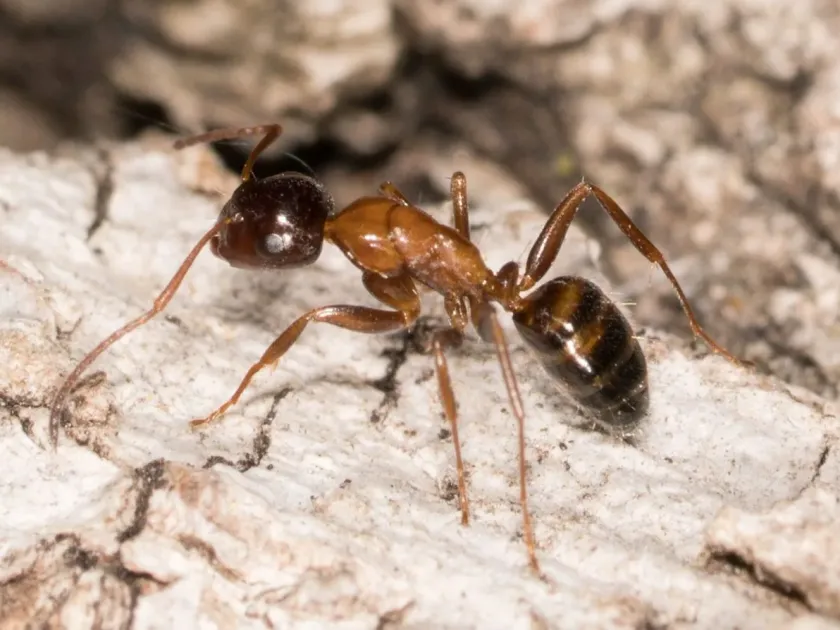
The Essig's carpenter ant (Camponotus essigi) is a species of ant belonging to the family Formicidae. They are known for their preference for nesting within decaying or damaged wood tissue.
These ants are characterized by a robust, dark-colored body with a matte texture. Their workers vary in size, showing the polymorphism typical of the Camponotus genus.
The colony structure is complex, featuring a queen that remains deep within the wood, protected by workers that are highly aggressive when defending their nesting sites.
Their mouthparts are powerful, adapted for stripping wood fibers to enlarge their intricate gallery systems rather than consuming the wood itself.
Proper identification usually requires observing their behavior during the evening, as they are primarily nocturnal or crepuscular foragers moving along tree trunks.
What it damages
This pest is primarily harmful to fruit and ornamental trees that already exhibit signs of decay or environmental stress, such as hollow areas or bark cracks.
The damage occurs when the ants excavate galleries throughout the heartwood or sapwood of the tree, creating tunnels that disrupt the structural integrity of the plant.
Although they do not feed on cellulose, their nesting activity can lead to the death of large branches, significantly reducing the tree's fruit-bearing capacity over time.
The tunnels created by the ants act as entry points for water and wood-decaying fungi, accelerating the rot process initiated by other environmental factors.
In cases of heavy infestation, the structural stability of the tree is severely weakened, creating a risk of branch breakage during storms or high winds.
Signs of infestation
A primary sign of infestation is the presence of "frass"—a coarse, sawdust-like material that the ants push out from their galleries onto the bark or the ground below.
A hollow sound when tapping on the tree trunk or major branches is a strong indicator that the internal wood has been extensively tunneled by an active colony.
Observed trails of workers moving along the tree bark, especially during night hours, indicate that the tree is being used as a foraging base or nesting site.
Small circular exit holes in the bark are clear signs of the interior gallery system being accessed by the colony for sanitation and foraging purposes.
The presence of large populations of aphids on the tree is also suspicious, as carpenter ants are known to tend and protect aphids to harvest their honeydew.
Control measures
Management begins with cultural practices, such as removing deadwood, pruning infected limbs, and sealing tree cavities to prevent colonization by the ants.
Chemical control involving insecticidal baits is highly effective, as the workers carry the toxic particles back to the nest to feed the queen, eventually eliminating the colony.
Sticky bands or mechanical barriers applied to tree trunks can successfully disrupt foraging paths, forcing the ants to abandon the tree due to food scarcity.
Regular monitoring of tree health, including proper irrigation and fertilization, ensures that the trees remain vigorous and less susceptible to wood-boring insects.
- Prune and destroy severely infested tree branches.
- Apply systemic insecticides to established gallery entry points.
- Keep the garden area free of rotting stumps or logs.
- Control aphid populations on the tree canopy.
Taxonomy
- Latin name
- Camponotus essigi
- Order
- Hymenoptera
- Family
- Formicidae
- EPPO code
- CAMOES
Discussion
No discussions yet — be the first.