
Red-legged carpenter ant
Camponotus chromaiodes
Description
How to identify
The red-legged carpenter ant, scientifically known as Camponotus chromaiodes, belongs to the Formicidae family and the Hymenoptera order.
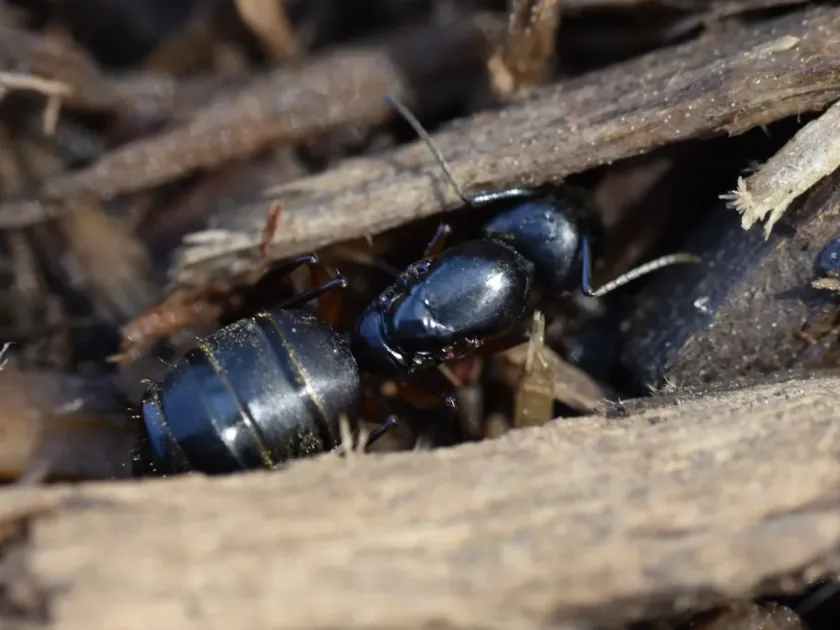
These ants are characterized by a distinct appearance, with a dark head and thorax contrasting with a reddish-brown abdomen and legs.
They are primarily nocturnal insects, which often means they go unnoticed until an infestation is well-established within a tree or structure.
Unlike termites, these ants do not consume wood as a primary food source; instead, they excavate galleries in wood solely for nesting purposes.
Their colonies are highly organized and can contain thousands of individuals, maintaining complex caste systems to support the growth of the brood.
What it damages
The primary damage caused by these ants is the structural weakening of trees as they hollow out the wood to accommodate their growing colony.
They prefer to colonize moist, decaying, or previously damaged wood, making unhealthy trees highly susceptible to infestation.
While they are commonly found in forests, they pose a significant threat to orchard trees, including apple, pear, and other stone fruit varieties.
By creating internal galleries, they facilitate the entry of moisture and pathogenic fungi, which further accelerates the decay of the affected wood.
Extensive tunneling can compromise the structural integrity of the trunk, increasing the risk of branches breaking or the tree falling during heavy winds.
Signs of infestation
The most reliable sign of an infestation is the presence of frass, which resembles sawdust, accumulating at the base of trees or around exit holes.
A hollow sound when tapping the trunk indicates the presence of internal galleries and void spaces excavated by the ant colony.
Nighttime observation often reveals trails of workers moving along the bark or foliage as they forage for food and protect their nesting sites.
Decaying stumps, logs, and neglected woody debris in the garden act as primary attractants and starting points for new colonies.
The presence of aphid colonies on the tree is another indicator, as carpenter ants frequently tend to aphids to harvest the honeydew they secrete.
Control measures
Effective management begins with strict sanitation, including the removal of rotting stumps, deadwood, and severely damaged branches from the garden.
The use of targeted insecticidal baits in gel or granule form is highly effective, as worker ants transport the bait back to the nest to eliminate the colony.
Applying sticky adhesive barriers to tree trunks can significantly restrict the movement of ants, protecting the upper canopy from their activity.
Maintaining the overall health of trees through proper fertilization and pruning makes them more resilient and less attractive to potential nesting colonies.
If an infestation is deep-seated, systemic treatments administered by professionals may be necessary to ensure the survival of the valuable specimen.
Taxonomy
- Latin name
- Camponotus chromaiodes
- Order
- Hymenoptera
- Family
- Formicidae
- EPPO code
- CAMOFE
Discussion
No discussions yet — be the first.