
Carpenter ants
Camponotus
Description
How to identify
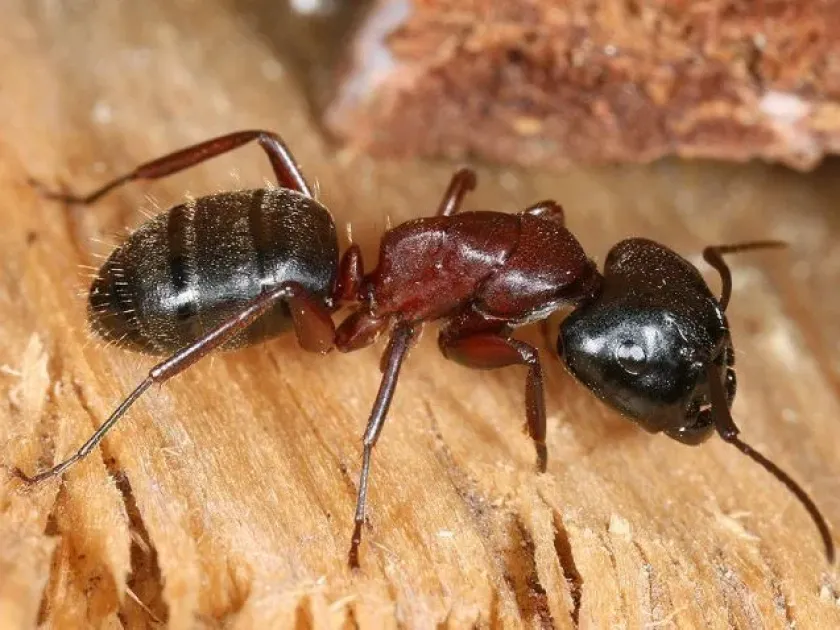
Carpenter ants (genus Camponotus) are large ants ranging from 6 to 18 mm in length. Their color typically varies from dark brown to black, though some species may have reddish hues.
They are identifiable by a smooth, rounded thorax profile when viewed from the side, lacking the spines found in many other ant species. They belong to the Formicidae family.
A key anatomical feature is the presence of a single node (petiole) between the thorax and abdomen, and they lack a stinger, relying on biting and spraying formic acid for defense.
Colonies are polymorphic, meaning the nest contains individuals of different sizes—ranging from small workers to large soldiers with disproportionately large heads.
Unlike termites, they do not eat wood. Instead, they excavate nests within moist or decaying timber, creating extensive galleries and tunnels to house their brood.
What it damages
These ants primarily damage weakened or moisture-damaged trees. In orchards, they frequently occupy old fruit trees that have internal rot or hollow sections.
Although they do not digest cellulose, the physical excavation of the wood significantly compromises the structural integrity of the tree, making it prone to snapping in high winds.
Carpenter ants also pose a major threat to wooden structures, garden features, and outbuildings if they contain damp wood, potentially causing extensive damage to property.
The colony's presence is often associated with the protection of aphids, as the ants feed on the honeydew produced by these pests, which further stresses the host plants.
Heavy infestations can lead to massive hollow cavities within the heartwood of a tree, eventually resulting in the decline or death of the infested plant.
When it appears
Activity generally begins in the spring when temperatures consistently reach above 10-12°C. This is when the colony emerges from its winter dormancy.
Swarming occurs in late spring or early summer, where winged reproductive ants emerge to mate and start new colonies in suitable nesting sites.
Summer is the peak of activity, with workers constantly moving along established trails to forage for food, often following specific paths on tree trunks.
As temperatures drop in the autumn, the ants become less active and retreat deep into their galleries or underground to overwinter in a state of reduced metabolism.
In cases where nests are located within heated buildings or well-insulated tree structures, the colony may show signs of activity year-round, regardless of the outdoor season.
Signs of infestation
The most telltale sign of an infestation is the presence of sawdust-like material (frass) near the base of the tree, which consists of wood shavings and insect debris.
If you tap on an infested tree trunk, it may produce a hollow or drumming sound, indicating the presence of tunnels and galleries inside the wood.
Observing large black ants foraging on the bark during evening or night hours is a strong indication that a colony is present in or near the tree.
Look for small, slit-like exit holes in the bark, through which the ants periodically discard debris from their excavations inside the tree.
High populations of aphids on young shoots, accompanied by ants guarding them, often suggest that a carpenter ant nest is nearby or within the tree itself.
Control measures
Managing carpenter ants requires a combination of sanitation, direct treatment of the colony, and physical barriers to prevent further damage.
Preventive maintenance includes keeping trees healthy, pruning dead limbs, and sealing any cracks or wounds in the bark to keep the wood dry and unattractive to ants.
- Apply slow-acting bait gels, which workers take back to the nest, allowing the poison to reach and eliminate the queen.
- Use liquid or aerosol insecticides injected directly into the galleries if the location of the nest is identified.
- Install sticky barrier bands on tree trunks to stop foragers from climbing and to prevent them from accessing aphid populations.
If a tree is severely hollowed out and poses a safety risk, removal and proper disposal of the infested wood are recommended to protect surrounding plants.
For wooden garden features, regular application of wood preservatives and exterior insecticides can deter ants from establishing new nests in the timber.
Taxonomy
- Latin name
- Camponotus
- Order
- Hymenoptera
- Family
- Formicidae
- EPPO code
- CAMOSP
Discussion
No discussions yet — be the first.