
Brachymyrmex
Brachymyrmex
Description
How to identify
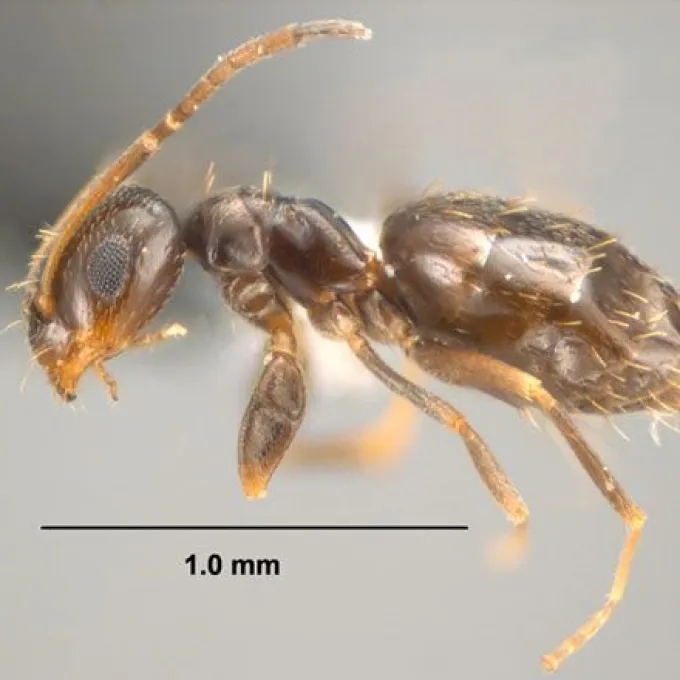
Brachymyrmex is a genus of ants belonging to the family Formicidae and the order Hymenoptera. These are extremely small ants, with worker individuals typically measuring between 1 and 2 mm in length, making them easily overlooked.
The body coloration ranges from pale yellow to dark brown. Morphologically, they lack a stinger and feature a single node on the pedicel between the thorax and the abdomen, which is a key identification characteristic for this genus.
They prefer to nest in soil, under leaf litter, rocks, or decomposing wood. In greenhouse or indoor environments, they frequently colonize potted plants, utilizing the soil voids to establish their nest chambers.
Their colonies are often polygynous, meaning they contain multiple fertile queens. This reproductive strategy allows the colony to survive disturbances and recover quickly, making them persistent pests in various environments.
The life cycle undergoes complete metamorphosis: egg, larva, pupa, and adult. The developmental rate is highly temperature-dependent, allowing for rapid population growth under warm and humid conditions.
What it damages
The primary damage caused by Brachymyrmex is indirect, resulting from their mutualistic relationship with sap-sucking pests such as aphids, mealybugs, and scale insects. The ants protect these pests from predators and transport them to healthy plant parts.
Ants feed on the honeydew secreted by these pests, which often leads to the growth of sooty mold on the foliage. This layer of mold blocks sunlight, significantly reducing the plant's photosynthetic capacity and overall vigor.
Direct damage occurs when ants feed on young shoots, floral buds, or fruits to obtain plant sap, leading to tissue necrosis, deformation, or the creation of entry points for secondary pathogens and diseases.
In greenhouses and nurseries, their nest-building activity in the root zone can be destructive. It often disrupts root-soil contact, causing moisture stress, wilting, and, in severe cases, the death of young seedlings or ornamental plants.
They commonly infest citrus, ornamental potted plants, tomatoes, and greenhouse vegetables, where the presence of aphid colonies provides a constant and abundant food source for the ants.
Signs of infestation
The most common sign of an infestation is the presence of distinct, thin foraging trails of tiny ants. They are frequently observed during routine plant maintenance, watering, or soil cultivation.
The sudden appearance of aphids or scale insects on new growth is a strong indicator of Brachymyrmex activity. If aphids appear on previously healthy foliage, it is likely that the ants have transported them there.
A sticky honeydew residue on the leaves, followed by the development of black sooty mold, serves as a clear visual marker that the plant is infested with both the ants and their associated sap-sucking pests.
In container plants, localized wilting or stunted growth, despite adequate watering, may indicate that the ants have colonized the root ball, causing aeration issues or physical root damage.
In domestic or greenhouse settings, ants may be seen congregating around carbohydrate sources, such as fallen fruit, sugar spills, or moist soil surfaces, indicating proximity to an active nest.
Control measures
Management requires a holistic approach, focusing on controlling both the ants and the associated sap-sucking pests. Gel baits are highly effective, as the worker ants carry the toxicant back to the nest to eliminate the queens.
For indoor or greenhouse use, targeted application of granular or liquid insecticides around the base of pots or along foraging trails can significantly reduce the population without widespread chemical use.
Restricting ant access to the foliage is crucial. Using physical barriers, such as sticky bands on stems or oil-based deterrents, prevents the ants from moving their aphid livestock onto susceptible plant tissues.
Cultivation practices, including frequent light tilling of the topsoil, help destroy nest chambers and disrupt the ants' established pathways, forcing them to relocate or perish.
- Use slow-acting, protein or sugar-based gel baits.
- Apply soapy water sprays to remove aphids and honeydew.
- Install mechanical barriers or sticky traps on trunks.
- Keep the greenhouse clean by removing food debris.
- Cultivate soil surface regularly to disrupt nests.
Taxonomy
- Latin name
- Brachymyrmex
- Order
- Hymenoptera
- Family
- Formicidae
- EPPO code
- BRCXSP
Discussion
No discussions yet — be the first.