
Texas leaf-cutting ant
Atta texana
Description
How to identify
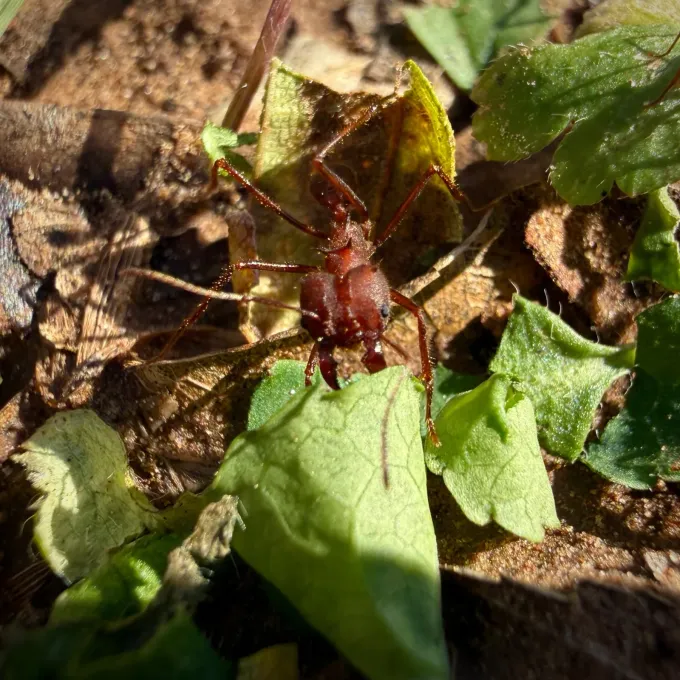
The Texas leaf-cutting ant (Atta texana) is a prominent member of the Formicidae family, known for its complex social structure and colonial lifestyle.
These ants are characterized by a caste system, where workers differ in size, allowing them to specialize in various tasks from foraging to colony defense and maintenance.
Their bodies feature sharp spines on the thorax and powerful mandibles, which are essential for cutting through tough vegetation and soil excavation.
The life cycle involves complete metamorphosis, including egg, larva, pupa, and adult stages, all developing within the protective environment of a subterranean nest.
The colony is maintained by a single queen, and the entire society focuses on cultivating a specific type of fungus as their primary food source.
What it damages
This species is a highly destructive polyphagous pest that feeds on a wide range of plants, including valuable crops and ornamental species.
They are particularly known for stripping the foliage of pine seedlings, fruit trees, and various garden vegetables, significantly hindering plant growth.
By consuming leaves, flowers, and buds, the ants deprive plants of their ability to photosynthesize, often leading to total defoliation and death.
The economic impact is severe because a single large colony can devastate a significant portion of a crop field or a small orchard in a very short time.
Besides immediate plant loss, the excavation activities of the ants can destabilize the soil and damage the root systems of agricultural plantings.
When it appears
Activity is most pronounced during the warm seasons, as these ants are highly sensitive to extreme temperatures and moisture conditions.
They generally exhibit nocturnal behavior, foraging at night to avoid the intense heat and evaporation rates typical of their native habitat.
New colonies are often initiated following periods of rainfall, which soften the soil and create optimal conditions for the founding queen to start her tunnel system.
Foraging activity follows a seasonal pattern, peaking during periods when the favored host plants are actively producing new, succulent growth.
In winter, colony activity may decrease as the ants retreat to deeper chambers within the nest to escape freezing or suboptimal ground temperatures.
Signs of infestation
The presence of Atta texana is easily identified by distinct foraging trails that lead directly from the colony entrance to the targeted plants.
Distinctive craters of loose soil particles are deposited around the entrance holes of the nests, which can reach several meters in depth.
Damage to foliage is unmistakable: leaves show precise, semi-circular cutouts along the edges, giving them a jagged, skeletonized appearance.
Plants affected by these ants are often completely defoliated, with no remaining debris on the ground, as every piece of leaf is carried into the nest.
In areas with long-term infestations, the ground may become barren due to constant harvesting and the physical disruption of the upper soil layers.
Control measures
The most effective strategy for management involves the use of specialized bait formulations that contain slow-acting insecticides.
Foragers collect the toxic bait and bring it deep into the nest, where it is consumed by the colony members and ultimately reaches the queen.
Mechanical destruction of the nest is generally ineffective because of the immense size and depth of the underground chamber networks.
Surface sprays offer only temporary protection and fail to eliminate the source of the infestation, making baiting the standard for professional control.
Early detection and prompt application of baits remain the most successful approach to protecting agricultural crops from leaf-cutting ant damage.
Taxonomy
- Latin name
- Atta texana
- Order
- Hymenoptera
- Family
- Formicidae
- EPPO code
- ATTATE
Discussion
No discussions yet — be the first.