
Leafcutter ant
Atta sexdens
Description
How to identify
The leafcutter ant (Atta sexdens) is a member of the Hymenoptera order, specifically the family Formicidae, known for its complex social behavior.
These ants exhibit distinct polymorphism, meaning they have different castes including minims, media, and major workers (soldiers) with specialized tasks.
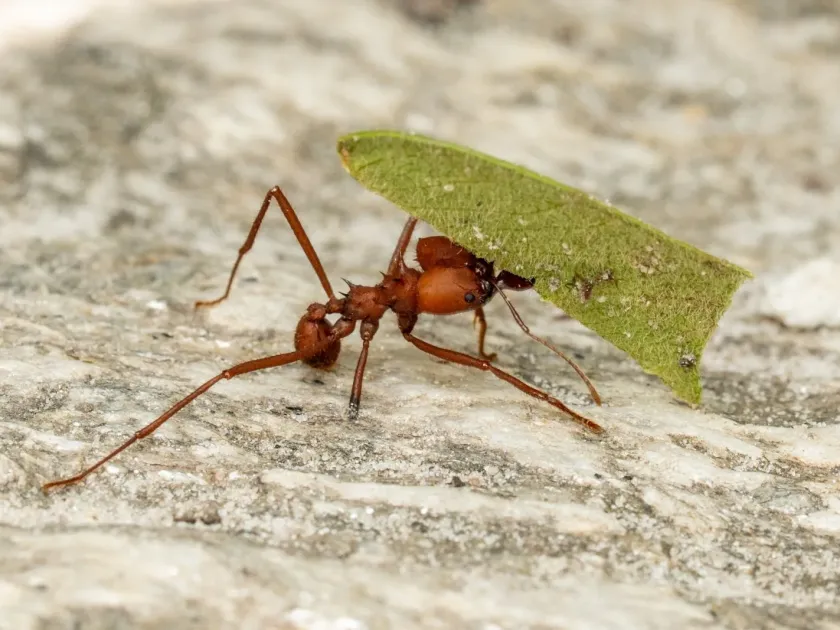
Physically, they feature sharp spines on their thorax and powerful mandibles, which are essential for cutting through tough leaf tissue.
Colonies operate in large underground systems consisting of thousands of chambers, including nursery rooms and specialized areas for fungus cultivation.
The queen is the central figure of the colony, living for many years and producing thousands of eggs daily to maintain the population.
What it damages
Leafcutter ants are considered primary agricultural pests in South and Central America, capable of devastating entire plantation crops.
They feed on a specific fungus that they cultivate in their nests, using fresh leaves harvested from surrounding vegetation as substrate.
They attack a massive variety of crops, including citrus, coffee, cocoa, eucalyptus, and various leguminous species, causing severe economic damage.
Defoliation is extremely efficient; a large colony can strip a mature tree of its leaves in a single night, severely hindering photosynthesis.
The underground nest structure causes soil instability and damages the root systems of agricultural crops, further compromising plant health.
When it appears
Leafcutter ant activity persists throughout the year in tropical environments, with no true hibernation cycle like in temperate species.
Foraging behavior intensity is dictated by environmental moisture levels and ambient temperatures, which affect their metabolism and fungus growth.
Nuptial flights, when new queens leave to establish new colonies, are typically triggered by the onset of rainy season conditions.
While surface activity might decline during extreme heat or excessive rainfall, the maintenance of the fungus gardens continues deep underground.
Young plantations are at high risk, as ants prioritize tender, nutrient-rich leaves found in new agricultural developments.
Signs of infestation
The most distinctive sign of an infestation is the presence of well-defined ant trails, often spanning several meters across a farm.
Leaf damage is characterized by clean, semicircular cuts on the edges of leaves, caused by the precise movement of the ants' mandibles.
Large mounds of excavated soil surrounding the openings of underground tunnels provide clear indicators of nest size and location.
Observers often see lines of ants carrying large leaf fragments above their bodies, creating a visible "moving green line" effect.
Finding piles of discarded leaf material or debris near nest entrances suggests an active, mature colony in the process of fungus farming.
Control measures
Controlling Atta sexdens is notoriously difficult because the heart of the colony, including the queen, is protected deep underground.
The most effective method involves using toxic baits that workers gather and carry deep into the colony, eventually killing the fungus and the queen.
Topical insecticides applied to nest entrances can manage populations, but often fail to reach the deepest parts of the complex tunnel system.
Biological control, using specific fungi that infect ant colonies, is a growing field of study aiming to provide environmentally friendly solutions.
Integrated Pest Management (IPM) strategies emphasize early detection and preventive barriers to protect young plants before colonies mature.
Taxonomy
- Latin name
- Atta sexdens
- Order
- Hymenoptera
- Family
- Formicidae
- EPPO code
- ATTASD
Discussion
No discussions yet — be the first.