
Leaf-cutting ant
Atta laevigata
Description
How to identify
The leaf-cutting ant (Atta laevigata) is a prominent member of the Formicidae family within the order Hymenoptera. It is recognized for its massive colony sizes and highly organized social structure.
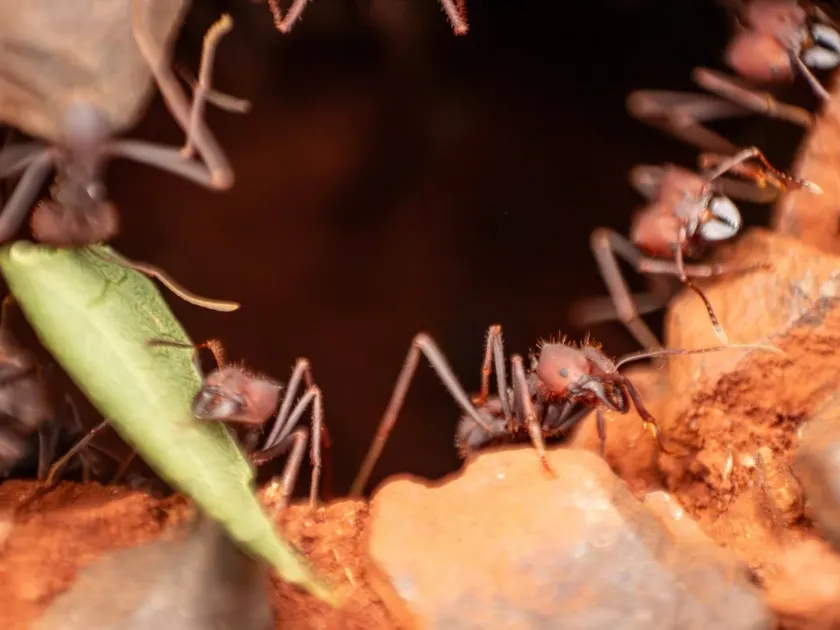
Workers exhibit significant polymorphism, with sizes ranging from a few millimeters to over a centimeter in length. Their bodies are typically reddish-brown, and large workers possess powerful, serrated mandibles capable of cutting tough plant materials.
The queens of this species are substantial in size, far exceeding the dimensions of the workers, and are responsible for the foundation and growth of large, long-lived colonies that can contain millions of ants.
These ants are not direct herbivores; they are fungus-growers. They utilize cut plant fragments as a primary substrate to cultivate a specialized symbiotic fungus inside their underground nests, which serves as their sole food source.
They maintain complex subterranean networks that extend several meters into the soil. Their communication is facilitated by sophisticated pheromone trails, enabling thousands of workers to forage and transport resources over long distances.
What it damages
Atta laevigata is a significant agricultural pest that causes substantial economic loss across various sectors, including fruit production, forestry, and cereal cultivation.
The sheer size of the colony allows these ants to defoliate entire trees or plantations in a single night. Such rapid destruction halts photosynthesis, stresses the plant, and can lead to plant mortality if repeated.
Nurseries and young seedling plantations are particularly vulnerable. The ants can systematically strip young saplings, rendering them unable to recover and causing catastrophic losses to young inventory.
Beyond plant tissue removal, the excavation of their massive underground chambers impacts soil stability. Their nest building can cause ground subsidence and disrupt root systems, further damaging the health of perennial crops.
Their selective foraging behavior can disrupt natural plant community balances. By removing specific species of leaves, they unintentionally favor non-target plant species, causing imbalances in the local agroecosystem.
When it appears
In their native tropical habitats, Atta laevigata remains active throughout the year. There is no traditional hibernation or diapause, allowing them to forage whenever environmental conditions permit.
Peak foraging activity often aligns with periods of high plant vegetative growth, when the availability of fresh, nutrient-rich leaves is at its highest, optimizing their fungal garden production.
Rainy seasons are crucial for the colony, as they assist in maintaining the necessary moisture levels within the underground fungus gardens, leading to increased surface activity by the workers.
The nuptial flight, where reproductive individuals emerge to start new colonies, is often triggered by the onset of the rainy season, ensuring favorable soil moisture for the founding of new nests.
Agricultural monitoring must be constant. Because the colonies do not hibernate, they pose a year-round threat to crops, requiring persistent observation by farmers and agronomists to prevent large-scale damage.
Signs of infestation
The most distinctive sign of infestation is the presence of clear, well-trodden trails. These paths lead from the nest entrance to the forage plants and can span impressive distances.
Discarded leaf veins under plants are a clear indicator of leaf-cutting activity. The ants selectively consume the soft tissue of the leaves, leaving behind the tough, skeletal vascular structure.
Large mounds of fresh soil, known as crater-like structures, at the entrances of the nests are clear indicators of extensive underground tunnel construction and active colony maintenance.
Sudden defoliation of specific plants or branches in an orchard is a classic symptom. Because the ants are selective, they may completely strip one tree while leaving adjacent trees untouched for a period.
Visual identification of workers carrying leaf fragments back to the nest is the most definitive sign. Observing the direction of the ants allows for the direct tracing of the colony's central location.
Control measures
Controlling leaf-cutting ants is challenging because the workers only represent a small fraction of the colony, and the queen remains safely deep within the underground structure.
The most effective strategy involves the use of slow-acting toxic baits. The foragers carry the bait into the nest, where it is shared and eventually reaches the queen, leading to the collapse of the entire colony.
Fumigation of nest entrances is used in some commercial operations. While effective for destroying the colony directly, it requires specialized equipment and carries environmental risks that must be carefully managed.
Physical barriers, such as sticky bands on tree trunks, can protect high-value trees by preventing workers from accessing the foliage, though this is only a temporary solution for the trees treated.
Biological control, such as utilizing entomopathogenic fungi to infect the colony from within, is a growing field of study, offering a more sustainable approach to managing these pests without harsh chemicals.
Taxonomy
- Latin name
- Atta laevigata
- Order
- Hymenoptera
- Family
- Formicidae
- EPPO code
- ATTALA
Discussion
No discussions yet — be the first.