
Leaf-cutter ant
Atta hystrix
Description
How to identify
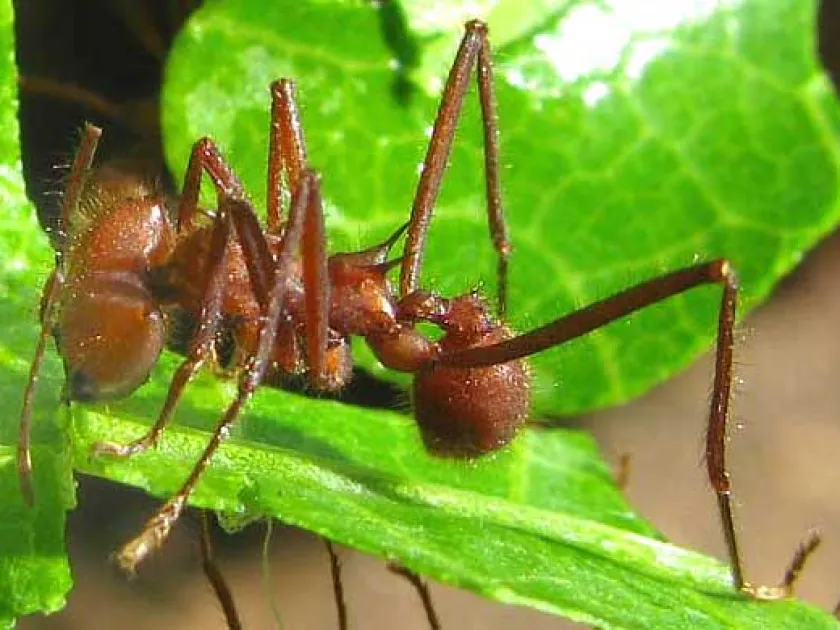
The leaf-cutter ant Atta hystrix is a member of the Formicidae family, specifically noted for its distinct spiny appearance on the head and thorax, resembling a porcupine.
These ants are highly polymorphic, with workers ranging from tiny individuals that tend to the fungus gardens to large soldiers that defend the colony.
The colony structure is complex, comprising a massive underground network of tunnels that can extend deep into the soil and spread across large areas.
They are obligate symbionts, meaning they cannot survive without the specific fungi they cultivate in specialized underground chambers.
A new colony begins when a queen performs a mating flight, lands, excavates a small chamber, and introduces the fungus mycelium she carries to start a new garden.
What it damages
These ants are major agricultural pests, harvesting vast amounts of fresh vegetation to use as a substrate for their fungus gardens rather than eating the leaves themselves.
Heavy defoliation caused by Atta hystrix strips plants of their foliage, severely inhibiting photosynthesis and weakening the overall health of the crop.
In intensive agricultural settings, a single established colony can defoliate entire rows of fruit trees or vegetables in a single night.
Young plants and nursery saplings are particularly vulnerable, often suffering irreparable damage that leads to the death of the specimen.
The economic impact is profound, as the ants frequently attack high-value cash crops and trees, leading to significant yield losses for farmers.
Signs of infestation
The most visible sign of infestation is the presence of well-trodden ant trails, often visible on the forest or field floor, where workers carry leaf fragments.
Plants attacked by these ants show clean, uniform cuts along the edges of leaves, which appear as if they were professionally trimmed.
Large mounds of excavated soil and debris around the base of trees or in fields indicate the presence of extensive underground nesting systems.
Rapid and unexplained disappearance of plant foliage is a classic indicator, as leaf-cutter ants move quickly and are highly efficient in their harvesting.
Waste dumps containing used substrate and ant carcasses located near the colony entrances are reliable indicators of an active and mature nest.
Control measures
Controlling Atta hystrix is challenging because the main colony resides deep underground, protected from surface-level topical treatments.
The most successful control strategy involves the use of toxic baits, which the ants transport into the nest, eventually eliminating the queen and collapsing the colony.
Surface insecticides are generally ineffective for long-term control as they only kill foraging workers and do not reach the core of the nest.
Integrated pest management includes regular field monitoring to identify nascent colonies and intervene before the nest becomes fully established.
- Deployment of slow-acting toxic bait systems.
- Use of physical barriers like sticky bands to prevent ants from reaching the tree canopy.
- Soil fumigation techniques in severe infestation cases.
Taxonomy
- Latin name
- Atta hystrix
- Order
- Hymenoptera
- Family
- Formicidae
- EPPO code
- ATTAHY
Discussion
No discussions yet — be the first.